
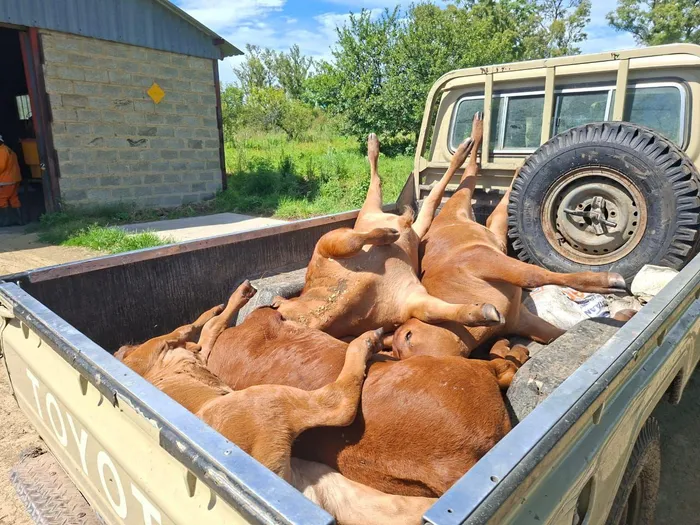
Farmers want to know when the they will get vaccines as Foot and Mouth Disease wreaks havoc across the country.
Image: Supplied.
SOUTH Africa faces a looming food security crisis as Foot-and-Mouth Disease (FMD) spreads across the country, destroying cattle, disrupting milk and meat production, and costing farmers millions of rand.
Industry bodies yesterday warned that delayed vaccines, unclear regulations, and insufficient government co-ordination could intensify the impact on livelihoods, rural communities, and the national food supply.
While milk supplies are stable right now, experts worry that the FMD outbreak could destabilise production if vaccines are not delivered promptly.
“We don't know what the total effect is going to be and when it's going to stop, because we don't know when the vaccine is going to arrive,” said Bertus Van Heerden from Milk SA.
He says the country produces roughly 3.3 billion litres of milk annually, about nine million litres a day, for both domestic consumption and exports. Right now there is enough unprocessed milk for cheese and other dairy products, but Van Heerden cautions that things can change.
“We are worried about the fact that we've got foot and mouth disease, we've got a fairly substantial drought in the Eastern Cape, which is also one of the major producing provinces for dairy, unprocessed milk production, on-farm milk production. And currently, we don't have any vaccines and every day without vaccines, things can just get worse and that is the biggest problem.”
Van Heerden says the crisis could get bigger, but the true impact on the farming community will only be seen next year or in two years’ time.
However, on the ground the situation is grim. Farmers in KwaZulu-Natal are confronted by new infections daily, and the financial and emotional toll is mounting.
Angus Williamson, Vice President of Kwanalu and president of the KZN Red Meat Producers Organisation, said the hooves and the mouths of the dairy cows get lesions on them, the teats get infected with mastitis and they “literally fall off.”
He said this was happening across the province while calves were dying as a result of Tiger Heart Syndrome caused by FMD.
“One minute the cow is absolutely healthy and walking around, the next thing it is dead, and there’s nothing you can do about this.”
“Milk supplies have decreased but are stable at the current time. Meat will become a challenge going forward if we do not know what the status quo is with regards to the slaughterings of positive cattle because currently they are only slaughtered at registered FMD abattoirs, of which there are not enough in the province.”
Williamson added that the crisis has been ongoing for years with little meaningful government response:
“Basically from 2021 until now we’ve been dealing with FMD as a crisis, and this has fallen on deaf ears.”
He flagged serious concerns around vaccine availability, rollout logistics, communication, and clarity on protocols, saying that farmers want to vaccinate but are still in the dark:
“If we are informed on when all these things are going to happen and are provided with regular updates on how each intervention is moving forward, we can assist farmers and the ministry in achieving the strategy as set out. These updates should include answers on legislative amendments, when will the DMA be de-gazetted, when will vaccines arrive, what the process to get in line for vaccination etcetera will be.”
Medication to ease the pain caused by FMD and boost the immune system could cost up to R6000 per cow.
Speaking to the Independent on Saturday, one farmer described the outbreak as "a disease that mentally destroys you”. He said production had dropped from 20 litres of milk per cow to three litres a day. He says their daily challenge is going to the dairy and hoping there aren’t any more sick cows, some of which they’ve had to shoot. To date, their financial losses exceed R4 million and continue to climb, and more workers had to be employed to deal with the crisis.
“So for about two months pretty much everyone worked, no one had any time off so it was really hard on them and very difficult for staff members to put milking machines on raw teats because the skin comes off the teat, so it's just a disease that just mentally destroys you, and we're only really starting to count the costs now and you're starting to see your overdraft climbing and the banks are asking if they can give you some more money, so we have taken some loans out, so it's hit us hard in all directions.”
Bergville farmer Amy Gace said FMD could have been avoided if the right protocols had been put in place and adhered to from the beginning. “The mental and emotional stress is huge because the fear of reinfection is just as bad, and a worry, because these animals don't seem to get immunity. And what's so frustrating is that the vaccine only seems to last two to three months and there's no access, there's no guarantee we're going to get vaccines.”
She described the situation as being trapped in the unknown: “We don't even know what strains we've got, what we're dealing with.
The National Red Meat Producers’ Organisation (RPO) says the plan put forward by Agriculture Minister John Steenhuisen earlier this week seems more like a wishlist; nothing concrete, short on detail, while confusion persists.
“It is a well-known fact that no vaccines are available for use by the Department. The only available vaccines are those that were privately purchased and paid for by the feedlots and the Milk Producers’ Organisation (MPO),” said Dr Frikkie Maré, CEO of the RPO.
Agriculture Minister John Steenhuisen this week announced that the government would prioritise high-risk zones, aiming to reduce outbreak incidence through systematic vaccination and preserve FMD-free provinces through buffer vaccination and strict movement controls.
He said a million doses of vaccine would be procured from Argentina.
“The company indicated that, as soon as the permits are issued, they are able to supply the vaccine in the coming two weeks. We are currently preparing the application for authorisation by the South African Health Products Regulatory Authority (SAHPRA) to use an unregistered medicine under Section 21 of Act 101. This application will be filed by Monday.”
Steenhuisen added that the same company would be able to supply an additional five million doses by March 2026.
In addition, the government has procured vaccines from the Botswana Vaccine Institute (BVI) and will continue sourcing from the institute.
“Last year, we received confirmation from the BVI that they can supply us with one million doses per month. Unfortunately, due to the closure of their factory for cleaning purposes, they could not deliver on time.”
He said the government also has a permit to import Dollvet vaccine from Turkey.
“As indicated earlier, it will take us some time to contain the disease.”
Locally, the government will activate a production line initially producing 20 000 doses per week, scaling up to a capacity of 960 000 doses, he said.