
Interpol said that wildlife crime is now an industry worth more than US$20 billion a year, ranging from the movement of thousands of shark fins to banned ivory and primate meat.
Image: File / Lucas Alexander / Unsplash
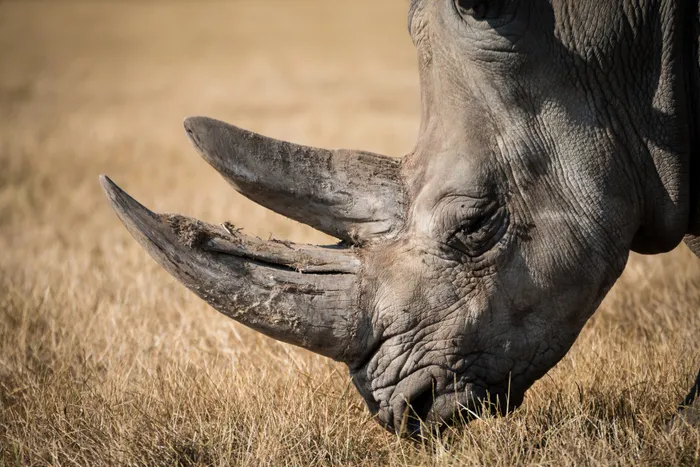
SOUTH Africa’s anti-poaching and anti-trafficking measures have produced a 16% decline in rhino poaching in 2025, marking a hard-won victory for conservationists and law enforcement.
According to Minister of Forestry, Fisheries and the Environment, Willie Aucamp, 352 rhinos were poached last year, down from 420 in 2024, with 266 killed on state properties and 86 on private reserves and farms.
“From January to December 2025, the decrease in poaching is a testament to the dedication and tactical co-ordination of our teams,” Aucamp said.
Yet the picture is not uniformly rosy. Mpumalanga suffered the brunt of losses, with 178 rhinos poached - 175 of them in Kruger National Park alone, a sharp rise from 88 the previous year. Conversely, Hluhluwe-iMfolozi Park in KwaZulu-Natal saw poaching plummet from 198 to 63 rhinos, credited to the Integrated Wildlife Zones (IWZ) Programme and strong support from WWF, Save the Rhino International, Wildlife ACT, and Peace Parks Foundation.
SANParks continues to bolster Kruger’s anti-poaching arsenal through its KNP Rhino Conservation Plan, incorporating strategic dehorning, layered security, advanced technology, and K9 units, alongside integrity management, including polygraph testing of rangers, which has already led to the dismissal of seven employees. Additional field ranger recruitment and training are slated for February 2026.
Ezemvelo KZN Wildlife has also intensified interventions, expanding aerial detection, drone patrols, sensor networks, and rapid-response K9 operations, alongside integrity-focused measures and intelligence-led operations with SAPS.
The law enforcement effort is reflected in the courts. Rhino poachers and traffickers have received substantial prison sentences for crimes ranging from illegal hunting and possession of rhino horns to firearms offences and money laundering. Cases include:
On the international front, a transnational operation with Singapore authorities resulted in the seizure of 17 rhino horns weighing 55.4kg and 26.2kg of lion/tiger bones, highlighting South Africa’s growing role in combatting wildlife trafficking abroad.
Aucamp underscored the importance of cross-sector collaboration: “Working together with the South African anti-poaching and anti-trafficking organisations, we remain committed to a balanced, intelligence-driven, and partnership-based approach to rhino protection. Sustained success requires constant adaptation, integrity, and cooperation across all sectors.”
The Department of Forestry, Fisheries and the Environment urges members of the public to report any suspicious wildlife activity via the environmental crime hotline: 0800 205 005 or SAPS number 10111.