
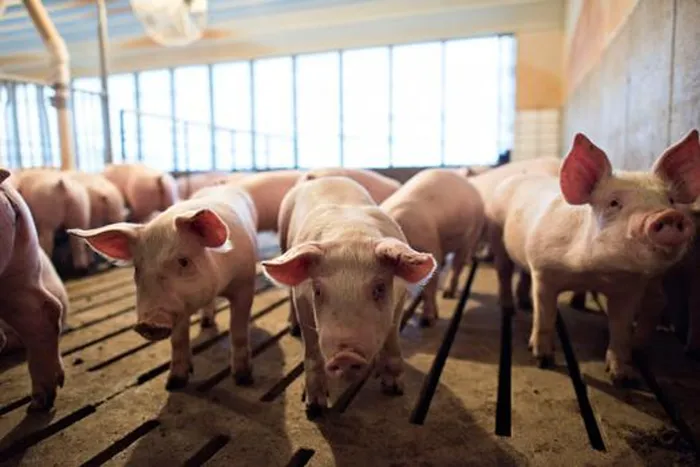
File image: IOL. Pork products are becoming more expensive as local piggeries battle disease.
Image: File
PORK is getting expensive and it’s not going to get cheaper anytime soon. Right now the industry is dealing with a double whammy: foot-and-mouth disease and African swine fever.
In the last few weeks alone, prices have jumped about eight rand per kilo. “Higher prices are already in play due to a drop in supply. There is scope for further upside if we do not manage to limit the spread of disease in pigs,” said Karla Zietsman, general manager of South African Pork Producers’ Organisation.
Speaking to the Independent on Saturday, she said prices were likely to “remain firm, with some additional upside scope, given tighter supply.”
Most attention has been on beef and dairy farmers lately, with FMD spreading fast. But pork farmers haven’t been sitting quietly, they’ve been battling the same problem.
Zietsman said there are currently seven commercial piggeries with suspected or confirmed FMD cases. “Although cases differ markedly, there have been reports of mortalities reaching 20% of the herd. This is usually concentrated in young weaners and suckling pigs, resulting in reduced supply over the next 15 to 17 weeks. Current supply is also lower due to FMD-infected piggeries being quarantined, with no FMD-designated abattoir for pigs available at this time,” she said.
African swine fever has also affected the industry with four outbreaks since November which led to almost 30 000 pigs being culled. “This includes sows, which speaks to longer-term productive capacity, and slaughter animals, which have an immediate impact on supply. Given the loss in productive capacity, we deem that supply will remain tighter throughout 2026,” Zietsman said.
Vaccines for FMD will be rolled out in outbreak areas or on high-risk farms, she said, but the industry has no vaccine for ASF, meaning recovery will take longer.
Arnold Prinsloo, CEO of Eskort — which produces antibiotic-free pork and makes up roughly 10% of the market — said the industry is fragile.
“South Africa slaughters roughly 72 000 pigs per week across formal and informal sectors. The formal market has lost about 7 000 pigs due to ASF and FMD outbreaks,” he said.
“Even a 2% shortage can drive price increases of around 10%. That’s pork’s price elasticity in action.”
Prices have jumped from around R32 per kilo to R40, and Prinsloo expects further increases as the outbreaks ripple through the supply chain. “Until recently, we had surplus stock that acted as a buffer. That buffer is gone. Now it’s pure supply-and-demand dynamics — just like what happened in the beef industry,” he said.
Eskort hasn’t had any cases of ASF or FMD, thanks to strict biosecurity and antibiotic-free farming. But Prinsloo warns no producer is immune to broader market pressures.
He reassured consumers that pork sold through formal channels remains safe. ASF and FMD affect animals only, not humans, and strict veterinary inspections under the Meat Safety Act continue to keep the food safe.
The industry, he said, is working closely with producers, abattoirs, and state veterinary services to contain outbreaks, stabilise supply, and keep consumer confidence intact.
For shoppers, the bottom line is simple: breakfast could cost more. Bacon, pork chops, sausages, and other pork products are already more expensive, and the market shows little sign of relief. Analysts warn that, unless the spread of disease is controlled, prices may continue to climb well into 2026.