
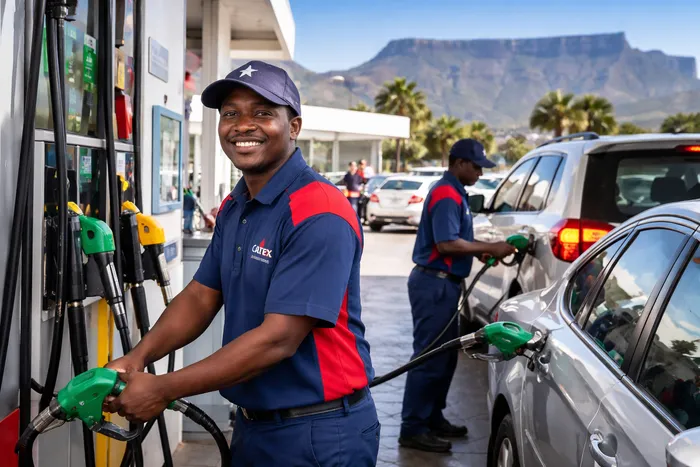
Premier Alan Winde said the province has sufficient fuel reserves, despite growing concerns linked to instability in the Middle East.
Image: Sora
FAKE news has amplified South Africa’s growing fuel anxiety, drawing in a respected academic and hitting households already under pressure.
Professor Brian Figaji, Chancellor of the Cape Peninsula University of Technology, fell victim to one of many viral social media messages stoking fear about the country’s petrol and diesel supplies — just as the April 1 wave of fuel, electricity, and transport price hikes is set to squeeze consumers.
The WhatsApp message, widely circulated and dated March 19, 2026, claims that Figaji had attended a meeting with a petrol and diesel supplier whose directors told him that there was a national shortage of petrol and diesel.
“Truck quotas have just been cut from 800 litres to 200 litres. We won’t be able to get any petrol or diesel from next week, and if we can, it will only be in small amounts at a time. So, keep your cars full. This also means it will affect the delivery of essential food supplies.”
However, Figaji told the Independent on Saturday that he had not authored the text. “I did NOT write this message, and I did not share this message myself. I am embarrassed having my name on that specific sheet.”
The drama unfolded as the Department of Mineral and Petroleum Resources (DMPR) said it had “noted with concern” the various messages by organisations and individuals urging the public to rush to filling stations due to a perceived fuel shortage and anticipated fuel price increases.
In a joint statement with the Fuels Industry Association (FIASA), the government said it wanted to “firmly reiterate” that the country’s fuel supply remains stable in the immediate term, and there is no basis for panic-buying.
“While there may be isolated localised logistical challenges affecting the movement or availability of fuel in certain areas, these are operational in nature and do not constitute a national supply shortage. These issues are being actively managed through established industry and regulatory channels. It is therefore incorrect and misleading to link such isolated domestic logistical matters to broader geopolitical developments. Such claims risk creating unnecessary alarm and confusion among the public,” the statement read.
They added that calls for people to rush to the pumps were irresponsible, placing undue pressure on supply systems, creating congestion at service stations, and sparking anxiety among consumers.
“The Department calls all organisations, public representatives, commentators and social media users to act responsibly and to refrain from spreading unverified or speculative claims regarding fuel supply and fuel price developments. Members of the public are encouraged to continue purchasing fuel in the normal course and to rely on official government communication for accurate and verified information.”
Despite the assurances, reports of shortages trickled in from across the country, most notably Gauteng. Some feared fuel stations were holding onto stock to sell it at a higher price when the April fuel price increases take effect. Saudi Arabia, one of the world’s biggest oil producers, warned that crude prices could surge past $180 a barrel, adding to local uncertainty.
Civil society organisation - Afriforum provided the Independent on Saturday with a list of garages where fuel had allegedly run out, spanning the Eastern Cape, Free State, Gauteng, Mpumalanga, North West, Northern Cape, and Western Cape. Jacque Broodryk of Afriforum said the availability of fuel was unpredictable: “They seem to run out for a day or two and then get fuel again.”
The Western Cape Government also addressed local concerns. Premier Alan Winde said: “There is no cause for concern. There is more than enough fuel in reserve. All suppliers must immediately release full orders of fuel to all clients. We will not tolerate suppliers unethically holding onto fuel, while our agricultural sector is under pressure.”
The provincial statement explained that isolated shortages, particularly in the Garden Route and West Coast Districts, were due to suppliers not releasing fuel, impacting farmers. Agri Western Cape reported that some farmers were only receiving around 20% of their usual monthly diesel allocations.
“Fuel is a critical resource for the agricultural sector, particularly as we head into the fruit picking and winter grain planting season. This is a sector already under pressure as a result of Foot-and-Mouth Disease; it is unacceptable that unnecessary fuel rationing now poses an additional stressor,” Winde added.
While misinformation has heightened anxiety at the pumps, South Africans are already facing a real cost-of-living squeeze.
On April 1, fuel levies, the Road Accident Fund levy, carbon taxes, and Eskom electricity tariff hikes are set to take effect — coinciding with high international oil prices. Economists warn that the convergence of these increases could create a concentrated cost shock, further straining households, small businesses, and transport-dependent sectors.
NWU Business School economist Prof Raymond Parsons explained the looming impact: “The better-than-expected headline inflation of 3% in February is welcome but has now already been overtaken by a highly negative inflationary outlook.
Apart from the fuel price rises driven by international oil prices, there must now be added the adjustments to the fuel and Road Accident Fund levies and the carbon tax, as well as the Eskom tariff increases. The convergence of these factors on April 1 creates the prospect of a concentrated cost shock for consumers and business.”
Looking ahead, he warned that the effects would be felt throughout the year. “On present evidence, the outlook for headline inflation in 2026 as a whole is therefore now likely to average out at closer to 4%.
This outcome is likely to intensify cost-of-living pressures, especially for the poor, and also increases business operating costs. Both the economic and psychological impact of such a clustered shock should not be underestimated. Mitigating steps need to be considered.”
Financial planner Bertie Nel highlighted the uncertainty caused by the Middle East conflict and rising oil prices, saying it was prompting emotional, often hasty decisions by consumers.
“People will result in making possibly uninformed decisions or emotional decisions,” he said, adding that a structured long-term plan is the best defence against short-term shocks.
Transport costs are at the heart of economic activity. Ashif Black, country representative for South Africa at ride-hailing service inDrive, said rising fuel prices ripple through supply chains, delivery services, and daily commuting.
“When pump prices increase, drivers must either absorb the additional cost, work longer hours to maintain income or increase fares to remain financially viable. None of these options are straightforward in a market where riders themselves are becoming more cost-conscious,” he said.
He also highlighted the impact on small businesses. “Across South Africa, many small and medium-sized enterprises rely on flexible logistics services to move goods between suppliers, warehouses and customers.
When fuel costs rise, those businesses face a myriad of difficult trade-offs… The result is a chain reaction across the economy. Transport becomes more expensive, goods become more expensive and consumers ultimately absorb part of the cost.”
South Africa’s 800 000 domestic workers are expected to bear the brunt, according to Gloria Kente, General Secretary of the South African Domestic Service and Allied Workers Union (SADSAWU). “Now they’re going to depend on the loan sharks. They’re going to borrow money to go to work, and then they must pay that money back, and then they will be left with nothing. So it’s a big challenge because we are scared of losing our jobs.”
Abigail Moyo, spokesperson for trade union UASA, emphasised the limits of recent CPI relief. “Food and non-alcoholic beverages stood at 3.7%, and insurance and financial services at 4.7%. With fuel prices set to soar and inflation expectations rising to 5.4% for the next year, workers face a tough road ahead.
Theuns du Buisson, economic researcher at the Solidarity Research Institute (SRI), warned that workers could be left behind if short-term low inflation guides salary increases.
“If the very low inflation rate of 3% is used to determine salary increases, while everyone knows that significant price shocks are on the horizon, workers could obviously end up on the losing side. Solidarity therefore urges employers to approach this matter with caution,” he said.
In Parliament, BOSA Leader Dr Mmusi Maimane warned that the Middle East conflict would worsen the economic squeeze. “The consequence of this double squeeze is now unavoidable. Forecasts point to a massive fuel price hike in April, with petrol expected to rise by more than R4 per litre and diesel by over R7.”
He urged Parliament to act to protect citizens: “To shield citizens from this burden, I am challenging MPs in this House to reject the proposed increase in the Fuel Levy that was included in the recent Budget. The High Court has made it clear that only this House has the authority to approve or implement tax increases. While the Minister of Finance may propose such measures, it is Parliament that holds the power to accept or reject them. We have a moral duty to protect South Africans from unjust burdens, and MPs must exercise that duty.”