
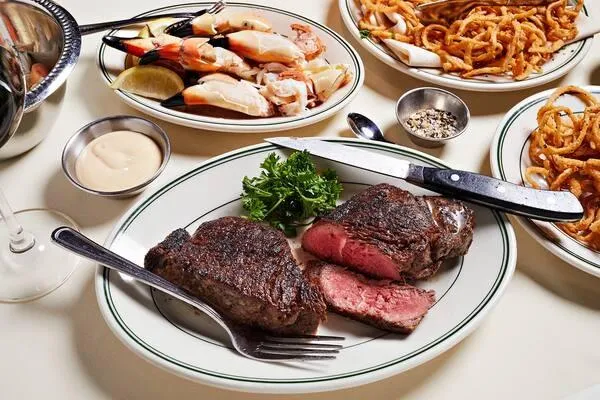
A New York strip at Joe's Seafood, Prime Steak and Stone Crab in Washington, where President Trump dined in September.
Image: Deb Lindsey — The Washington Post
FRENCH gastronomist Jean Anthelme Brillat-Savarin’s well-worn aphorism, “Tell me what you eat and I will tell you what you are,” is often used to explore nuanced questions about identity and food culture. But in the nation’s capital, the answer seems clear: Washington eats steak, and therefore, Washington is a steakhouse town.
District denizens have long chafed at this perceived slur, which is often administered down the nose of a media outlet in a city with a dining scene that considers itself superior. And yet, no matter how much this town attempts to shed the moniker, the label endures. A mere decade after a previous carnivorous boomlet prompted a prime-grade identity crisis (The Washington Post’s headline was “If D.C. 's steakhouse days are over, why do so many new ones keep opening?”), we are in the midst of yet another.
Nearly a dozen temples of high-end beef have opened since September or are slated to open across the city within the year.
But the most emblematic of the new entrants is Bazaar Meat, a rebrand of the former Spanish-Japanese restaurant Bazaar, located in the Waldorf Astoria hotel. That’s because its owner, the José Andrés Group, is helmed by a man who played an outsize role in shifting the city’s reputation in the 1990s from a backwater ruled by prime-rib purveyors to a vibrant locale where a diner could find tantalizing tapas, tableside guacamole and avant-garde fine-dining cuisine.
Andrés, like many Washingtonians, rejects the “steakhouse town” label, because he says the city’s dining scene has always been maligned. “Washington has been also the city of great Italian food, and Washington is the city of great bread,” he says. “Washington has been the city of great French.”
The cuts at Bazaar Meat - which on a recent visit included a $145-per-pound rib-eye from the Japanese cattle breed Akaushi and a $60-an-ounce wagyu - are meant to be shared. “I’m actually telling you I want you to eat less meat,” he says. “But the meat I’m going to give you is the best quality I can find.”
Restaurateurs say one reason is the uncertain economy. It’s been a brutal stretch for Washington-area restaurants for a variety of reasons: Rising food and labor costs, exacerbated by tariffs and Washington’s tipped wage law, have coincided with a hit to foot traffic for many due to widespread government layoffs and a dip in tourism related to the deployment of the National Guard to the city’s streets.
Beef prices are at record highs, according to the U.S. Department of Agriculture, because of a slew of factors including droughts, increased costs for livestock producers and high consumer demand for red meat.
The “comprehensive cutout value” - essentially the wholesale price for a beef carcass - is $4 a pound, up from $3.30 a year ago and $2.42 five years ago. High-end restaurants generally use better-quality and more-premium cuts that can cost considerably more to source, but even if they have to mark up their menus accordingly, restaurant owners say diners will reliably shell out for steak.
At Butterworth’s on Capitol Hill, chef-partner Bart Hutchins has studied the behavior of meat devotees. “Sure, beef is getting really, really expensive,” he says. “But there’s really no limit on what you can charge for it.” Hutchins estimates that most steakhouse customers “don’t even look at the price.”
Not everyone is following suit. Eric Eden, partner and co-founder of Garden Hospitality group, which operates Unconventional Diner, Italian-themed L’Ardente and Japanese food hall Love, Makoto, says he’s deliberately avoided getting into the steakhouse market, which he finds “cluttered.”
But he understands why the concept appeals to restaurateurs looking for prime real estate. Developers, Eden says, have “this Holy Trinity idea” when brainstorming tourist-friendly destinations. “They always want three types of restaurant: a steakhouse, a Japanese restaurant and an Italian restaurant.”
But Washington has seen steak surges in times of economic boom, too. The appeal, then, might be more endemic.
Carol Joynt, a longtime observer of Washington’s social and dining scene who has worked as a restaurant owner and a journalist covering the city’s power class, says steak will always be in the city’s DNA. “ Many D.C. diners “don’t want mystery. They have enough mystery in their professional lives,” she says.
Hutchins theorizes that some locals reflexively order steak so they can focus their attention elsewhere. “Dinner in D.C. isn’t about dinner,” he says. “It’s about the person you’re having dinner with.”
Steak, he says, is the no-brainer entrée. “I know what I’m getting. I don’t have to think about it while I’m about to ask this person to donate to my campaign, or sign on to my piece of legislation, or whatever it is people in D.C. do.”
This wave of steakhouses comes as Republicans, whose party has long been associated with red meat, hold a majority in Congress and occupy the White House. And the Trump administration offers a backdrop where steak is part of the zeitgeist. The president himself is known to favor a well-done steak. Health and Human Services Secretary Robert F. Kennedy Jr., the figurehead of the beef-tallow-touting Make America Healthy Again movement, has boasted that he eats beef twice a day. The new dietary guidelines pyramid he oversaw places red meat at the top.
Ethan Lane, the senior vice president of government affairs at the National Cattlemen’s Beef Association, says that Washington’s seemingly unshakable love affair with steak can take many forms.
“Every restaurant is a steakhouse if you squint hard enough,” he says. “I do think that we’re a steakhouse town, but I also think we have one of the coolest dining scenes in the country that has nothing to do with steakhouses. Those innovative new restaurants and unique experiences, a lot of times, still are going to have high-quality beef options, dare I say, potentially even a steak option.”
While it is ultimately up to patrons to decide, Hutchins suspects that red meat is somewhat hardwired into diners’ psyches. “There’s something very primal about it. There’s something very American about it.”