
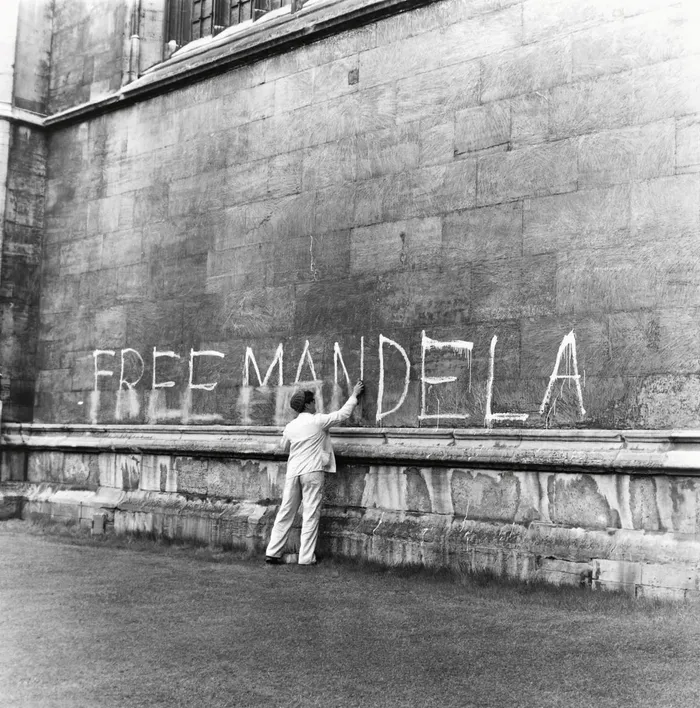
A young man removes graffiti reading "Free Mandela" from a wall of King's College Chapel, in Cambridge, England in 1965. Nelson Mandela was imprisoned in 1964 for opposing the Apartheid policies of the South African government and was not released until 1990. He later became South Africa's president.
Image: (Photo by © Hulton-Deutsch Collection/CORBIS/Corbis via Getty Images)
MUSIC was more than art during apartheid — it was a weapon, a unifier, and a secret language of defiance. Songs lifted spirits, spread messages, and brought communities together in ways that words alone could not.
“Our songs raised people’s hopes because once we were brave enough to say things as they were, it encouraged listeners to stand up for themselves and say, forward we go, backward never,” says legendary South African musician Sipho “Hotstix” Mabuse.
During the 40 years that apartheid — South Africa’s legalised system of racial segregation — held sway, liberation music refuelled and united a movement against oppression. Freedom songs, whether subtle or forceful, were vehicles of protest, often evolving to reflect the changing political landscape. Artists who spoke out risked censorship, exile, or imprisonment.
“Music has always been central to profiling or highlighting societal issues,” Mabuse explains. “In our case, during the Black Consciousness era, we were conscientised in ensuring songs became part of profiling the struggle… We understood what our role should’ve been, so we were overt in how we wrote our songs, performing them at major protest concerts. Touring Zimbabwe during the arms struggles there, we were very aware South Africa required the arts to play an intensified role, particularly musicians, to advance the struggle — and we did that through our music.”
Five Stages of Musical Protest
The anti-apartheid movement unfolded in roughly five stages:
Throughout these stages, music was both a communal expression and a strategic tool. It accompanied protests, funerals, religious revivals, cell meetings, training camps, and union gatherings. The militant toyi-toyi dance, with its repetitive chants and stomping, became synonymous with resistance — learned by ANC exiles from Zimbabwean guerrillas and traced back to uMkhonto we Sizwe (MK) training camps in Algeria and Morocco.
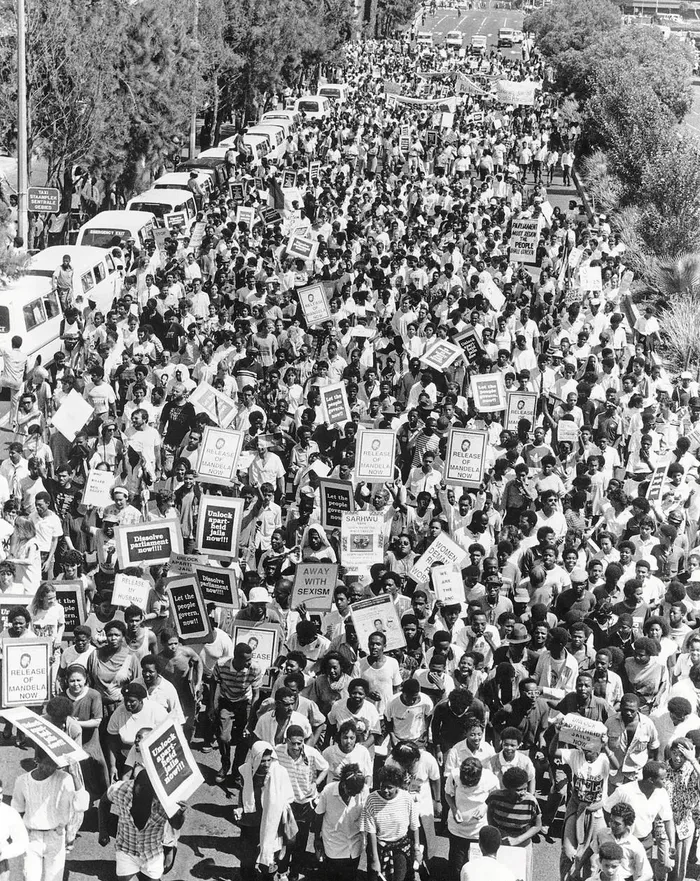
Thousands of protesters march for the release of anti-apartheid activist, Nelson Mandela, Johannesburg, South Africa, circa 1987.
Image: (Photo by Media24 Archives / Gallo Images via Getty Images / Getty Images)
Legendary artists like Hugh Masekela, Ladysmith Black Mambazo, Miriam Makeba, Johnny Clegg, and Brenda Fassie became global voices of the struggle, their music rallying support abroad while reinforcing the resolve of those at home. “Music awakens the senses and sparks curiosity,” says Dr Lindsay Michie, associate professor at the University of Lynchburg. “A stirring speech might resonate, but song connects deeply, reminding people of their humanity in revolutionary ways.”
Songs as Code, Protest, and Memory
Liberation songs carried hidden messages. Johnny Clegg and Juluka encoded anti-apartheid messages in Zulu proverbs. Yvonne Chaka Chaka’s “I’m Winning My Dear Love” became a tribute to Winnie Mandela. Lucky Dube’s “Liquor Slave” was transformed into “Legal Slave” at concerts to highlight systemic oppression. And the deceptively upbeat “Meadowlands,” sung about forced removals from Sophiatown, contained lyrics warning white authorities: “We’ll shoot you, we’ll kill you. Be careful what you do.”
Even grassroots songs, often never recorded, acted as oral histories, passed in marches, protests, and MK training camps. Vuyisile Mini, an ANC activist executed by apartheid authorities, composed militant songs such as Pasopa nansi ’ndondemnyama we Verwoerd, challenging the architect of apartheid directly. Letta Mbulu’s Senzeni Na? and Nonqonqo (To Those We Love) captured collective grief and fear during the 1960s, while Shona Malanga became an organising anthem in the 1970s and 1980s.
Dr Michie recalls the electric energy of anti-apartheid rallies in Mthatha and Butterworth: “People were determined, driven, and joyful. They sang and danced in a way that seemed to come from the very bones of the people. It created fearlessness in the face of intimidating weaponry. The authorities often felt more intimidated than the crowds they faced.”
Unity Through Music
Music transcended apartheid’s divisions, uniting disparate ethnic groups. Dr Michie recalls attending a Lucky Dube concert where amaXhosa, Zulu, and other groups stood together, momentarily putting aside government-fuelled divisions. Music also communicated resistance covertly, as with Dorothy Masuka transforming the children’s song Khauleza into a freedom cry, or protest songs like Mannenberg and Ndinovalo Ndinomingi (Pondo Blues) reinforcing cultural identity and collective memory.
While exiled musicians like Makeba and Masekela kept South Africa’s plight in the international spotlight, many artists stayed, using music as a form of cultural resistance. Patrick Pasha, Dudley Tito, and Freedom Fighters composed music at MK camps, reinforcing local activism even without global recognition.
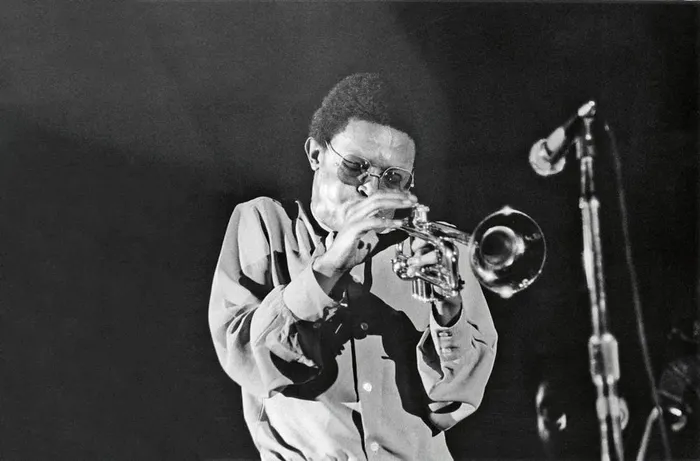
NEW YORK - AUGUST 18: South African jazz trumpeter Hugh Masekela performs live on August 18, 1968 in New York City, New York.
Image: (Photo by Michael Ochs Archives/Getty Images)
Music and the Prison Struggle
Music also sustained prisoners under apartheid. Dr Janie Cole, historical musicologist and founder of Music Beyond Borders (MBB), explores how music became resistance in Robben Island and women’s jails. Political prisoners drew on freedom songs and diverse musical styles to survive trauma, maintain identity, and communicate hope. Anthony Suze, Robben Island political prisoner 501/63, said: “Songs were inspirational, they created the mood. If you want to go into a fight, you sing. That song becomes the opium that takes over the body, mind and soul.”
MBB’s work highlights the overlooked role of women prisoners and their musical resistance. Dr Cole explains, “Women’s struggle stories during apartheid and imprisonment are historically overlooked, but their treatment by security police was misogynistic, harsh, and devastating. We focus on the unknown ‘foot soldiers’ of the struggle, giving a fresh perspective on resistance and survival.”
Global Resonance and Legacy
By the 1980s, international attention intensified. Peter Gabriel’s Biko exposed the murder of activist Steve Biko to the Western world. South African films like Sarafina! — a retelling of the 1976 Soweto uprising — continued to inspire hope and perseverance, with music by Dr Mbongeni Ngema and Hugh Masekela.
Mabuse reflects on the political potency of music: “It wasn’t just Black musicians. A group of Afrikaans musicians also wrote protest music. Musicians made people aware of struggles far beyond their borders — poverty in Ethiopia, oppression in South Africa. The power of music is much bigger than many people think.”
Freedom songs were a living, breathing part of South Africa’s struggle. They united communities, communicated coded messages, preserved cultural identity, and inspired action. Without them, the fight against apartheid — its courage, resilience, and ultimate victory — would be unimaginable.
“Music is integral to cultural identity,” Dr Cole concludes. “It was inseparable from resistance. Singing is the primary cultural expression in South Africa, so it was only natural it became a form of defiance. It’s inconceivable to think about resistance to apartheid without a musical soundtrack.”