
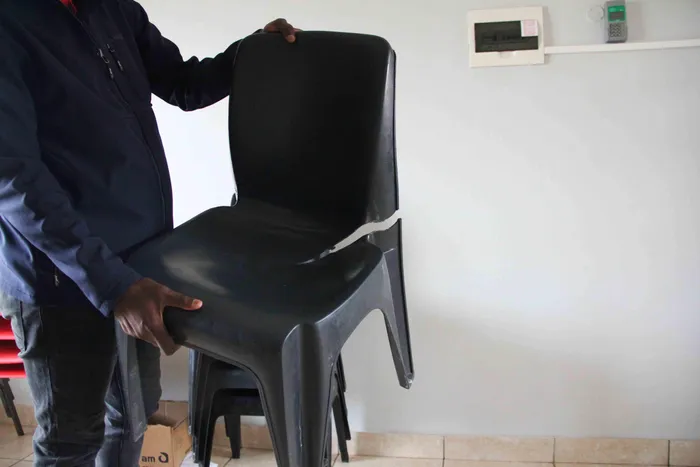
Due to insufficient and broken chairs, patients have to stand for long hours in queues.
Image: Sandi Kwon Hoo / DFA
Public health services are failing millions of South Africans, as clinics in rural areas battle medicine shortages, crumbling facilities, and overworked staff. A report by the Rural Health Advocacy Project (RHAP) highlights the critical state of the system, citing poor infrastructure, medical supply gaps, insufficient health professionals, and inadequate water in rural regions.
The report found that in 2019 and 2020, only 54.9% of South Africa’s clinics met the required standard for proper healthcare. Rural provinces were the worst affected, with Limpopo at 28.9%, Eastern Cape 32.5%, and Northern Cape 34.6%. Vhembe in Limpopo had the lowest compliance at 8.1%, followed by Frances Baard in the Northern Cape (20%), Ehlanzeni in Mpumalanga (22.3%), and OR Tambo in the Eastern Cape (27.8%). The findings suggest quality of care remains a critical concern, particularly as the country moves toward full implementation of the National Health Insurance (NHI).
The health system faces chronic underfunding, a severe workforce shortage—0.9 doctors per 1,000 people—and deteriorating infrastructure, affecting over 84% of the population. Corruption, poor management, and a high disease burden contribute to long wait times, equipment shortages, and poor quality care.
RHAP emphasised that true access to health services is not just about hospital beds but also the quality, reliability, and functionality of local clinics. In the Western and Eastern Cape, the key factor influencing patients’ use of public facilities was whether they received the medication they needed. Patients tolerated long waits due to staff attitudes or limited doctor access if care included thorough examinations, clear explanations, and essential medicines.
The report noted that globally there is insufficient data to assess access to essential medicines accurately. In South Africa, the Stock Visibility System had not improved this by 2019. An alternative indicator suggested by the South African Health Review 2019 measures the proportion of primary care facilities experiencing a stock-out of any tracer item during the review period.
Indicators of service capacity are often difficult to assess because optimal levels or targets are unclear. Professional registries, such as the Health Professions Council of South Africa (HPCSA), may overestimate the active workforce by not tracking retirements, migration, or exact work locations.
While public sector employees are recorded in the PERSAL system, there is no equivalent registry for private sector professionals, making it hard to pinpoint workforce distribution.
In a submission to the Select Committee on Appropriations on the 2026 Division of Revenue Bill, Section27 and the Treatment Action Campaign reported that clinics and hospitals nationwide remain under pressure, with patients facing long waits, overcrowding, and inconsistent care. Access is undermined by underfunding, overcrowding, and stockouts, while facilities struggle to operate in spaces that are often unsafe and worn down.
The organisations demanded a R15 billion increase for the health sector. They noted that funding for healthcare infrastructure continues to decline in real terms. The Health Facilities Revitalisation Grant, which supports construction and refurbishment of clinics and hospitals, received only a nominal R149 million increase (1.69%), amounting to a real-term cut of R104 million (1.38%). The organisations warned that provincial departments lack resources to build new facilities or maintain overcrowded existing ones.
Recent data highlights the depth of the crisis: 82% of facility managers surveyed reported staffing shortages, particularly in OR Tambo and uMgungundlovu, while 61% of patients reported critical staff shortages, making the problem highly visible.
The National Education, Health and Allied Workers’ Union (Nehawu) said healthcare services remain inequitably distributed, largely because historical injustices left black communities in underdeveloped rural areas. The absence of comprehensive universal health coverage exacerbates the problem. Spokesperson Lwazi Nkolonzi added that recurring budget reductions due to government austerity measures directly affect service delivery, causing staff shortages, medicine supply gaps, and deteriorating infrastructure.
Democratic Nursing Organisation of South Africa (Denosa) general-secretary Kwena Manamela attributed part of the problem to corruption, citing criminal syndicates exploiting financial opportunities in the sector.
The RHAP report also noted unique challenges in rural areas: although populations are low, residents may live far from available health facilities, reducing access to care even where services exist.
The National Department of Health had not responded at the time of publication.