
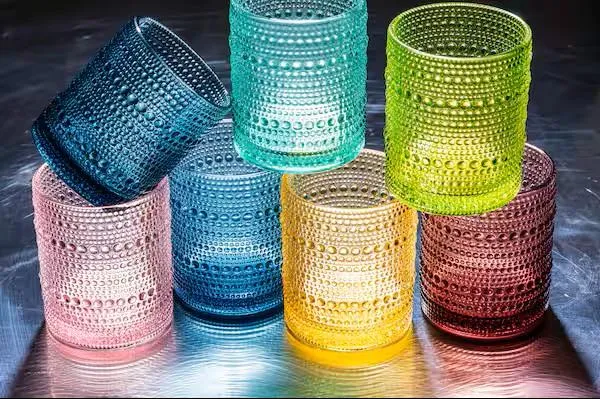
Once you start looking for these glasses at restaurants, you'll start seeing them everywhere.
Image: Scott Suchman/The Washington Post
SOMETIMES, an aesthetic shift will sneak up on you and you won’t realize how ubiquitous it has become. Like when you suddenly noticed that all the jeans were baggy again. Or you looked around and saw that almost no new cars have metallic paint.
That’s how it goes with a certain style of glassware that has made its way firmly - yet quietly - into restaurants and onto home dining tables across the country. You’ve almost certainly seen it: It has rows of raised beads in the glass, like a stack of delicate pearl necklaces looped around the vessel. It comes in a rainbow of colors, from sky-blue to a pale rose.
Once you notice, you’ll see them everywhere. Your neighborhood taqueria probably serves margaritas in them. You might have toasted a birthday with one at an upscale restaurant. Retailers from Williams Sonoma to Costco have carried them, which is why you might have spotted them at your neighbor’s dinner party or on your friend’s breakfast table.
We’ve entered an era ruled by the Jupiter style from Zwiesel Fortessa, the tableware company based in Ashburn, Virginia, and Bavaria, Germany, that originated and produces this distinctive style. (There are knockoffs, of course.)
Another sign that the glassware has reached peak ubiquity? It even made a cameo on “Heated Rivalry,” the steamy Canadian hockey series that improbably became a massive hit. They appear on the dining table at the well-appointed home of the parents of one of the leads, Shane, though viewers were probably too engrossed in the drama over Shane’s dalliance with a rival hockey star to pay them much mind.
Amber Kendrick, the creative director at Zwiesel Fortessa, traced the style’s popularity to around 2015, when the company began selling it through its division that supplies to events, mostly though caterers or hospitality venues. People liked the colors and the more casual vibe, she says, that were distinct from the prevailing trends. “At that time, whiteware was everywhere - white tableware and formal glassware - and so I think having a pop of color and some texture definitely was appealing,” she says.
The style’s popularity led the company to start selling more to its restaurant customers. And then Covid boosted the glass’s profile even further, as housebound people wanted to bring restaurant style to their own table settings, and sales boomed in Fortessa’s consumer division.
Kendrick notes that the glass is reminiscent of carnival glass, a style of glassware popular in the early 20th century that was made in colorful, often iridescent finishes and featured whimsical patterns pressed into the glass. “It’s a playful glass … as opposed to subtle elegance, this is very much the opposite,” she says. “It’s like going to the circus, and then you have all the colorways.”
They were originally inspired by a glass found at a European flea market by one of the company’s previous owners, she said.
Michael Costa, the concept chef at Zaytinya, calls the Jupiter glass “the workhorse” of his restaurants, where the clear, colorless version is used as the water glass at all seven locations. For Costa, the choice was both aesthetic and practical. As far as looks go, “it just has a bit of a festive feeling,” he says. “It’s celebratory.”
Just as important when you’re dealing with more than 1,000 glasses on hand at the Washington location is function. Costa says the thick glass is less prone to breakage, and the texture means that the staff doesn’t have to spend as much time polishing water stains. “When you’re talking about hundreds of glasses, saving a few seconds matters enormously,” he says.
Restaurateurs think of details that most casual diners don’t even realize they’re experiencing. Costa says he likes the way the glass feels in your hand. “Usually, a thicker water glass is going to feel kind of funky and clumsy, but those don’t,” he says. “A lot of it has to do with the tactile sensation when you grab it. I think that’s a really undervalued part of any kind of china and glass program, the physical interaction that the guest has with the object.”
Other styles of glass have had their moments and symbolism. In the 1990s, chunky Mexican-style tumblers with cobalt rims (think peak Pier One) were all the rage. And nothing gives “French bistro” like a classic Duralex Picardie style. Stubby, thin-walled “bodega glasses” signaled hipsterdom in the late aughts.
But for now, it’s Jupiter’s world, and we’re just drinking in i