
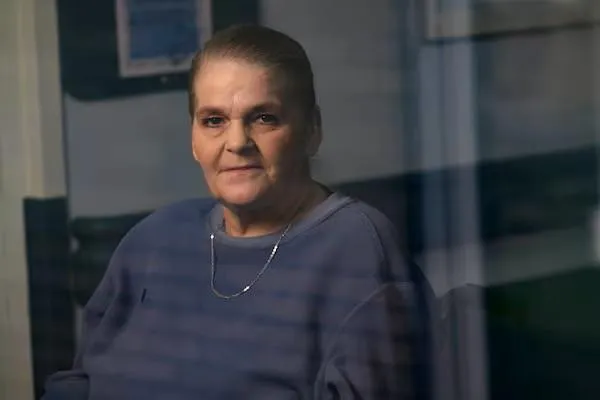
Kimberlee Williams was arrested in 2021 after being identified as a suspect in a bank fraud case through facial recognition software.
Image: Jeff Swensen/ The Washington Post
TO investigators, the case against Kimberlee Williams appeared straightforward.
“It’s very obvious it’s you,” an officer in Montgomery County, Maryland, told Williams as she sat handcuffed during questioning.
Police believed Williams matched a woman seen in surveillance images from a bank fraud investigation in Maryland. They pointed to similarities in build, age and facial shape. Williams, however, insisted they were wrong.
“That wasn’t me,” she said repeatedly. She told officers she lived in Oklahoma, had never been to Maryland, and could not have been involved in the alleged fraud.
Williams, now 57, was arrested and flown to Maryland after being taken into custody in Oklahoma. She was later charged across three Maryland counties — Montgomery, Prince George’s and Anne Arundel — and spent about six months in jail before all charges were eventually dismissed.
Court records and police documents show she faced 16 charges in total, including 12 felonies.
She would not learn for years how she came to be identified as a suspect: a bank investigator had reported that facial recognition technology suggested Williams was the person seen in surveillance footage. That detail was not disclosed by Montgomery County police when they pursued charges, according to police records.
Experts say that omission is significant. Several criminal justice specialists told The Washington Post that the use of facial recognition should have been disclosed in charging documents and investigative reports.
On Tuesday, the American Civil Liberties Union sent formal complaints to the three police departments involved, calling for policy changes and an apology. The group alleges Montgomery County prosecutors “maliciously prosecuted” Williams by failing to disclose the role of facial recognition in identifying her. It also argued that all three agencies failed to properly verify the bank investigator’s tip before moving forward with charges.
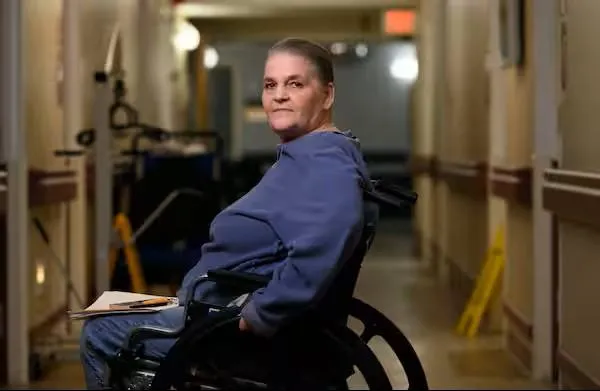
Kimberlee Williams was wrongly identified as a suspect in a bank fraud case through facial recognition software.
Image: Jeff Swensen/The Washington Post
The police departments did not respond to questions about Williams’s case. Anne Arundel County police said in a statement that it independently investigates outside tips before applying for charges and that a judicial officer reviews probable cause.
Williams’s case has become part of a wider debate over how law enforcement uses facial recognition technology, which experts say can generate false matches and is often treated as stronger evidence than it is.
“When an officer seeks charges or a warrant without revealing what they’re basing their identification on, they’re essentially hiding or burying the unreliable step in that investigation,” said Mitha Nandagopalan of the Innocence Project.
According to court records and investigative documents, the case began in December 2019, when a woman made two fraudulent cash withdrawals at a SunTrust bank in Potomac, Maryland, using forged checks totaling about $17,000. Surveillance cameras captured her on consecutive days, wearing different clothing and hairstyles.
A bank investigator uploaded the images to CrimeDex, a private online network used by corporate and law enforcement investigators to share leads. A tip later suggested that facial recognition software had identified Kimberlee Williams as a match.
It remains unclear who performed the facial recognition search. CrimeDex does not conduct such searches itself but allows users to share findings. The bank investigator wrote to police that a “comparison of arrest photos against bank surveillance stills resulted in the identification of Williams.”
That identification was passed to police in Montgomery County and then shared with investigators in Prince George’s and Anne Arundel counties. In those communications, the use of facial recognition was not disclosed.
Police in all three counties opened investigations based on the tip and a visual comparison of photographs. Williams was also linked, in part, to prior convictions for writing bad checks in Oklahoma.
No officers, according to reports, documented efforts to verify whether Williams had ever been in Maryland at the time of the crimes.
A warrant was issued, and Williams was arrested in Oklahoma in 2021 at Fort Sill, a U.S. Army base near Lawton, where she was stopped during a delivery visit with family.
“I thought they were joking,” Williams said of the arrest. “I’ve never been to Maryland.”
She was held for weeks in Oklahoma before being transported to Maryland, where she said she tried repeatedly to convince detectives of her innocence. She offered alibis and suggested a polygraph test.
“I’m like, how do I convince a detective that that wasn’t me?” she said.
Inside jail, Williams remained for months as prosecutors in the three counties pursued charges sequentially. Each later dismissed the case, but not before she spent time in custody across multiple facilities.
Her family provided sworn statements and other evidence placing her in Oklahoma at the time of the alleged crimes, according to documents reviewed by The Post and submissions shared by the ACLU.
After her release in late 2021, Williams returned to Oklahoma without money or immediate means of transport, later borrowing a stranger’s phone to contact her family.
Her case was eventually expunged, according to the ACLU. In 2024, Maryland passed legislation restricting law enforcement’s use of facial recognition, including limiting its use as the sole basis for arrest.
Williams later said she struggled to recover from the experience and spent time in a rehabilitation facility in Pennsylvania after a serious illness.
Her daughter, Jordyn Wasko, said the case deeply affected the family.
“She lost a part of herself,” Wasko said.
Williams, now reflecting on the case, said she was still struck by the images that led to her arrest.
“I wish I knew who she was,” she said.