
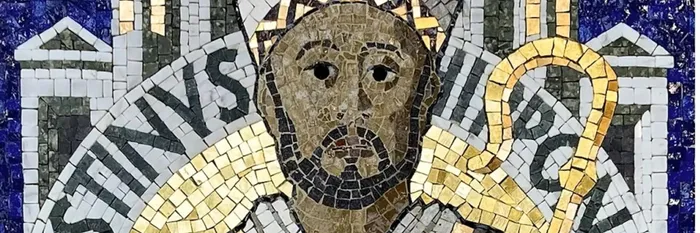
Saint Augustine of Hippo depicted in a mosaic by John Maddison, Chapel of Saint Paul, Westminster Cathedral, 2023.
Image: Courtesy Diocese of Westminster/Liveright
POPE Leo XIV’s first official trip to Africa started with a fascinating stop in Algeria. Here the pontiff’s visit to the Grand Mosque of Algiers was an attempt to strengthen Christian-Muslim relations. The stop was also to pay homage to Saint Augustine, founder of the order that he is a member of. Catherine Conybeare, a professor of history, language and the classics, has written a book revising Augustine’s story to place his African origins and beliefs at the centre. We asked her about it.
What is the main take-away from the book?
Above all, that one of the foundational figures in the European intellectual tradition came from Africa and spent almost his entire life there. It emphasises the global church’s debt to Africa.
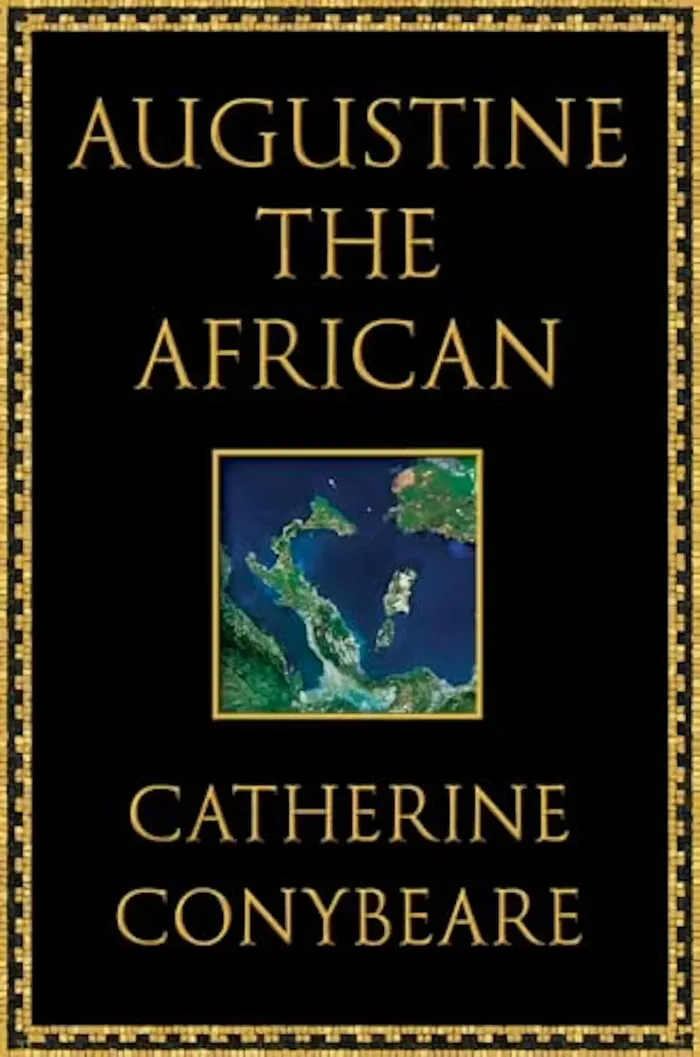
The book which explains how an African saint inspires Pope Leo XIV.
Image: Liveright
Who was Saint Augustine?
Saint Augustine (354-430 CE) was a rhetorician (persuasive speaker) and philosopher from what is now Algeria. He was educated in north Africa and rose to the rank of official orator at the court of the emperor in Milan – and then, after years of spiritual searching, underwent a dramatic conversion to Christianity and returned to north Africa.
There, he was ordained first as priest then as bishop in the coastal city of Hippo, modern Annaba. He spent the rest of his life in Hippo, teaching, preaching, debating, and writing his magnificent works of theology.
He is perhaps best known for his Confessions. But there are other crucial works as well, including The City of God and On the Trinity. Altogether, they make him one of the most important figures in the foundation of the Christian church.
Augustine remains highly significant in the history of western thought, even beyond his theological contributions. His ideas on time, memory, language, the interpretation of texts, political theory, and the writing of history itself are all fundamental to thinkers working in these fields.
Why is Augustine so important to Pope Leo XIV?
Pope Leo XIV is a member of the Augustinian order, founded in the 13th century, eight centuries after Augustine’s death. In his very first speech from the balcony in St Peter’s Square the pope described himself as “a son of Saint Augustine”.
But beyond his affiliation to the Augustinian order, the pope shows deep affinities, both intellectual and spiritual, with Saint Augustine. Pope Leo’s emphasis on love and peace brings him close to his theologian predecessor. Augustine put love at the heart of his theology.
Pope Leo also emphasises dialogue, and dialogue was at the heart of how Augustine practised both philosophy and theology. The pope has recently been using the very Augustinian concept of the “desire for domination” to criticise the instigation of war. Augustine argued that this desire corrupts and ruins those who structure their lives around it. Above all, Augustine is remarkable for his intellectual humility. He put searching and questioning, as opposed to seeking dogmatic answers, at the heart of his theology. This too is a signal characteristic of Pope Leo.
Did his work influence Islam in any way?
His work did not, as far as I am aware, influence Islam. But I have discovered, in conversation with colleagues in Algeria, that he is admired and welcomed as a pre-Islamic thinker, and hence he can help to build bridges between Christianity and Islam.
Why is it important to reclaim him as an African?
It tips the view of the world towards the global south, and specifically to Africa, whose significance is so often overlooked in our narratives of intellectual history. Moreover, the fact that he was both African and Roman gave him a distinctive insider/outsider view of the Roman empire. When he set out to critique the empire in his book The City of God, his view was very much from its periphery: he saw the empire from an oblique angle, with guarded admiration but without complacency, and with no sense that it should be inevitable or eternal.
Catherine Conybeare - Leslie Clark Professor in the Humanities and Professor of Greek, Latin, and Classical Studies, Bryn Mawr College