
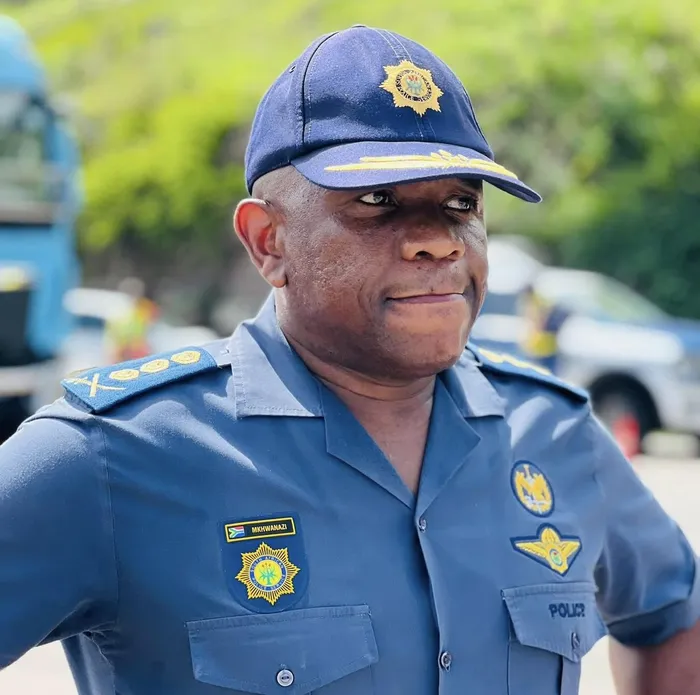
Lieutenant General Nhlanhla Mkhwanazi is set to spearhead a national offensive against high-level crime syndicates.
Image: Facebook/SAPS
CLOSE to a billion rand has been set aside for the national Organised Crime Task Team led by KwaZulu-Natal Provincial Commissioner Lieutenant General Nhlanhla Mkhwanazi.
Mkhwanazi confirmed this yesterday saying that the money was sourced from the Criminal Assets Recovery Account (CARA) fund, to finance its operations for the current financial year.
Discussing the project’s objectives, Mkhwanazi emphasised that the fight against organised crime is fundamentally a fight against deep-seated corruption within state agencies, including the SAPS itself.
“The work has already started,” Mkhwanazi stated, detailing the team's strategy. “We have analysis of dockets that we need to begin with very soon so that we can identify which [cases] we are going to tackle.”
He confirmed the operation is not confined to one province, noting, “KZN is one of the beneficiaries of that project.”
He further explained the task team’s targets, stating that the project will focus on the highest levels of organised crime, international syndicates, and traditional organised crime, drug trafficking, and gangsterism.
The scope extends beyond the SAPS, with Mkhwanazi confirming the investigation will also target the enemy “within law enforcement agencies, both from the SAPS and other law enforcement agencies,” and “agencies within the criminal justice system.”
Furthermore, a significant focus will be on corruption tied to government contracts and entities.
The new national structure is designed to overcome historical challenges where police units, working in isolation, became vulnerable to infiltration by criminal syndicates.
Mkhwanazi explained that the key is coordination and breaking down territorial barriers.
He explained that the goal of the structure created for the Political Killings Task Team (PKTT) was to bring all those involved units together under one central command.
“This is exactly what we are trying to do with this organised crime approach; we take from different disciplines and bring them under one command so that we are able to have a focused investigation.”
The team will integrate officers from the uniform branch, detective specialisations, and combatting units, moving them away from their traditional units and deploying them where the national task requires.
This fluidity of deployment is crucial, according to Mkhwanazi.
“If you are from Durban and we want you in Pretoria, we will send you to Pretoria, go and work there for that period while your family is in KZN, so we move them around,” he said.
Furthermore, a critical element of the R1bn project is the implementation of a rigorous counter-intelligence framework to vet and audit the task team members themselves.
Mkhwanazi noted that law enforcement is “not immune to corruption” and that internal integrity is paramount to the team’s success.
“We have to develop countermeasures to mitigate the risks,” he said.
Ultimately, the long-term goal of the CARA-funded project is to create a self-sufficient system where assets recovered from criminals are used to fund further operations.
“The long term plan is to be self-sufficient by the very same criminals… We get their things, we sell it, and we finance ourselves and we go back. It doesn’t help if taxpayers are paying for this and these criminals are making millions,” Mkhwanazi stated.