
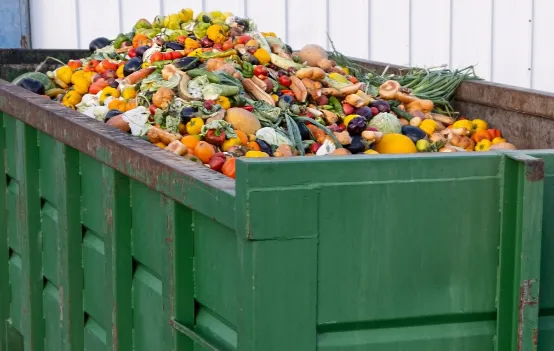
Between 9 124 and 17 969 tonnes of fruits and vegetables are wasted each year in South Africa, equivalent to roughly 450 to 900 fully loaded large trucks, according to a new study.
Image: Supplied
TONIGHT someone you know will go to bed hungry, not by choice. Another will go to bed overfed. Both live in the same food system.
Despite this, experts say South Africa produces enough food to feed its population. Yet every year, millions of tonnes end up in landfill sites, discarded while hunger persists in households across the country.
A 2021 report by Statistics South Africa, based on the General Household Survey, found that around 2.1 million households (11.6%) experienced hunger. While most households reported adequate access to food, a significant minority remain food insecure.
The burden is particularly severe for children. More than 680,000 households with children under the age of five reported hunger in the same year — a critical concern given the long-term developmental consequences of early-life malnutrition, including stunting and impaired cognitive growth.
Stats SA notes that food insecurity is not confined to rural areas, but is concentrated in urban centres. Close to half a million affected households are in Cape Town (240,970) and Johannesburg (238,610).
“South Africa faces challenges ranging from high unemployment and poverty to the ongoing energy crisis and rising costs of living. These impact negatively on South Africa’s state of food security by making food expensive and inaccessible to many and increasing the number of people and households experiencing food inadequacy and hunger.”
In January, the Access to Nutrition Initiative released its South Africa Retail Assessment 2025, evaluating how leading food retailers influence access to nutritious and affordable food.
The report found that shoppers are driven by cost and marketing; in simple terms, what is cheapest and most visible.
But even where food support systems exist, like community kitchens, many still go hungry.
A study by FoodForward SA in partnership with Southern Africa Labour and Development Research Unit at the University of Cape Town shows food insecurity is increasing — and it is severe and persistent.
A survey of 796 households receiving food support found around 70% experience moderate-to-severe food insecurity, while roughly one in four households endure conditions so severe they go an entire day without food. Children are disproportionately affected.
Andy Du Plessis, managing director of FoodForward SA, said: “This study shows, with painful clarity, that the food insecurity many South Africans live with is not occasional — it is a daily reality, even for families who are already receiving food support. Behind every percentage is a household juggling impossible choices between food, transport, medication and debt.”
The research found most children in these households face moderate food insecurity, with a third experiencing severe hunger. In many homes, adults skip meals so children or partners can eat, while 77.8% report speaking directly to children about the lack of food.
Experts say South Africa’s hunger crisis is systemic; shaped by how food is produced, distributed and discarded. About 10 million tonnes of food is thrown away every year, roughly a third of the country’s food supply. Fruits, vegetables and cereals account for about 70% of this waste, with meat, dairy, roots, tubers and oilseeds making up most of the rest.
Dr Lize Barclay, senior lecturer in Futures Studies and Systems Thinking at Stellenbosch Business School, says it is not just food being thrown away, but resources, money and dignity.
“Food waste is a complex systems issue that touches water usage, energy, land, climate and ultimately human dignity,” she says.
“About 90% of waste in South Africa goes to landfill, and organic waste makes up roughly 27% of that. As food decomposes, it releases methane and carbon dioxide, potent greenhouse gases that intensify climate pressure globally.”
She says reducing food waste is one of the most immediate and practical ways individuals can ease pressure on energy, water and land — while also saving money.
As the crisis deepens, health experts warn that what people are eating is just as important as what they are not.
The Physicians Association for Nutrition has called for urgent, science-based action to place nutrition at the centre of health systems, food systems and climate resilience.
Prof Andrew Robinson, medical director of PAN South Africa, says diets are rapidly changing, with major consequences.
“In Africa, non-communicable diseases have eclipsed infectious diseases,” he says. “There are many reasons — air pollution, stress, environmental pollution — but nutrition sits at the centre of the health system, regardless of those other factors.”
He adds that food has shifted from a communal, shared experience to something increasingly consumed alone — in cars, in front of screens, disconnected from its source.
“We’re so disconnected from where our food comes from. If you knew the farmer who grew your vegetables, you’d have more confidence in what you’re eating. Making food central to public health means rebuilding those relationships.”
Robinson advocates for small-scale food growing, even if it’s just a pot plant, arguing that healthy food starts with healthy soil.
To improve health, he says, you have to improve food — and that begins long before the supermarket shelf. When the system that produces food is compromised, the health of the population follows.
Researchers argue the problem is not just how much food South Africa wastes, but how it deals with the excess. Instead of dumping waste in landfills, they say it should be redirected, repurposed and reintegrated into a circular economy where it turns excess into value rather than burying it. South Africa doesn't have a shortage of food, just a system that fails to ensure that no one goes to bed hungry or throws excess food away.