
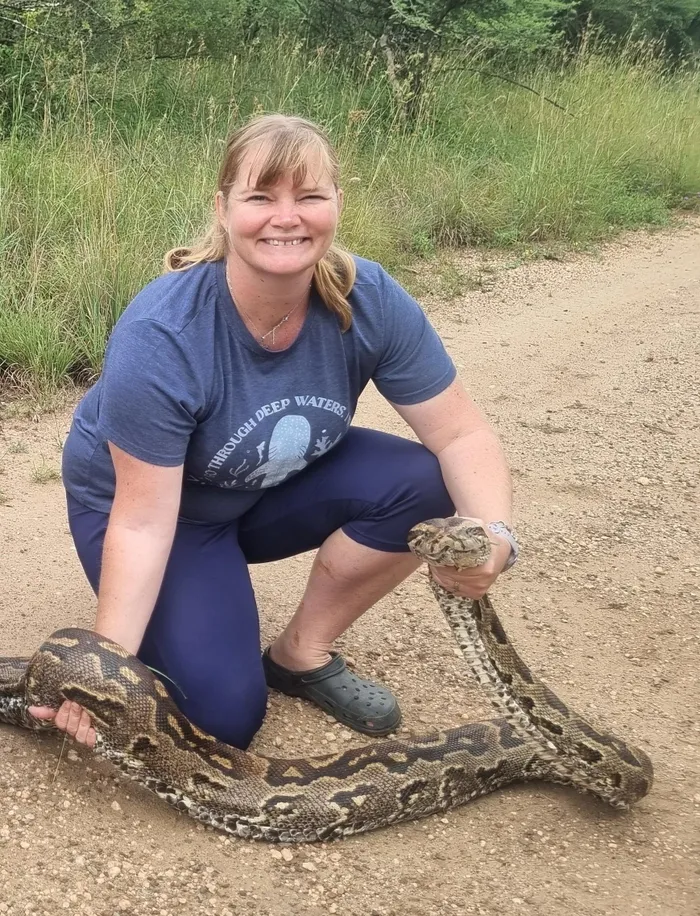
Dr Kirsty Kyle researched southern African pythons for her PhD.
Image: Supplied.
A NEWLY graduated PhD researcher has used social media data and citizen science to produce fresh evidence that one of southern Africa’s most feared reptiles is more complex, more maternal and more misunderstood than commonly believed.
Beautiful and charismatic are not words often associated with pythons, but Dr Kirsty Kyle found them so intriguing that she based her PhD on the reptile.
“These big cold-blooded reptiles that everyone’s scared of actually have more maternal instincts than most people. It’s quite amazing,” she said.
Her study focused on the “persecuted and fascinating” Southern African python, the region’s largest snake species. She examined their diet, the threats they face, and how they interact with people and their environment.
Kyle said female pythons show remarkable maternal care during their breeding season. Once the process begins, a female can go without feeding until her eggs hatch and the hatchlings become independent.
According to Kyle, as winter approaches the python usually becomes darker. After laying her eggs, usually in a burrow, she then sunbathes to absorb heat through her darker skin. At night, she coils tightly around the eggs, transferring warmth to help regulate their temperature. The female continues this behaviour even after the eggs hatch. Kyle said that the hatchlings climb onto the python’s body to keep warm because her larger body retains heat longer than theirs. Once the young snakes complete their first shed, they separate and leave.
She said female pythons usually need to reach about three metres in length before they are able to breed, which means they are often around eight years old before laying eggs.
“We expect ‘intelligence’ from certain species, such as primates, dolphins and elephants, but I firmly believe that if we spend enough time with any species, we will be surprised by what they can show us.”
While most people shy away from snakes because of fear, Kyle says they have a bad reputation which doesn’t match their behaviour.
So far only one fatality has been recorded after a boy herding cattle was killed by a python in the 1980s, she says.

This QR code takes the reader to a bilingual infographic poster which addresses some of the popular myths and beliefs around pythons.
Image: Supplied.
For her PhD, Kyle used social media to find predation records to gain clarity on what southern African pythons eat because the existing information was vague, and identified about 60 species.
Kyle said the research also described a feeding behaviour known as caudal luring, where the python twitches the differently coloured tip of its tail to attract small animals which were close enough to strike.
She said while pythons were known as ambush predators which would sit and wait on a game trail, they also do a lot of their own hunting and some scavenging.
For her study she also compiled a questionnaire on perceptions of pythons and 480 people, mainly in KwaZulu-Natal, participated.
“It was encouraging in that there was an overall positive trend, but what did come out is that there are a huge number of misconceptions around pythons and weird beliefs. Respondents said that they steal milk from your livestock and shoot lightning out of their eyes.”
A key part of her research project involved several novel approaches to data gathering.
“Some important aspects included using citizen science and social media for scientific research,” she explained. “We created a bilingual infographic poster addressing some of the popular myths and beliefs around pythons, and established new and interesting feeding behaviours for the species.”
Kyle said the study also highlighted how citizen science and social media are becoming increasingly useful tools for scientific research, allowing sightings and behaviour to be recorded far more widely than in the past.
She said southern Africa still offers huge opportunities for reptile research because many species remain understudied and basic ecological information is still lacking.
Kyle said pythons are found a lot more in protected areas than non-protected areas because they are large animals and prone to being squashed on the road. These days pythons are around four and a half metres long but historically they were known to grow up to six metres, she said.
Some of the dangers they face include electric fencing because they struggle to slither under electric fences because of the bulge in their bodies and become trapped. They were also vulnerable to fires in cane fields which inhabit because of the availability of food.
“In some traditions they are still protected because they are thought to have links with ancestors. What we’re finding is that the whole traditional belief system has a lot less sway over young people these days. So what used to kind of protect them in a way is now actually not really helping them anymore.”
According to Kyle, pythons are valued in the muthi trade and for food as in some areas they’re considered an “absolute delicacy.”
Kyle says the study would not have been possible without the guidance of Colleen Downs, who inspired her to sign up for a PhD in Ecology.
Apart from her love for reptiles and amphibians she credits her mother for nurturing her love for science.
“I was brought up not to be scared of anything creepy-crawly-wise. So that leaves room to be curious and what’s amazing in this country is that we’re so blessed to have incredible projects still to be done on some of our really big, impressive species.”
She hopes that her research will open the door a bit further for other women to pursue their dreams in science, even if they are a bit “unconventional”.