
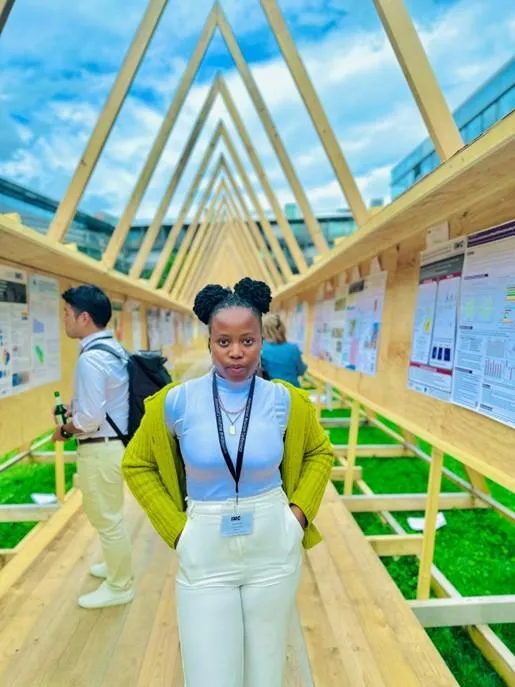
Dr Zandile Mncube has found an innovative method to monitor urban development issues.
Image: Supplied.
WHEN load shedding cuts the lights across South Africa, the darkness is not only felt on the ground; it also affects what is recorded from space.
Dr Zandile Mncube, who graduates from the University of KwaZulu-Natal this week, has explored an innovative way of tracking urban development by using nighttime light to measure patterns of growth, economic activity and rising temperatures.
The research uses advanced deep learning techniques applied to nighttime light data captured by satellites, analysing radiance patterns across Durban, Cape Town and Johannesburg.
“Nighttime light data is available monthly, making it more accessible for timely decision-making in planning, resource allocation and sustainable development,” she explained.
Mncube’s method tracks how artificial light from households, streetlights, traffic systems, commercial centres and billboards changes over time and serves as a visible footprint of human activity on the ground.
Nighttime light data is increasingly being used by planners and policymakers to track urban growth patterns in near real time, especially in rapidly changing cities where official statistics arrive too slowly to capture emerging trends.
The scientist, who hails from northern KwaZulu-Natal, says the data can help map urban growth, economic activity and environmental change more frequently than traditional statistics, which are typically released every 10 years.
“And that means you know how humans are using space. So as we know, how we use the environment affects climate change, the economy, the resources that we have and it relates to the population that we have,” said Mncube.
But in South Africa, she says, rolling blackouts complicate that picture by reducing the amount of light which satellites record as they pass over cities.
"So it would pick up fewer lights compared to the actual lights that are happening. So the challenge now was that how do I relate what is on the ground to what I'm seeing on the satellite image. But it wasn't so hard."
Mncube told The Independent on Saturday that one of her most striking findings came when satellite data showed a decline in nighttime lights even as economic indicators moved in the opposite direction.
“The nighttime light was going down and then GDP was going up,” she said, pointing to load shedding as a key factor in the mismatch between what is happening on the ground and what is visible from space.
For her PhD thesis, A Geo-Temporal Analysis and Forecasting of Nighttime Light Intensities over Three Largest Municipalities of South Africa, her research integrated geography, GIS, remote sensing and data science, including deep-learning techniques, highlighting its interdisciplinary nature.
She says that after the information is captured by satellite, you can see human activity through the radiance levels. Higher radiance levels generally indicate higher levels of human activity.
The lights in rural areas, she says, will not be the same as those in urban areas. In her study she wanted to determine how light contributes to environmental factors such as urban heat island and found a strong relationship.
“So you can see if there are changes in temperature and also if there is any spread of urban settlements. So over time, the spread of light will show you where the houses are developing, there are more businesses that are in the area, so you can use it to track that as well.”
She also found that her study can help complement statistical data in the country between census cycles that are done every 10 years.
“In those years, when the population data is not collected and all those GDP stats are not collected, you can actually use that to track the development of the country and of the region."
Completing her PhD is a huge achievement for the 28-year-old from Mnambithi in Ladysmith.
Mncube is the first in her family to complete postgraduate studies, and remembers how far she has come from 2016 when she got into a taxi with just enough money for transport to begin her university studies. It was perseverance and the support of her parents and her grandmother that carried her from the first year through to her PhD.
Her biggest worry right now is that she may burst into tears during the graduation ceremony. “I don’t know how I’m going to hold it together because I don’t want to cry on stage. I want to dance on stage.' It's an emotional moment.”
She says her grandmother never went to school but always advocated for education. Sadly, she died in 2024.
“You know, with Black families, it is not a common thing for someone, for your mother or your father to tell you that ‘I am proud of you. You’ve done well. You have uplifted our name as a family’, but my parents do."