
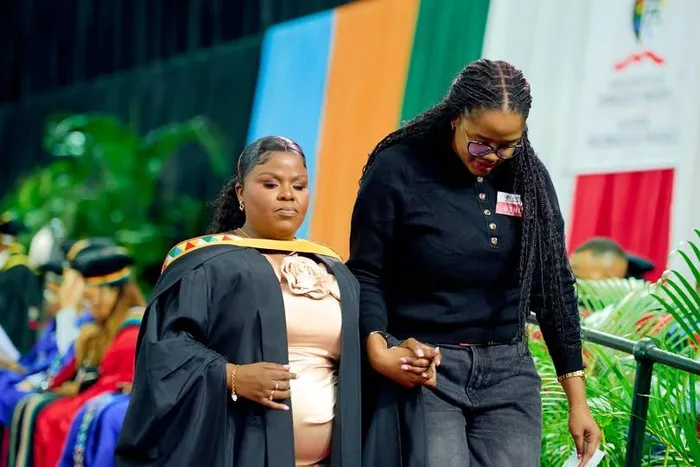
Nandipha Sothiya who is blind, has graduated with a Postgraduate Diploma in Human Resource Management from UKZN.
Image: Supplied.
A BLIND UKZN graduate says inaccessible university systems still force students with disabilities to rely on others to submit assignments and access marks.
Nandipha Sothiya (39) never imagined she would return to university after more than a decade away from studying, but this week the blind Pietermaritzburg teacher graduated with a postgraduate diploma in Human Resource Management.
“I don’t know how I did it,” she said.
Sothiya says it took two years of carefully balancing various responsibilities — teaching, motherhood and inaccessible study systems — to complete her studies.
“There were moments where I felt like quitting,” she said this week. But explained that she pushed through because she had already come too far to stop.
Sothiya said many university systems still require blind students to depend on others to complete basic academic tasks independently.
Although she studied part-time, it was quite an adjustment because of all the changes since she was last a student, as well as adapting to technological changes, including AI.
Previously, she completed a Bachelor of Social Science and a postgraduate certificate in education.
“I took a break for all these years and in 2024, I enrolled for this course. Remember when I was last in university, I had no children, it was just me, myself and I. So, it was a bit better.”
During her studies she continued teaching at a school for the blind in Pietermaritzburg where she teaches English, Life Orientation and Braille to learners who are blind or visually impaired.
And she had to ensure that her three young children aged 10, seven and four were fine.
“I stole a lot of time from my kids,” she said. “You come home, sit a while in the lounge, and next thing, 7 or 8 o’clock, you are locking yourself in the room.”
However, the advancement in technology helped her stay on track.
“Technology has a great impact on our lives, especially for blind people. We can do so much more now without having physical assistance because the technology is user-friendly for us.”
Sothiya says there are several apps that she relies on to do things independently, just by using technology.
“If I'm alone in the house, I know I can just go to certain apps for help, like ‘Be My Eyes’, where I can just put on the camera. For instance, if you've got two or three tins and you don't know if this is baked beans or this is tuna fish, you just go on an app and it tells you what it is. So, I think technology has really changed our lives. But, at the same time, it's not all the way there yet.”
Sothiya said while UKZN had provided support throughout her studies, many systems were still not fully accessible for blind students. She often had to rely on the university’s disability unit and sighted assistance to access notes, check marks and submit assignments online.
“The notes, the lecture posts, they are not in a conducive format for me to read directly like it is for other students who don’t have a visual problem."
“You need someone sighted to go into those websites for you and read it out to you.”
“I can’t go and turn it in myself. I have to have someone in the units come and assist me.”
Her studies were completed online and she relied heavily on assistive technology, but she still needed help with submissions, getting marks and accessing study materials.
She does all her work on a laptop and uses touch typing and voice-assisted software to navigate the way.
“The laptop tells you what you’re touching at that point. So, there’s a voice command that tells you what you are currently doing.”
Sothiya has encouraged other persons with disabilities, especially women, not to give up on their goals.
“This experience taught me that while my disability may require me to approach things differently, it does not limit my ability to succeed. My future plans include growing both within the education sector and exploring opportunities in Human Resource Management. I am especially interested in contributing to more inclusive workplaces and advocating for equal opportunities for people with disabilities,” she added.
Following her graduation this week, Sothiya said finally wearing her gown was emotional after years of doubt and exhaustion.
“I can't believe this is happening. There were moments where I felt like either I might not make it here or I would quit. But I think the moment really hit hard when I wore that gown. I almost cried but I held myself back.”
But this is not the end of the road. Sothiya is thinking about pursuing a Master’s degree or another postgraduate qualification.
And she hopes to move beyond the classroom and contribute to leadership, curriculum development and more inclusive education systems for people with disabilities.
“People are there talking for us, but they don’t understand what it’s like,” she said. For now she is taking a break but thinks she might sign up for another qualification very soon. “You can't remain with just one degree. Things are changing, life is changing.
“You also need to change,” she said.