
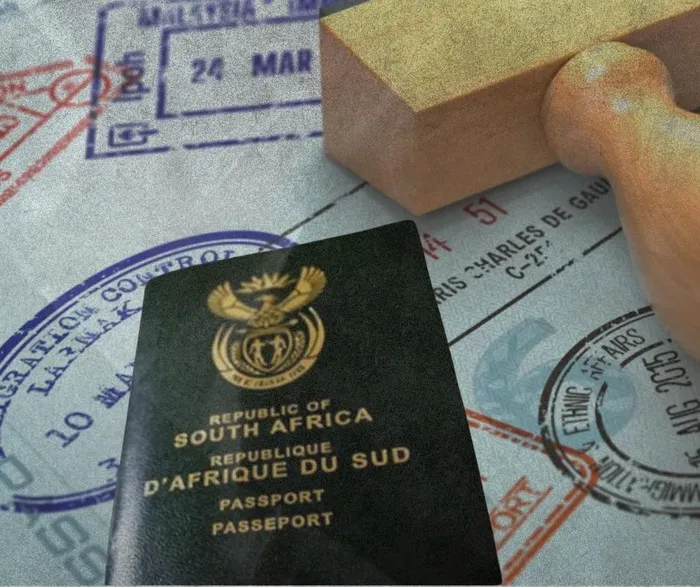
A Stats SA survey reveals that immigrants account for 5.1% of South Africa's population.
Image: IOL Graphic
MISINFORMATION about migrants and refugees is fuelling fear and anger in South Africa as the country grapples with rising tensions linked to protests and reported incidents of intimidation.
Migrant support organisations say public debate is increasingly shaped by distorted narratives and fragmented accounts of violence rather than verified evidence, contributing to growing anxiety among migrant communities.
The Consortium for Refugees and Migrants in South Africa (CoRMSA) says it continues to receive reports of sporadic incidents and intimidation in parts of Durban, Estcourt, Gauteng and the Eastern Cape, although it cautions that not all accounts have been independently verified.
Yasmin Rajah of CoRMSA says many of the claims circulating in public discourse are inaccurate or misleading.
“There’s a huge amount of misinformation… just the fact that they’re taking our jobs — there’s only a small percentage of jobs that are actually being talked about,” she said.
She disputed claims that migrants and refugees broadly access state grants, saying even recognised refugees face significant administrative barriers.
“People are traumatised. They’re scared to come out. Even when they’re documented, they don’t feel protected,” Rajah said.
She added that children are increasingly affected by anxiety linked to insecurity and fear.
“A lot of mothers are saying to us their children are scared, and they’re scared to send their kids to school,” she said.
Rajah warned that isolated incidents of violence or harassment are often rapidly amplified, deepening fear among migrant communities and contributing to a wider climate of insecurity.
Official demographic data provides context to the scale of migration in South Africa.
According to Statistics South Africa’s migration report based on Census 2022 data, the country’s foreign-born population has grown steadily over the past two decades.
The share of international migrants increased from 2.1% of the total population in 1996 to 3.9% in 2022, reaching an estimated 2.4 million people.
The report shows that most migrants originate from the Southern African Development Community (SADC) region, reflecting long-standing labour migration patterns.
It also notes variations in migration patterns across groups, with some categories showing a higher proportion of male migrants, particularly outside the SADC region.
Years of frustration over irregular migration have been building in South Africa, surfacing in public protests, political rhetoric and calls for stricter border enforcement. High unemployment, pressure on public services, housing shortages and deepening inequality have contributed to broader debates about state capacity and access to resources.
While migration figures remain contested, South Africa is estimated to host more than three million migrants, making it one of the continent’s largest migrant destinations, with many from neighbouring SADC countries.
Concerns around irregular migration have increasingly become linked in public discourse to anxieties about jobs, crime and overstretched state systems.
Legal experts say South Africa’s immigration system is undergoing one of its most significant reform phases in years following Cabinet approval in April of a revised White Paper on Citizenship, Immigration and Refugee Protection.
The framework outlines changes including a proposed “first safe country” principle, a points-based system for citizenship, and expanded digitalisation of immigration systems.
Senior Associates in Employment and Immigration Law at Cliffe Dekker Hofmeyr (CDH), Lee Masuku and Taryn York, say the reforms represent an administrative effort to restore control rather than close South Africa off.
“The proposed reforms must be viewed less as an issue of ‘closing South Africa’ and more as a matter of re-asserting regulatory control through law, planning and systems,” they said.
The Department of Home Affairs has also secured a Constitutional Court ruling in Director-General, Department of Home Affairs and Others v Irankunda and Another, which found that asylum seekers whose applications have been finally rejected may not reapply on the same grounds.
The ruling overturned an earlier Supreme Court of Appeal decision and is aimed at reducing delays and backlogs in the asylum system.
Home Affairs Minister Leon Schreiber said the judgment marked progress in restoring order within the immigration system.
“This judgment… is an affirmation of the progress we are making in restoring the rule of law and clamping down on abuse in migration and asylum systems,” he said.
The ruling also reinforces the proposed “first safe country” principle, which would require asylum seekers to claim protection in the first safe country they enter, rather than moving through multiple jurisdictions.
Legal experts caution, however, that the principle may face constitutional scrutiny depending on how it is implemented.
“What is critical is how the principle is applied, not merely that it exists,” said Masuku and York. “Constitutional pushback is possible, and the courts will play a central role in defining its limits.”
Beyond asylum reform, the White Paper proposes a shift toward a points-based skilled migration system, digitised visa processing and tighter administrative controls.
Officials have also outlined additional enforcement measures aimed at addressing undocumented migration.
Minister in the Presidency Khumbudzo Ntshavheni said government is continuing efforts to strengthen border control through the Border Management Authority (BMA), accelerate deportations, and intensify workplace inspections targeting undocumented labour.
She added that authorities are also stepping up enforcement of labour and municipal regulations linked to undocumented migration.
Ntshavheni said the revised policy framework further includes provisions allowing government to designate certain trades, professions and businesses for South African citizens and recognised refugees.