
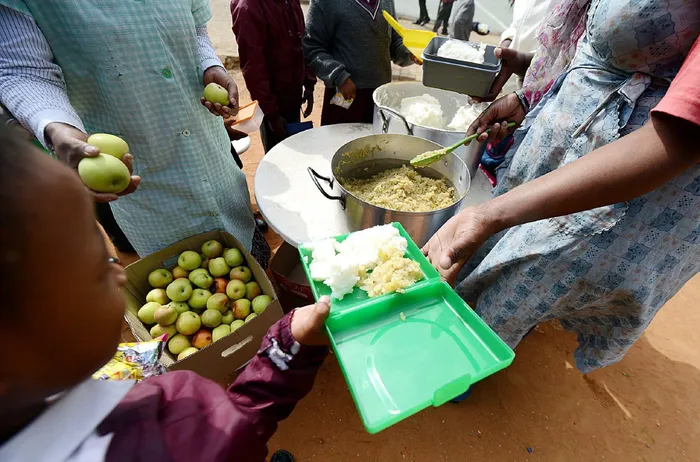
The KwaZulu-Natal Department of Education said the National School Nutrition Programme (NSNP) has been successfully rolled out to schools across the province.
Image: Supplied.
FOOD safety experts, researchers and public health officials are urging a nationwide tightening of safeguards in South Africa’s school nutrition system, warning that gaps in hygiene, infrastructure and monitoring could be exposing learners to preventable health risks.
The call emerged from a national webinar convened by the Tiger Brands Foundation in partnership with the Department of Basic Education and the Food Evolution Research Centre, bringing together scientists, policymakers and food industry specialists to assess risks in school feeding environments.
Participants warned that while school meals remain a critical safety net for millions of children, weaknesses in food handling, storage systems, and kitchen infrastructure continue to create conditions where contamination can spread quickly — sometimes before anyone notices.
Experts cautioned that outbreaks linked to school meals may be underreported, making it difficult for authorities to intervene early. They said this creates a “silent system risk” where isolated incidents can escalate into broader community health concerns.
Professor Paul Chelule of Sefako Makgatho Health Sciences University stressed that food safety governance in school environments must extend beyond kitchens to include surrounding informal vendors and supply chains.
He flagged recurring challenges such as unsafe storage conditions, weak infrastructure, and inconsistent compliance with food safety regulations, warning that “we need our children to be safe” is not a slogan but a baseline public obligation.
Microbiologist Edna Mokwena of Tiger Brands Limited said safe school meals are directly linked to learner wellbeing and long-term national resilience. She noted that most foodborne illnesses are preventable with basic but consistently applied controls — hygiene, temperature management, proper storage and strict monitoring.
“For many children, school meals are their most important daily nutrition source,” said Dr Schae-Lee Olckers, NPD Manager at LeCaf Foods, adding that safety must be engineered into food systems long before meals reach school gates.
Research presented by Thandeka Nyawo, a researcher at Walter Sisulu University and PhD candidate linked to the Food Evolution Research Centre, highlighted persistent operational weaknesses in parts of the school nutrition system.
Her findings point to uneven training of food handlers, limited kitchen infrastructure, weak supervision, inconsistent monitoring and ongoing concerns around supplier compliance. In some cases, schools reportedly lack basic equipment required to maintain safe food preparation standards.
It is a reminder that school nutrition programmes, while widely praised as one of the country’s most impactful social interventions, often operate on infrastructure that varies dramatically from one district to another — a kind of nutritional lottery depending on geography.
From a public health surveillance perspective, Dr Nicola Page of the National Institute for Communicable Diseases said schools continue to appear in outbreak reporting data, underscoring the need for stronger early-warning systems.
She called for improved coordination between schools, municipalities and health authorities, arguing that faster reporting can significantly reduce the number of children affected during outbreaks.
“Early reporting prevents escalation,” she noted, pointing to the importance of communication systems that function in real time rather than after the fact.
Across the discussions, a consistent theme emerged: South Africa’s school nutrition system is not failing — but it is uneven, and uneven systems tend to leak risk.
Speakers emphasised that strengthening supplier accountability, improving food traceability, investing in kitchen infrastructure, and ensuring continuous training for food handlers are essential steps to reduce vulnerabilities.
There was also a quiet but important subtext: school feeding schemes are no longer just education policy — they are public health infrastructure, operating at national scale, every school day, like a vast decentralised kitchen network feeding millions.
And like any large system, it is only as strong as its weakest fridge, its most rushed handler, or its least inspected storage room.
The webinar concluded with a shared view that stronger collaboration between education, health, research and industry is essential if South Africa is to safeguard its school nutrition programmes.
Because in the end, experts warned, the question is not whether school meals matter — that part is settled — but whether the systems behind them are being taken seriously enough to match their importance.