
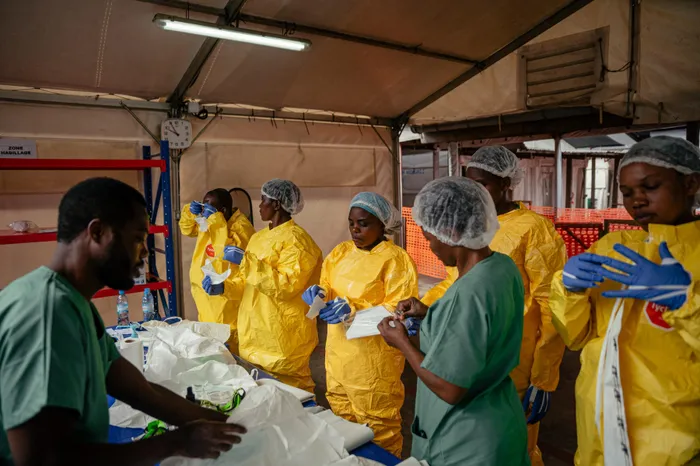
Health workers are hard at work in the DRC which is in the midst of an outbreak of Ebola.
Image: AFP
HEALTH workers battling war, fear and disease in the Democratic Republic of Congo (DRC) are receiving psychological support as they race to contain an Ebola outbreak.
Experts say ongoing conflict and insecurity are making it harder to track infections and reach vulnerable communities.
Médecins Sans Frontières (MSF) teams are working around the clock but have warned that the overall response has not yet caught up to the rapid spread of the epidemic.
Dr Jean-Gilbert Ndong, the medical coordinator for MSF in the DRC, says fear, mistrust, conflict and insecurity have added another layer to an already complex situation, making the outbreak harder to contain.
“All those factors are complicating our operations by restricting access to patients and the community. Ituri is known as an unsafe province due to ongoing military fights.”
Ndong told the Independent on Saturday this week that they were currently working in Ebola-affected areas such as Mongwalu, Bunia, Goma, Béni and Butembo.
“We are also ensuring continuity of care in our routine projects in Ituri, North and South Kivu. The support provided is access to care, medical care, community-based surveillance, construction (Goma and Mongwalu). We are also providing PPE.”
According to Ndong, they urgently need to increase testing capacity and establish points of care in affected areas.
In addition, they must strengthen non-Ebola healthcare services by providing free access to care in affected communities. It is also vital, he said, to demilitarise Ebola management.
MSF has provided psychological support to its teams, who are regularly debriefed as they race against the clock to contain the rare Bundibugyo strain of Ebola, for which no licensed vaccine is currently available.
“In earlier stages, the symptoms are headache, body pain, fever, stomach pain, and later run hemorrhagic signs, such as bloody diarrhoea, bloody vomiting, which led to death in 40% of cases,” said Ndong.
While the number of Ebola-related cases and deaths continues to rise, Ndong said that fear and conflict have complicated their operations by restricting access to patients and the community.
“Actually, it is difficult to assess the impact of Ebola on other illnesses. MSF is ensuring non-Ebola care (malaria, TB and HIV) in its projects and advocating for free access to care during this epidemic in the affected areas,” Ndong added.
MSF warned that outbreaks such as Ebola place enormous pressure on already strained health systems, making it difficult for patients suffering from other illnesses to access treatment.
It said maintaining essential health services remained a critical part of the response, particularly for vulnerable patients who rely on routine healthcare for chronic illnesses and maternal care.
Between 2014 and 2016, the West African Ebola epidemic claimed more than 11,300 lives, making it the deadliest outbreak of the disease on record.
“The reality today is that nobody knows the true scale and severity of this outbreak,” said Dr Alan Gonzalez, MSF’s deputy director of operations.
“New suspected cases are being reported daily, yet hundreds of samples remain untested,” he said.
He said the level of support being provided in Ebola-affected areas falls far short of what is needed.
“People urgently need a response that matches the scale of the crisis they are facing.”
“To bring the situation under even partial control, there must be an immediate expansion of testing capacity.”
Gonzalez said this must be accompanied by a rapid, coordinated and tailored scale-up of the overall response, supported by experienced medical and humanitarian organisations. There must also be guaranteed and sustained access to allow the swift entry of medical supplies and humanitarian staff into affected areas.
“This outbreak is unfolding in a context where medical needs are already acute, and we are now at real risk of a silent escalation of other critical health problems people face every day.
“So many health facilities are overwhelmed, and access to regular, non-Ebola care is affected while many people remain at home, too afraid to seek help,” Gonzalez said.
MSF warned that for the response to be successful it must be carried out in consultation with communities, including listening to concerns, addressing fear and misinformation, and building trust so that people feel safe seeking care.
Recently, the International Federation of Red Cross and Red Crescent Societies (IFRC) said it had scaled up its Ebola response efforts in the DRC, Uganda and neighbouring countries, and launched a CHF29 million regional emergency appeal.
Together with the DRC’s Red Cross Society, volunteers are helping families understand how Ebola spreads, countering misinformation and encouraging people to seek medical assistance immediately when symptoms appear.
The organisation said communities were also being educated about safe burial practices and infection prevention measures.
It said families had been advised not to touch or wash the bodies of suspected Ebola victims, as this remains one of the most common routes of transmission during outbreaks.
Health organisations have repeatedly stressed that early detection, rapid testing, community engagement and uninterrupted access to healthcare will be critical if the outbreak is to be brought under control.