
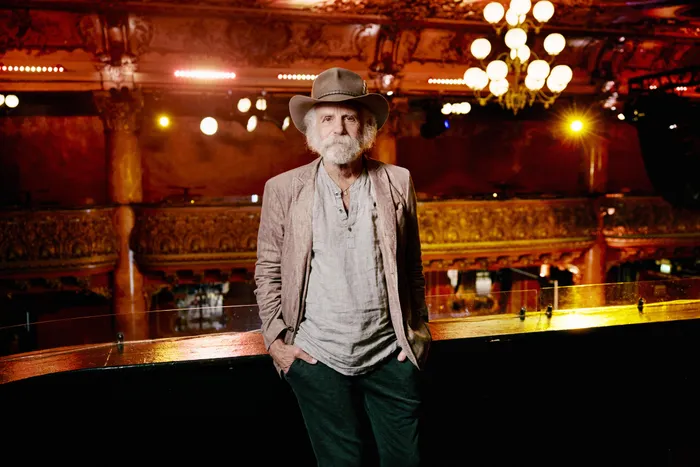
Bob Weir of the Grateful Dead is shown at the Great American Music Hall in San Francisco's Tenderloin district in October 2024.
Image: Jesse Dittmar for The Washington Post
Bob Weir, rhythm guitarist, vocalist and co-founder of the Grateful Dead, has died at 78, according to a family statement on his website Saturday. He “succumbed to underlying lung issues” after being diagnosed with cancer in July, it added. The statement did not say when he died.
“Bobby’s final months reflected the same spirit that defined his life. Diagnosed in July, he began treatment only weeks before returning to his hometown stage for a three-night celebration of 60 years of music at Golden Gate Park,” the statement said.
Weir, alongside bandmates Phil Lesh and Jerry Garcia, was one of the front three of the Grateful Dead quintet, formed in 1965.
Originally called the Warlocks, the band changed its name to the Grateful Dead after discovering another band with the same name. (The other Warlocks would later change their name to the Velvet Underground.) Weir was 17 at the time of the band’s formation and came to be known as “the kid”.
Weir co-wrote some of the songs that became fixtures of the band’s live performances, including The Other One, Sugar Magnolia, and Playing in the Band. Weir also worked closely with lyricist John Perry Barlow on hits such as Cassidy, Estimated Prophet and Throwing Stones.
Over three decades, between 1965 and 1995, the band explored every contour of fun, The Washington Post wrote last year when its members received Kennedy Center Honors. “Fusing rock and roll, folk, and jazz with avant-garde, visual, and literary traditions - and virtually inventing a new way to play music in the process - they became one of the most popular, enduring, and influential bands in American history,” the Kennedy Center noted in its appreciation of Weir, Lesh, Mickey Hart and Bill Kreutzmann.
“You pick your friends. You don’t pick your brothers,” Weir told The Post in an interview last year. “In this particular case, we were fated together. We blurred all those lines. We have a brotherhood, and we also have an abiding friendship.”
The 1960s are often remembered as a significant moment in American youth culture, and speaking to Rolling Stone this year, Weir said: “But back in the Sixties, there was a convergence of new factors in our cultural makeup. Rock & roll had emerged. Music was the code by which we communicated.”
In that decade, the Grateful Dead played a major role in music, hippie and drug culture in the United States. The band travelled and partied with author Ken Kesey and the Merry Pranksters, known for using the psychedelic drug LSD, as depicted in Tom Wolfe’s 1968 nonfiction book The Electric Kool-Aid Acid Test.
One of the constants of Grateful Dead stage-show recordings was Weir’s banter - calling intermissions, showing off his dry humour or issuing his familiar crowd instructions to “take a step back,” and then another. Even as Garcia was the band’s mystical figurehead, the affable Weir served as the band’s central conduit with fans, known as Deadheads.
He rejected the godlike reverence they projected onto Garcia. “I won’t have it,” Weir said in an interview with The Post in 2022. “The deification that those folks made of Jerry is basically what killed him,” he said. “It disgusted him, and rightly so.” Asked whether he had experienced that type of idolisation himself, he quashed the idea: “I’ve seen where that goes. That’s a lesson I learned the hard way, from losing a friend.” Garcia died at a drug-treatment centre in California in 1995 at the age of 53.
By the time of Garcia’s death, Weir had evolved from “the kid” into a central figure who would keep the Grateful Dead’s legacy and music alive. Along with pop and blues guitarist John Mayer, as well as original drummers Kreutzmann and Hart, Weir formed and led Dead & Company since 2015. Separately, Weir founded Wolf Bros in 2018, a quartet with keyboardist Jeff Chimenti, bassist/producer Don Was and drummer Jay Lane.
“He often spoke of a three-hundred-year legacy, determined to ensure the songbook would endure long after him,” his family said in the statement, adding that they hoped that dream would live on through future generations of Deadheads.
In his Rolling Stone interview last year, Weir reflected on death: “Every day, things change. I’ll say this: I look forward to dying. I tend to think of death as the last and best reward for a life well-lived.”
The Grateful Dead was inducted into the Rock & Roll Hall of Fame in 1994. The band received a Grammy Lifetime Achievement honor in 2007 and holds a world record for performing 2,318 concerts. In 2024, the band hit another milestone when it notched its 59th album to reach the Billboard Top 40.
Tributes for Weir poured in on social media from Deadheads and fellow musicians. Duane Betts, guitarist and son of Allman Brothers co-founder Dickey Betts, a longtime friend of Weir who died in 2024, described his death as a “huge loss” in an Instagram story. Singer-songwriter Maggie Rogers recalled Weir’s help early in her career. “This man … welcomed me into a spirit of making music that has everything to do with community and connection and soul, and always with a twinkling of perfect mischief at the edges,” she wrote in an Instagram post.
The Empire State Building was lit up in tie-dyed colors in tribute.
California Gov. Gavin Newsom (D) described Weir as a musician who helped create the soundtrack of a generation. “He was - and will always be - a king of psychedelic rock,” he wrote on X.
Weir is survived by his wife, Natascha, and daughters Monet and Chloe.