
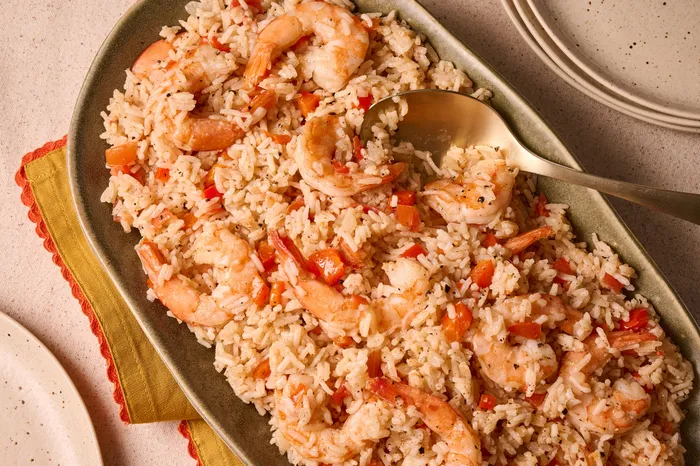
Shrimp Pilau.
Image: Lauren Bulbin/ The Washington Post; food styling by Lisa Cherkasky
Aaron Hutcherson
Southern food is a rich and varied cuisine, full of complexities that make it nearly impossible to confine to a single cookbook. But that is precisely the challenge culinary historian Michael W. Twitty took on in his latest cookbook, “Recipes From the American South.”
“The South is not the Confederacy,” Twitty told the audience while we were in conversation at a Washington bookstore in October. “How do you take a place that has been settled by human beings for 13,000 years and reduce it to four years of white supremacy rule?” There is no strict border separating distinct worlds in the United States. “There is no such thing as you leap over a border and all of a sudden everything’s different,” Twitty said. “There is no sweet tea line. There is no grits line.”
Although geographical boundaries can help to get a sense of the region, when it comes to looking at the scope of Southern food, as with the food of any region or culture, you need to take into account the movement of people. As people voluntarily and forcefully come and go, culinary knowledge and traditions move with them, mixing and mingling with whatever’s already present. “Like Southern culture, Southern food is a product of fortunate collisions, cooperation, and sometimes chaos or confusion,” Twitty writes in the book’s introduction.
Flipping through the pages of the cookbook challenges the assumptions we might have about what Southern food is. Yes, there’s the fried chicken, candied sweet potatoes and braised greens that might be front of mind, but Twitty’s tome also looks back to highlight and preserve the dishes that aren’t as ubiquitous today, such as turtle soup, chitterlings, rabbit stew, possum braised with sweet potatoes, and Lady Baltimore cake. But then there are also collard green empanadas, Sephardic pink rice, Chinese Mississippi collard greens and Moravian sugar cake.
“I wanted to make sure people recognize the Chinese South. Recognize the Jewish South. Recognize the Kurdish South. Recognize the Latino South. Recognize that, in fact, Indigenous people are still a very strong part of Southern culture,” Twitty said.
“Recipes From the American South” took nearly five years from concept to publication. Originally asked to help find a younger, lesser-known author for the behemoth of a book, Twitty eventually took on the task himself, with assistance from a number of Southern food experts.
Part of the challenge in selecting and developing the recipes, Twitty said, was considering the evolution of the taste of ingredients over time, as industrial farming began favoring yield over flavor. And of course there’s no singularly correct or authentic way to prepare dishes, especially those that have morphed through generations, despite what certain cooks might tell you. Southerners in particular can be very protective over their cuisine. “The food is our family,” Twitty said. “We give it nicknames,” such as hoppin’ John or limping Susan.
Twitty’s solution was to approximate as best one can what something is supposed to taste like, but also “the emotional feelings it should evoke,” he said. “There’s a lot of this, sort of like, letting go of the idea that if I don’t have this or that in the exact same way, it’s less authentic, or less important, or less true.”

Kitchen pepper is a colonial- and antebellum-era spice mixture that provides an extra layer of flavor and fragrance, which can be added to all sorts of soups, stews, vegetables and meat.
Image: Lauren Bulbin/ The Washington Post; food styling by Lisa Cherkasky
The cookbook features more than 260 recipes, including six different types of biscuits and, depending on your definition, nine or so cornbread and cornbread-adjacent recipes. “Why so many biscuit and cornbread recipes?” Twitty said. “Because that’s the staple.” One recipe that didn’t make the cut was Smith Island cake, the official dessert of Maryland, and there were a couple more that he said slipped his mind. “I forgot fried okra, y’all,” Twitty told the audience at the bookstore talk, which elicited an audible gasp from a member of the crowd. “That’s going to get me into some serious trouble with some people.”
The dish that caught my attention for sharing here with you was Shrimp Pilau - also known as shrimp rice, shrimp pee-law or shrimp perloo. It’s a type of rice pilaf from the Lowcountry, which primarily encompasses the coasts of South Carolina and Georgia. “Shrimp rice or shrimp pilau is one of the most popular dishes of the South, born of the collision between the colonizing French kitchen and the exiled cuisines of West and Central African peoples,” Twitty writes about the recipe. In addition to the two main ingredients, it includes tomato, bell pepper, onion and garlic.
But what really makes it a standout is a kitchen pepper spice blend. It’s a Colonial- and antebellum-era mixture that includes black, white and cayenne peppers alongside allspice, cinnamon, ginger, mace and nutmeg. It’s peppery and a little funky, has a slight kick, and is bursting with layers of warmth and fragrance - a fitting taste of the ever-changing American South.
Pilau is a classic rice pilaf from the Lowcountry, and this one features shrimp, tomato and bell pepper. “Shrimp rice or shrimp pilau is one of the most popular dishes of the South, born of the collision between the colonizing French kitchen and the exiled cuisines of West and Central African peoples,” Michael W. Twitty writes in “Recipes From the American South.” This version is seasoned with kitchen pepper, a Colonial- and antebellum-era spice mixture that adds an extra layer of flavor and fragrance, which can be added to all sorts of soups, stews, vegetables and meat. (It already contains cayenne pepper for a touch of heat, so omit the additional amount called for if you prefer less spice.)
Servings: 4 to 6
Total time: 45 mins
Storage: Store the kitchen pepper in an airtight container in a cool, dry spot for up to 6 months. Refrigerate the pilau for up to 2 days.
Ingredients
For the kitchen pepper
2 tablespoons freshly ground black pepper
1 tablespoon ground allspice
1 tablespoon ground cinnamon
1 tablespoon ground ginger
1 tablespoon ground mace
1 tablespoon ground nutmeg
1 tablespoon ground white pepper
1 teaspoon cayenne pepper
For the shrimp pilau
2 tablespoons vegetable oil or bacon fat, divided
1 medium yellow onion, finely chopped
1/2 teaspoon fine salt, divided, plus more as needed
2 garlic cloves, minced or finely grated
2 cups uncooked long-grain white rice, rinsed
3 cups chicken or shrimp stock or broth, preferably reduced-sodium or no-salt-added
1 medium red bell pepper, diced
1 medium tomato, diced
450g jumbo (21-25 count) or large (26-30 count) shrimp, peeled, deveined and, if desired, tails removed
1/4 teaspoon cayenne pepper (optional)
Freshly ground black pepper
Method
Make the kitchen pepper: In a small bowl, whisk together the black pepper, allspice, cinnamon, ginger, mace, nutmeg, white pepper and cayenne pepper until combined. You should have about 1/2 cup.
Make the pilau: In a medium (3-4 litre) saucepan over medium-high heat, heat 1 tablespoon of the oil until shimmering. Add the onion and 1/4 teaspoon of the salt, and cook, stirring occasionally, until starting to soften, 3 to 4 minutes. Add the garlic and cook, stirring occasionally, until fragrant, about 1 minute.
Add the rice and stir to combine. Add the stock and bring to a boil. Reduce heat so the stock is at a gentle simmer; cover; and cook, stirring once or twice, until the rice is tender and the liquid is absorbed, 10 to 15 minutes. Remove from the heat and let sit, covered, while you cook the shrimp.
In a large (30cm) skillet over medium-high heat, heat the remaining 1 tablespoon of oil until shimmering. Add the bell pepper and cook, stirring occasionally, until starting to soften, 2 to 3 minutes. Add the tomato and cook, stirring occasionally, until starting to break down, about 2 minutes. Add the shrimp, cayenne if using, 2 teaspoons of the kitchen pepper, and the remaining 1/4 teaspoon of salt, and cook, stirring occasionally, until the shrimp are opaque, 3 to 4 minutes. Remove from the heat.
Once the rice is cooked, fluff it gently with a fork. In a large bowl, stir together the rice and the shrimp mixture until combined. Taste, and season with more salt and black pepper, as desired. Serve hot.
Adapted from “Recipes From the American South” by Michael W. Twitty (Phaidon, 2025).