
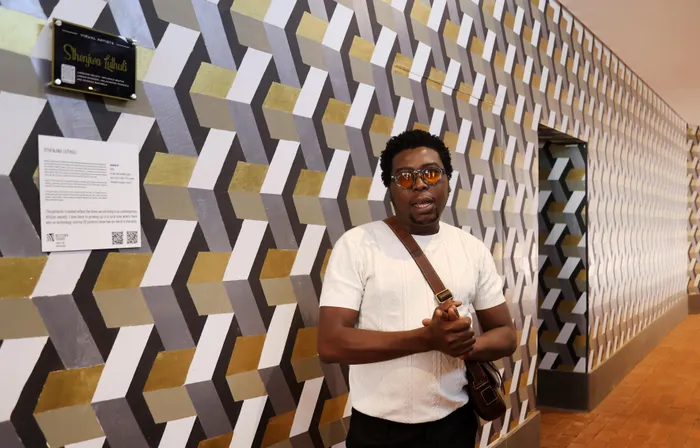
Artist Sthenjwa Luthuli in front of one of his dramatic geometric patterned murals.
Image: TUMI PAKKIES/Independent Newspapers
There are finely woven grass mats and staggering geometric murals. From graffiti galloping horses, to metal “butterflies” on the wall, to the moving words of South Africa’s poet laureate, the public art programme at the city’s newest shopping centre Westown Square is woven into the fabric of the precinct.
This week the Independent on Saturday had the opportunity to talk the artists behind the works.
Curated by Angela Shaw, a researcher, designer, and former Executive Director of the KwaZulu-Natal Society of Arts (KZNSA), the initiative shows how public art can do more than decorate a space. It can influence the atmosphere, guide visitors through an environment, celebrate local heritage and reflect the cultural stories of Shongweni and the wider region.
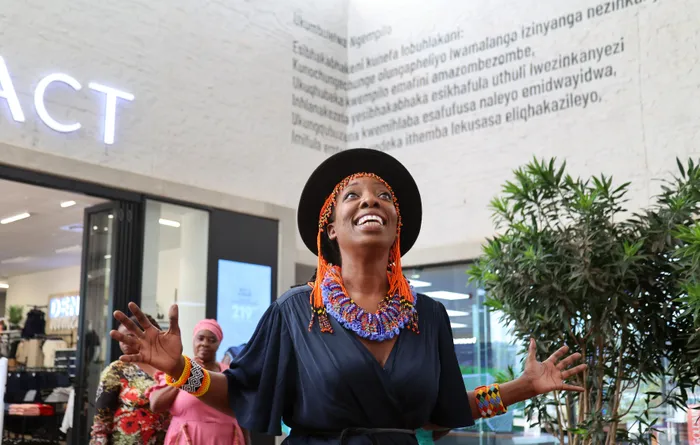
Mazisi Kunene's daughter Lamakhosi Kunene recites a poem that her father wrote near.
Image: Picture: TUMI PAKKIES/Independent Newspapers
“We wanted to focus on the artists we are so proud of, the big names, but also the artists that work right here and introduce them to the community,” said Shaw.
One of the most striking examples is Fan Palms by Xavier Clarisse, a polished stainless-steel installation that brings sculptural relief to the main square. Clarisse developed a lichen-inspired composition of steel elements, each mounted at angled intervals to create depth.
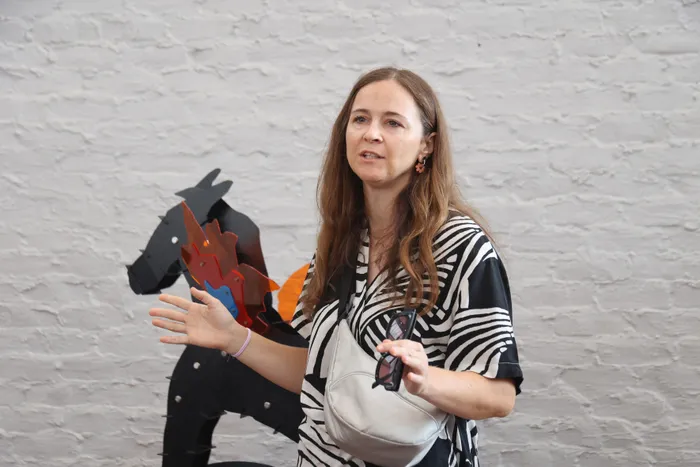
Artist Jessica Bothma explains her work Dark Horse.
Image: Picture: TUMI PAKKIES/Independent Newspapers
“The work becomes a living surface, reflecting shifts in conditions and echoing tree canopies, natural growth patterns and the surrounding valley landscape. It's a sculpture that can follow the mood of the day, the light, the sunshine and shadows.” Cross said.
“It’s decorative - and art can be decorative and hopefully when the ivy on the walls grows up it will add to the piece.”
Internationally acclaimed artist Sthenjwa Luthuli spoke of his four dramatic murals, whose distinctive abstract, op-art visual language references traditional Zulu patterns. Executed in water-based enamel paint, Luthuli’s murals were created with a team of established artists.
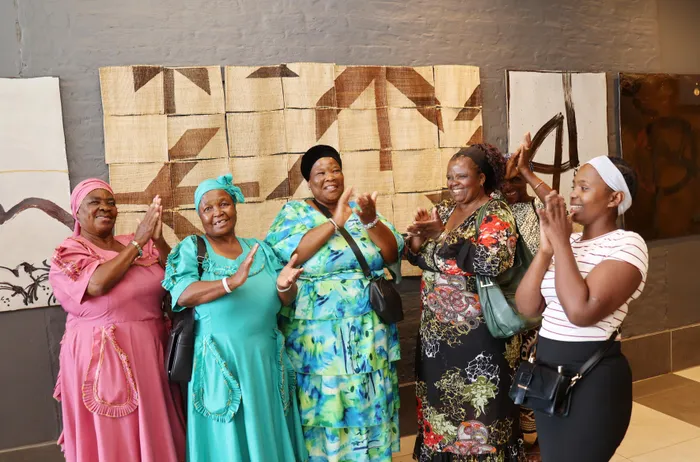
Numfundo Mkhize (far right) and the "gogos" of the Zuma, Mkhize and Mtungwa families who live in the Shongweni valley. A group have created this beautiful hand woven artwork.
Image: Picture: TUMI PAKKIES/Independent Newspapers
The Mariannhill artists enjoys working with patterns. “Normally I use patterns with human figures but these are just patterns. I use them to look at how us as human beings are being taught. I grew up as a person who couldn’t read or write. There was something different in me. I would think what am I capable of off?
“Patterns look at a system, at how it works. Patterns are how people think, how they use things. A teacher might be teaching us 1 plus 1 and we’re all taught the same thing - it’s so boxing. I’m posing different questions. As human beings need to be inspired by what surrounds us. We need to explore ourselves as much as we can. I started as a person who wanted to find myself when I dropped out of school in grade nine. I wanted to be a pilot but couldn’t make it. Instead I explored art in all its forms.”
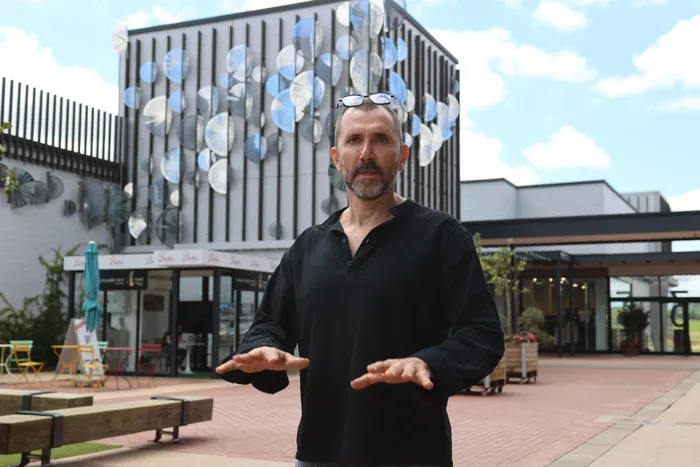
Artist Xavier Clarisse explaining his artwork Fan Palms.
Image: TUMI PAKKIES/Independent
Then there is the work of Ntshongweni Valley residents - master ceramicist Andrew Walford and the Zuma, Mkhize and Mtungwa families who work in isithebe weaving. Together they produced a series of wall tiles combining Walford’s ceramic works with an isithebe grass mat collage.
A sculptural presence is created by two works by Jessica Bothma, Dark Horse I & II. The artist is currently exhibiting at the KZNSA Gallery.
Bothma says the inspiration for her sculptures was a look at masculinity. “Men win wars on horseback. We measure power by horse power. I played with the idea of masculinity and power with toy horses. I try to offer some criticism but also balance things with joy and colour and playfulness.
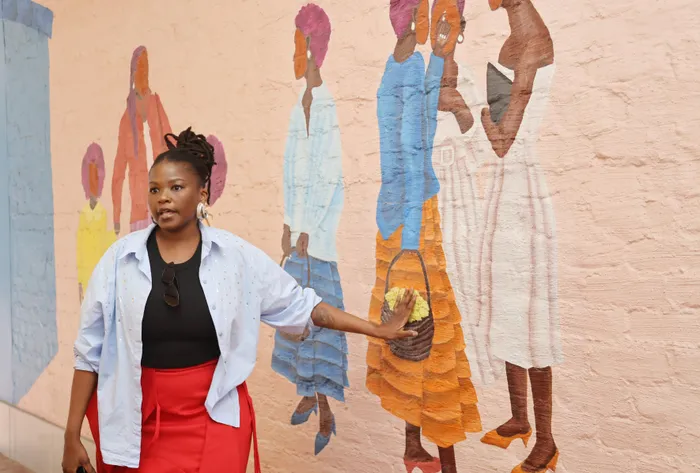
Artist Selloane Moeti talks about her mural which explores different cultural traditions coming together.
Image: Picture: TUMI PAKKIES/Independent Newspapers
“South Africa is also a dark horse as a nation. We’re constantly undervalued and then we surprise everyone. So it's a play on joy, trauma, possibility and chaos - everything we know as South Africans.”
Shaw also incorporated literary heritage through Mazisi Kunene’s seminal poem Ukumbulelwa Ngempilo / A Vision of Life (1979), which she described as "one of the most moving poems I have read”. Displayed in both isiZulu and English, the text introduces a contemplative layer to the precinct and recognises the intellectual and cultural legacy of Kunene as South Africa’s first Poet Laureate.
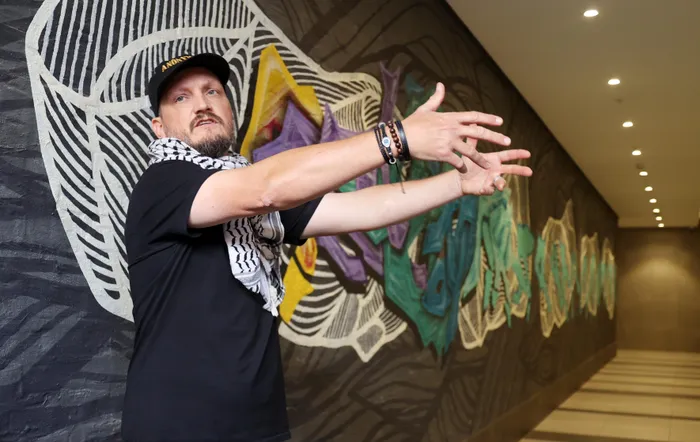
Multi-disciplinary artist Iain “Ewok” Robinson gallops through his Motion Murals inspired by early twentieth-century stop-frame animation of galloping horses.
Image: TUMI PAKKIES/Independent Newspapers
Artist Selloane Moeti contributed a large-scale mural Umbondo awenziwa, executed in water-based enamel paint combined with ibomvu (red clay). The work is a conversation about intercultural weddings, where two families stand at the threshold of a union. Each arrives carrying rituals, histories, and customs of their own. The painting holds the tension and beauty of this moment, the search for harmony between difference, and the weaving of traditions into a new beginning.
Multi-disciplinary artist Iain “Ewok” Robinson created his Motion Murals with aerosol spray paint. They appear in narrow passages leading to ablutions on Level 3. Robinson’s brief was to create imagery that would appear to be “in motion” as visitors walked past the walls. Drawing on early twentieth-century stop-frame animation of galloping horses, he developed a sequence of equine-inspired forms – referencing both the equestrian heritage of the area and the cinematic origins of motion studies.
In addition, Robinson created a series of 11 playful Peek-a-Boo interventions integrated into unexpected points across the public space – surprising moments that encourage curiosity, exploration and delight.
“You’re on your own mission, shopping, and suddenly you might stumble across one. I try to create these little moments that if you’re not looking for them you won’t see them,” he says.