
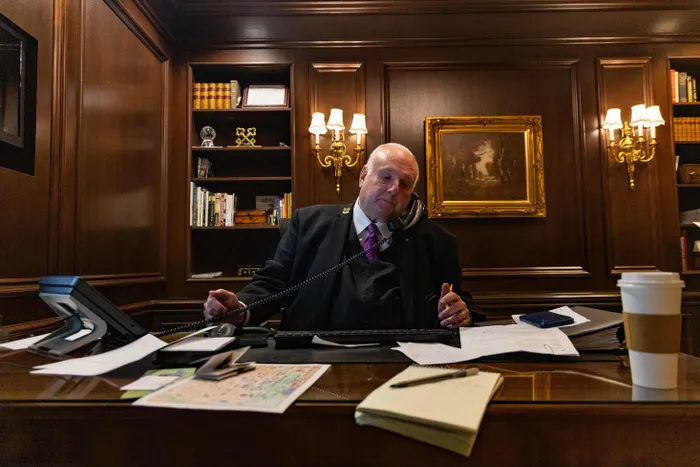
Robert Watson in his office at the Willard.
Image: Hanna Leka for The Washington Post
Andrea Sachs
For more than half a century, Robert Watson, one of the world’s most illustrious concierges, has been saying yes to hotel guests.
He said yes to Joe Walsh, the Eagles guitarist who requested matches to smoke in his room at the InterContinental London - this was Europe circa 1977, after all. Yes to the Indian bride who wanted to borrow an elephant for her grand entrance at a London hotel ballroom. Yes to the traveling mom who needed to ship breast milk home to her baby. And, most recently, yes to the Washington, D.C., visitor who wished to dine at Old Ebbitt Grill on a fully booked night. With one phone call, the chef (French for “chief”) concierge at Willard InterContinental reserved a table for 7:30 p.m.
“I don’t think there’s anything more satisfying than being able to solve somebody’s problem or to surprise and delight a guest,” said Watson, who has spent more than three-quarters of his 67 years working as a concierge. “We can do anything as long as it’s legal and moral, so that gives us a big spectrum of what we can do from A to zed.”
Watson, widely considered to be one of the longest-serving concierges in the world, has worked at the Willard since 2006 and has rarely met a question he couldn’t answer or a request he couldn’t fulfill. Since the age of 16, he has been assisting guests with issues big and small, simple and complicated, momentous and trifling. He has guided two turkeys, who stayed in splendor at the Willard, to the White House for their Thanksgiving pardoning.
“We work hard and we play hard,” said Watson, whose résumé features hotels in four countries on three continents, “and we experience things that some people never do.”
The times haven’t always been easy for Watson, the son of British parents who was born in Uruguay, spent his early teens in Costa Rica and now resides in Virginia. Over five decades in hospitality, seismic events have rattled and reshaped his industry, including economic downturns, wars, cultural upheavals, a global pandemic and technological advances that have turned guests into self-appointed concierges.
But through it all, he has never wavered from his singular purpose: “Concierge desk, this is Robert. How may I help you?”
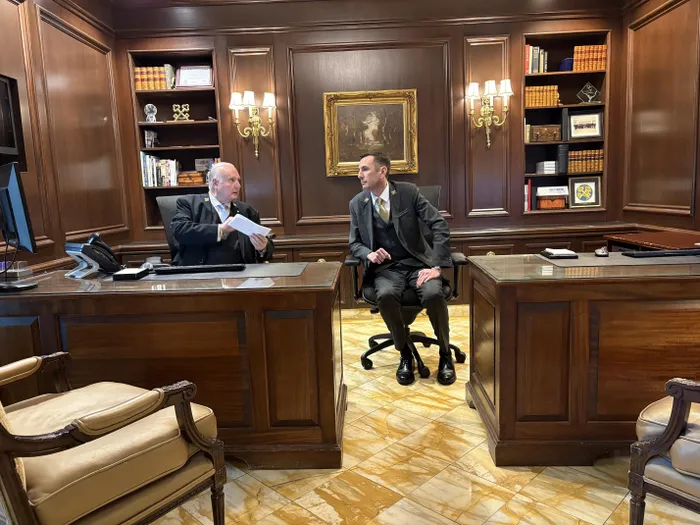
Watson and his No. 2, Matt Ziegler.
Image: Andrea Sachs/ The Washington Post
Watson presides from a stately office adjacent to the Willard’s opulent lobby, his large oak desk framed by a marble archway topped with gold letters that spell out “Concierge.” He sits within sotto voce of Matt Ziegler, his No. 2 since 2022.
The pair of concierges - down from seven in 2006, when Watson started, and four in 2019 - work five days a week, solo on light days and in tandem during busier times. Watson typically covers the first shift, from 7 a.m. to about 3 p.m. Ziegler, a 46-year-old father of four who is also the hotel’s kids concierge, takes over until about 9 p.m.
Their hours are fluid, however. If a guest requires, say, an after-hours seamstress or a private helicopter for the following morning, they stay.
“When the hotel is the busiest, we can often be at our slowest,” said Ziegler, referring to planned-to-the-minute conventions, “and the exact opposite is true when we’re at 25 percent, because every single one of those people are leisure, which amounts to 75 rooms, all utilizing us.”
The concierges receive requests every which way. Guests drop by, text, email and call, or dispatch their emissaries to inquire on their behalf.
On a recent Monday morning, Watson, impeccably dressed in a dark three-piece suit with a silk royal purple tie, was reviewing email messages in the concierge account when a guest popped his head through the doorway. He needed a loaner umbrella; Watson directed him to the bellhop.
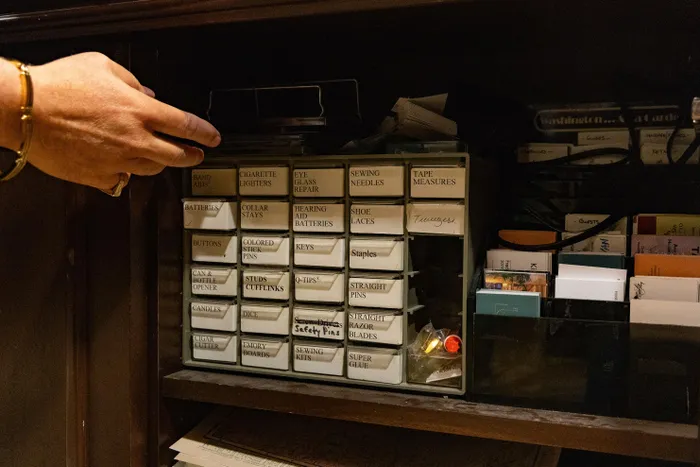
Watson’s “emporium” of emergency items for guests.
Image: Hanna Leka for The Washington Post
The phone trilled. A guest in the middle of a blowout was so dismayed by the stylist, she wanted to leave immediately, mid-coif. Watson patched her in to a reputable salon that could finish the job.
Many problems, he said, are quick fixes.
In the 1980s, a London guest ripped his black shoelace right before departing for the airport. Watson, in a pinch, dipped into his personal stash of emergency supplies. The rescue operation inspired the creation of the “emporium,” a first-aid kit for jet-setters that he has carried with him from London to Johannesburg and Cape Town, to Luxembourg, back to London and finally Washington.
At the Willard, the emporium resides inside a drawer in the wall-sized cabinet behind Watson’s desk. The case contains shoelaces, cufflinks and studs, dice, straight razor blades, cigarette lighters, hearing aid batteries, a tape measure, safety pins, cigar cutters, collar stays and bandages, because “Washington is made for walking” - and blisters. A separate box holds ties - standard and bowed, striped and plain - and suspenders. Another is stocked with chargers and cables.
“You never know what the next question will be or the next request,” Watson said. “You just have to be prepared and savvy.”
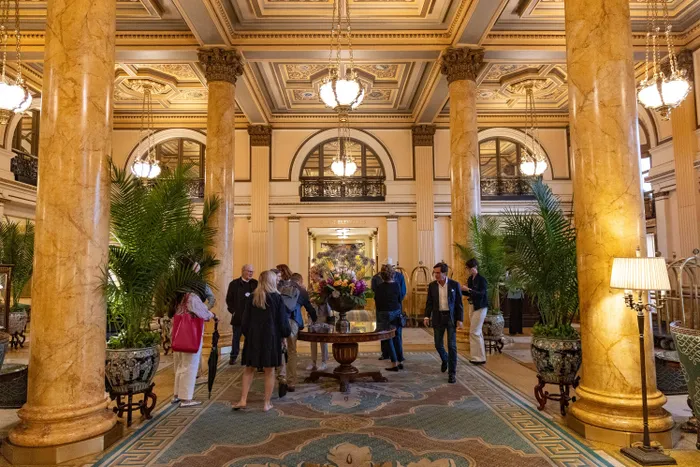
The lobby of the Willard, where Watson has worked since 2006.
Image: Hanna Leka for The Washington Post
Watson didn’t choose his career path. His father did.
When he was a teen, loafing around his family’s London house after graduating from high school in 1975, his father arranged a job for him as a page at the new InterContinental London.
Back then, most communications and bookings were conveyed by phone or paper. So, a young Watson would race around the city picking up plane tickets from airline counters, sending telegrams and receiving telefaxes for guests.
These days, with technology at his fingertips, Watson rarely has to venture far from his domain. He, like his guests, utilizes the most current research tools, such as Google and artificial intelligence. However, he also relies on some relics from past hotel concierges, such as paper city maps (marked up with his Golden Jubilee pen), and printouts of the Willard Concierges’ “In the Know” restaurant guide, plus local expertise burnished over time.
“The internet and Google make our job easier,” said Watson, who once dismissed the fax machine as a gimmick. “But they haven’t replaced us, and they will never replace us. Guests will still come to us for our opinion.”
Watson knows famous folks, such as Stevie Nicks, members of Eric Clapton’s touring band and Ivanka Trump, who, he said, did not try to recruit him for her father’s hotel in the Old Post Office building in D.C. She just wanted interior designing tips.
In his world, however, the most important people are the ones who can move mountains for his guests - general managers at coveted restaurants, private tour guides with access to exclusive attractions, insiders who can secure limited tickets to museums.
Watson keeps a little black book of contacts in his desk drawer and, on his cellphone, the numbers of his close-knit network of experts, which includes tailors, barbers, florists and private plane operators. When he rings them up to ask for “a favor,” he announces himself as “Robert from the Willard.” No further identification is required.
“That personal connection becomes even more of a luxury now in this world of AI,” said Markus Platzer, general manager of the Willard. “People do pay money for that human connection.”
For the second day in a row, guest Deowattie Persaud and her travel companion dropped by the concierge desk for advice. The day before, they had asked about the walking distance to the Smithsonian’s National Air and Space Museum. Of the multiple responses they received - one from a guy outside the Willard, the other from Google Maps - only Watson’s was correct. The walk took 25 minutes, not 7 or 40 minutes.
“He was very helpful, very welcoming and very knowledgeable,” said Persaud, who was visiting from Miami. “And, of course, he was right.”
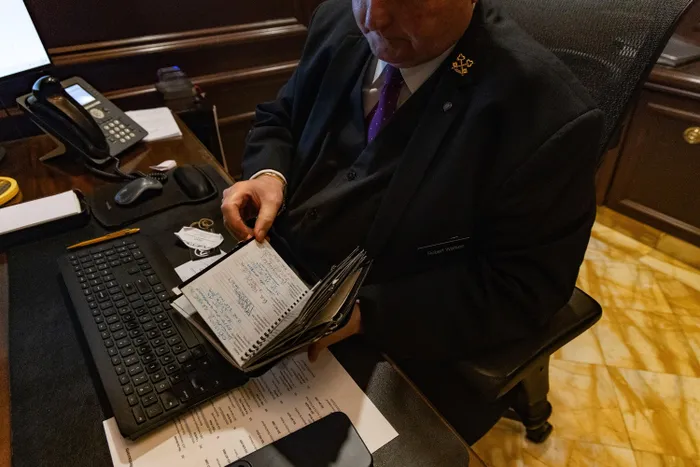
One of Watson’s secret weapons: a notebook of contacts throughout DC.
Image: Hanna Leka for The Washington Post
Watson has paused his career only once - a three-month furlough during the height of the coronavirus pandemic. Hundreds of other concierges were less fortunate.
During the global health crisis, Les Clefs d’Or (or “the Golden Keys”), the international association of concierges founded in France in 1929, watched its membership numbers plummet from more than 4,000 in 2019 to 2,788 in 2021. The U.S. chapter, the largest of the 52 divisions, lost about a third of its members. Roughly 700 jobs were eliminated.
“When the pandemic happened, the concierge teams were usually the first to be let go,” said Leigh Anne Dolecki, president of Les Clefs d’Or USA and chef concierge at Meadowood Napa Valley in California. “The concierge desks were removed and they weren’t invited back. So now, the majority of the members’ presence in the United States is at the really high-end luxury hotels.”
To stay aloft in the upper echelons of hospitality, where highly personalized service can distinguish the five stars from the four, luxury properties must staff a dedicated concierge desk. All the loftier if they can fill the position with a Les Clefs d’Or concierge, who must pass a rigorous application process to join the prestigious club.
“It’s a very protracted process to become a member,” Dolecki said. “You have to have two sponsors and take an exam. We do colleague checking.”
Watson wears his Les Clefs like a medal of valor, the pair of crossed gold keys gleaming on the lapels of his suit jacket.
“It’s my bling,” said Watson, who served as the federation’s international president from 2009 to 2011.
The keys also played a central role in the love story of Watson and another Les Clefs d’Or USA concierge in New York City. The pair connected over an English aristocrat who was relocating from a hotel in London to one in Manhattan. Their business relationship bloomed into romance. Watson proposed marriage with a tiny gold key inlaid with two diamonds. Paula Brooks, of course, said yes.
By late afternoon, the rain clouds that had caused a run on the Willard’s loaner umbrellas cleared. Sunbeams streamed through the glass windows, bathing the lobby in honeyed light.
Watson was finishing up his shift, which ran several hours longer than usual. On a scale of slow to hectic, he was busy.
He had secured dinner reservations at Old Ebbitt Grill and the Occidental, and directed a number of packages, many laden with liquor, to the rooms of their recipients. He helped several drop-ins, including a woman searching for a wine shop and a toy store, and a couple hoping to squeeze in a tour of the U.S. Capitol before their afternoon flight.
He had also received a number of calls and emails from guests with reservations months out, asking about the best place to watch the Independence Day fireworks (by the Jefferson Memorial, he said, even better than the Willard’s courtyard terrace) and a recommendation for flowers for a 55th anniversary celebration later in the summer.
“I am getting calls for Christmas and March 2027,” said Watson, who treats every request with a sense of urgency.
Before shutting down his computer, he checked the progress of the chauffeured SUV he had ordered for a guest arriving by private plane. The tiny car icon was inching its way toward the Willard.
As his final act of the day, he placed a sign on his desk, informing guests that the concierges had stepped away and directed them to the front desk for assistance.
“The shop is now closed,” Watson said, as he slipped on his overcoat.
The next day he’d be back, Les Clefs d’Or insignia pinned proudly to his lapels, ready with the question he has been asking for most his life. “How may I help you?”