
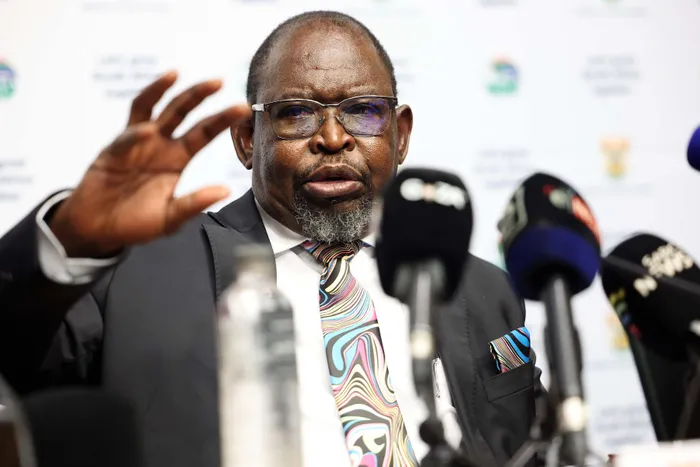
Finance Minister Treasury said the loan is aimed at supporting infrastructure reforms aimed at boosting economic growth, improving service delivery and addressing high unemployment.
Image: GCIS
The government has secured a $150 million (around R2.47 billion) development policy loan from the OPEC Fund for International Development (OPEC Fund), the National Treasury announced on Wednesday.
The OPEC Fund, a multilateral development finance institution, provides financing to developing countries for projects and programmes aimed at economic and social development.
Treasury said the loan is aimed at supporting infrastructure reforms aimed at boosting economic growth, improving service delivery and addressing high unemployment.
The agreement marks the first loan partnership between South Africa and the OPEC Fund, signalling growing international support for the country’s reform efforts as it seeks to modernise infrastructure and strengthen economic resilience.
Treasury described the deal as an important step in helping the country tackle persistent economic challenges, including sluggish growth and rising joblessness.
According to Treasury, the funding will back the government’s ongoing structural reform programme focused on removing infrastructure bottlenecks, particularly in the energy and freight transport sectors. These sectors have been identified as critical to improving economic efficiency, enabling investment and creating jobs.
“The loan will support Government’s ongoing reform programme aimed at unlocking infrastructure bottlenecks, particularly in the energy and freight transport sectors, which are critical for enabling inclusive economic growth, improving service delivery and fostering job creation,” Treasury said.
South Africa has been pursuing a series of reforms in the electricity, logistics and transport sectors in recent years as it seeks to revive economic activity after years of weak growth, rolling power cuts and inefficiencies in freight rail and ports.
Business groups and economists have repeatedly warned that infrastructure constraints continue to weigh heavily on investment and exports.
Treasury said the financing arrangement was aligned with the government’s broader funding strategy, which aims to diversify funding sources while reducing pressure on debt servicing costs.
The loan carries a six-year maturity period, including a two-year grace period, with an interest rate linked to the six-month Secured Overnight Financing Rate (SOFR) plus 1.25%. Treasury said the terms were favourable compared with conventional market borrowing.
“The financing terms of the loan are aligned with the National Treasury’s financing strategy, which seeks to diversify funding sources, secure cost effective financing and minimise increases in debt service costs,” the department said.
The announcement comes at a time when the government is under pressure to stabilise public finances while simultaneously investing in infrastructure needed to support economic recovery and long-term growth.
South Africa remains one of Africa’s three largest sovereign borrowers, alongside Egypt and Morocco, largely due to its relatively advanced financial system and long-standing access to capital markets.
Though Treasury has managed to maintain the main budget primary surplus, the country’s debt is projected to rise in nominal terms from R6.12 trillion in 2025/26 to R6.94trln in 2028/29.
The 2026 Budget Review projects the debt-to-GDP ratio peaking at 78.9% in 2025/26, slightly above prior estimates due to weaker nominal growth and higher borrowing. However, debt-service costs as a share of revenue are expected to fall to 20.2% by 2028/29.
The International Monetary Fund (IMF) recently recommended that South Africa adopt clearer fiscal rules and a credible debt target to stabilise its public finances and restore investor confidence.
According to the IMF, restoring fiscal credibility and placing debt on a sustained downward path would help rebuild fiscal buffers, reduce borrowing costs and create conditions for stronger economic growth.
Meanwhile, Treasury welcomed the new partnership with the OPEC Fund, saying it appreciated the institution’s support for South Africa’s development agenda and infrastructure reform programme.
BUSINESS REPORT