
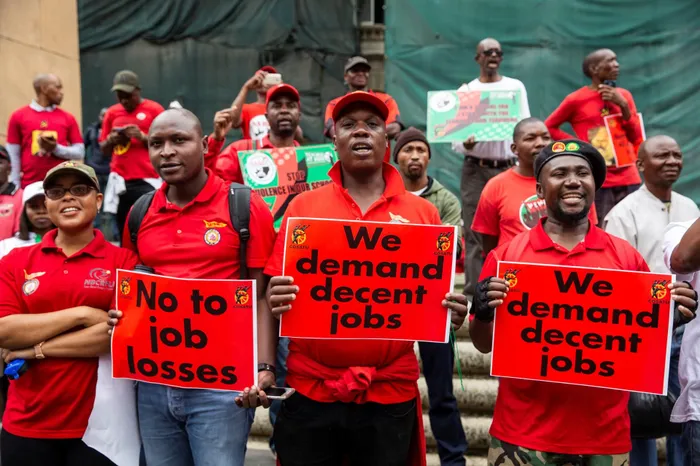
South African workers face a grim reality of unemployment and poverty. Cosatu advocates for a balanced approach to migration, urging for both management and a rejection of xenophobia to protect the working class.
Image: AFP
South African workers are hurting.
We wake up every day to the same story: no jobs, no hope, no safety. In this climate, migration has become a flashpoint.
The Congress of South African Trade Unions (COSATU) believes we need two things at once: honest management of migration, and a total rejection of xenophobia. We cannot choose one and ignore the other. Both are about protecting the working class.
Let’s be blunt about where we stand. Unemployment is at 43.7%. For young people, it is over 60%. That means 12 million people are locked out of the economy. Two out of three young workers have never had a job.
Poverty scars our townships and rural areas. Inequality remains the highest in the world. A worker in Alexandra earns in a year what a CEO in Sandton earns before lunch.
Public resources are stretched to breaking point. Our hospitals have queues out the door. Our schools have broken toilets and 80 learners per class.
RDP housing lists are many years long. There is simply not enough to meet every need. When budgets are tight, we must spend every Rand to protect South Africans first. That is not hatred. It is responsibility.
At the same time, crime is out of control. Workers are hijacked going to work. Spaza shops are robbed daily. Our sisters and daughters are not safe walking home. Communities are angry, and that anger is real. But anger without a plan helps no one.
Migration is not new. It is as old as humanity. People have always moved to find food, safety and work. South Africa was built on migration.
For more than 100 years, men from Lesotho, Mozambique, Eswatini, Zimbabwe, Malawi and Zambia came to work in our mines. They lived in hostels. They died in rockfalls. Their wages built the mining industry. Their families back home survived on those remittances.
We must also remember that many of our borders are artificial. Colonial rulers drew lines on maps in Berlin in 1884. They split families, nations and trade routes. The Limpopo River is not a wall between enemies. It is a bridge between neighbours.
We appreciate the support we received from our neighbours during the liberation struggle. When apartheid jailed our leaders and banned our organisations, the Frontline States sheltered us. Mozambique paid for hosting the ANC with South African raids that killed civilians and destroyed the economy. Angola was invaded repeatedly. Botswana and Lesotho were raided. Their people bled for our freedom. South Africa honours that sacrifice. But hospitality cannot mean a free-for-all.
The past decade saw a massive rise in migration to South Africa. We understand why. People are fleeing failed states, economic collapse, and violence. When your government cannot provide jobs, electricity or human rights, you move. No one leaves home because it is easy. They leave because staying means starving.
But let us be honest: the scale is no longer sustainable. Our clinics in Musina are overwhelmed. Our township are overcrowded.
Our job market cannot absorb millions of new entrants when we cannot employ our own. South Africa has an obligation to prioritise its citizens, especially the youth, for scarce jobs and resources. That is what every government in the world does.
All countries are battling unmanaged migration, from the United States to Germany to Brazil. South Africa is not unique. But if we do not manage this crisis, it will explode. History has shown us that when people feel abandoned, xenophobic violence follows. We have seen it before. We condemn it without reservation. Attacking a fellow African creates no jobs. It does not build a single house.
Cosatu is a federation of the working class. Our members are South African and migrant. Our enemy is unemployment. Our enemy are those who steal. Our enemy is the employer who replaces permanent jobs with undocumented labour.
We need managed migration. We need borders and laws that are enforced. And we need to reject xenophobia.
Let us unite workers, not divide them. South Africa will not be built on hatred. It will be built on jobs, justice and solidarity.
Solly Phetoe is the General Secretary of Cosatu.

Solly Phetoe is the general secretary of Cosatu.
Image: Doctor Ngcobo / Independent Newspapers.
Follow Business Report on Facebook, X and on LinkedIn for the latest Business and tech news.