
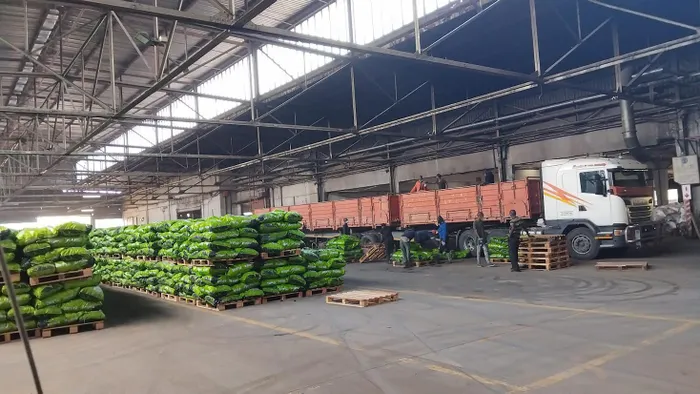
South Africa’s first fully operational intermodal freight village in the small KZN town of Estcourt is not only actively addressing the inefficiencies and congestion along SA's busiest road freight corridor between Durban and Gauteng but is about to expand into a multi-billion-rand operation
Image: Supplied
The small town of Estcourt in KwaZulu-Natal has made headlines with the unveiling of the country’s first fully operational intermodal freight village.
This innovative facility is not just an essential part of addressing the ongoing inefficiencies and congestion along South Africa’s busiest freight corridor between Durban and Gauteng, but it is also gearing up for a multi-billion-rand expansion that could reshape the logistics landscape and bolster the competitiveness of local manufacturers.
Wessel Jacobs, CEO of EIT Group, explained that the freight village draws inspiration from similar successful initiatives in Eastern Europe. It comprises a multi-mode logistics centre, providing an extensive range of transport, logistics, and value-add supply chain services for national and international cargo.
Currently focused on containerised cargo, future plans include the integration of bulk commodities, enhancing its capacity and utility further.
As part of the government’s economic recovery strategy, the expanded freight village promises to create jobs and promote growth in the region.
Chief Financial Officer Manka Sebastian stated, “Cutting transport costs by up to 50% to South Africa’s main port will elevate the competitiveness of our local manufacturers significantly.”
The ambitious plan aims to make local businesses more robust against international competition by reducing logistics costs, an area where African nations currently struggle compared to their global counterparts.
The statistics are telling: transport contributes a staggering 45% to Africa's import costs and 35% to export costs, drastically overshadowing figures from Europe and Asia.
Manka Sebastian elaborated, “If we improve logistics efficiency by 30 to 50%, we can counteract the punitive tariffs imposed by the Trump administration.”

Wessel Jacobs, Manka Sebastian and Siya Mncube
Image: Supplied
Strategically located at the former Masonite board manufacturing site, the intermodal freight village benefits from proximity to vital transport corridors, specifically along the N3 and rail junction.
It is situated 567km from Gauteng’s Transnet City Deep container terminal and only 176km from the main rail terminal at Durban, facilitating smoother, quicker transport pathways for freight movements.
Currently, about 7,000 trucks ply the N3 daily, moving an astonishing 27.5 million tons of freight annually. However, road transport accounts for over 85% of all freight movements in South Africa, with rail lagging behind at less than 14%.
The EIT Freight Village aims to redress this imbalance by enabling the transfer of goods from road to rail at Estcourt, optimising the journey to Durban and vice versa for imports.
Jacobs pointed out the problematic nature of the small stretch of freight transport, characterised by steep inclines and skyrocketing fuel costs which drastically contribute to the logistical challenges.
“By bypassing this section that accounts for up to 50% of costs, we can alleviate road congestion and reduce delays at the port,” he asserted.
Furthermore, the cost of warehousing and infrastructure in Estcourt represents a fraction of pricier options in larger cities, making it an attractive proposition for logistics players.
Jacobs noted that the former Masonite location was an optimal choice due to its existing but newly refurbished rail link. The first phase of the project reached operational status in March 2024, marking a successful proof-of-concept.
Looking ahead, Jacobs confirmed plans for further expansion of the freight village, including the enlargement of the existing terminal to 60,000 square metres and the establishment of a second terminal on a 500-hectare site across the rail line.
The ambition is to allocate specific terminals for clean and dirty cargo to streamline operations.
In the initial stages, EIT successfully ran its first test train in November 2023, securing three weekly slots with Transnet Freight Rail to transport goods efficiently to Durban, with aspirations for increasing this frequency to three trains daily.
"To date, we are yet to miss a single vessel at the port,” Jacobs confirmed, exemplifying the project’s reliability and potential for seamless logistic solutions.
IOL