
Men are more likely to be married in their old age than women.
Image: Pixabay
Women in South Africa continue to outlive men, and the gap means older women are far more likely to be widowed, while older men are more likely to remain married.
Statistics South Africa’s Marginalised Groups Series VIII – Healthy Ageing in South Africa, 2024 shows the country’s older population has grown rapidly over the past two decades, while also becoming increasingly female.
“South Africa’s ageing population is increasing steadily, bringing both opportunities and challenges for ensuring that people age well,” said Statistics South Africa.
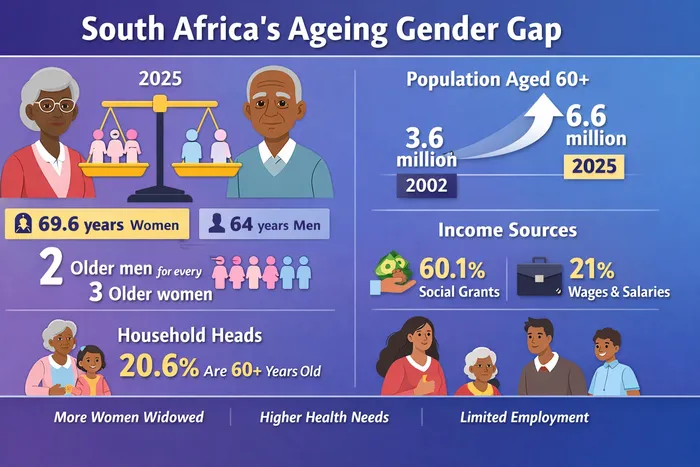
The number of South Africans aged 60 years and older rose by about three million people to 6.6 million. Within that group, women significantly outnumber men.
In 2025 there were about two older men for every three older women, with 65 men for every 100 women aged 60 and older. The gap has widened slightly since 2002, when there were 67 older men for every 100 women.
The imbalance is largely driven by life expectancy and improvements in overall living conditions. Women in South Africa live to an average of 69.6 years, compared with 64 years for men.
The demographic shift also shapes the broader concept of healthy ageing, defined as developing and maintaining the functional abilities that enable well-being in older age.
Statistics South Africa unpacks data on older South Africans.
Image: ChatGPT
Household patterns reflect some of these gender differences.
The proportion of households headed by older people increased from 19.3% in 2002 to 20.6% in 2024, highlighting the role older South Africans continue to play within families and communities.
More than half of households headed by older people are extended households, meaning they include relatives beyond the immediate family such as adult children or grandchildren. Nationally, 31.7% of households fall into this category.
Older women are more likely to live in extended households or alone. Older men, by contrast, are more likely to live with a spouse in either nuclear households or extended family arrangements.
Households headed by older women also tend to have more children relative to older people, suggesting many older women continue to carry caregiving responsibilities within families.
Health needs remain a central issue for this growing population group.
Chronic illnesses such as high blood pressure, diabetes and arthritis are among the most commonly reported conditions among older South Africans, with hypertension a leading cause of death.
Public healthcare facilities remain the main point of access. The proportion of older people relying on public hospitals and clinics rose from 60.2% in 2002 to 68.5% in 2024.
Medical aid coverage increased slightly over the same period, rising from 19.1% in 2002 to 21.9% in 2024, although disparities remain across population groups and provinces.
Many households headed by older people rely heavily on social support. In 2024, grants were the main source of income for 60.1% of these households, followed by salaries, wages or commission at 21%.
Employment among older South Africans remains limited, although older men are more likely to be employed than older women.
Living conditions improved significantly over the past two decades. The proportion of older people living in formal housing rose from 75.8% in 2002 to 91.3% in 2024, while residence in informal dwellings declined across provinces.
Access to services also expanded sharply. Internet access among older South Africans increased from 22.6% in 2009 to 86.6% in 2024, alongside improvements in electricity and sanitation access.
Despite these gains, the report notes that challenges remain, including uneven healthcare access, limited medical aid coverage, low labour market participation and continued economic vulnerability among older people.
IOL BUSINESS