
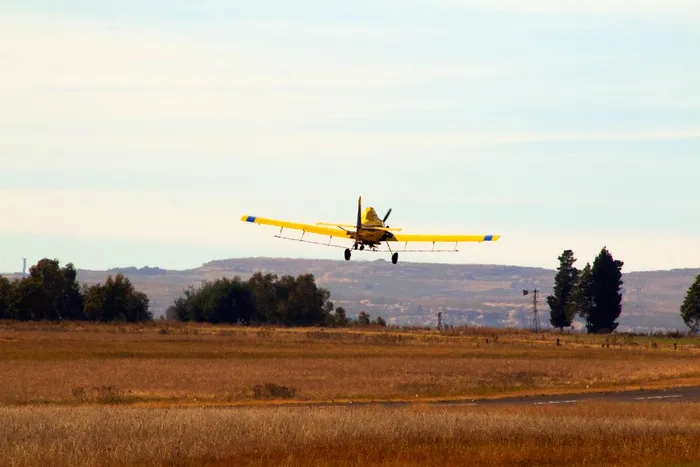
South Africa imports roughly 80% of its annual fertiliser requirements and global fertiliser price dynamics matter significantly.
Image: Nicola Mawson | IOL
South African farmers are facing rising input costs and growing operational pressure as geopolitical tensions in the Middle East disrupt global energy and shipping markets.
The impact is already filtering through to the agricultural sector, with higher diesel prices, tightening fertiliser supply and increasing strain on export logistics, said BDO South Africa.
“South Africa’s agricultural sector is uniquely exposed to global shocks,” says Sanele Nkosi, Head of Agriculture at BDO South Africa. “Farmers rely heavily on imported inputs such as fertilisers, fuel and machinery, while selling into globally priced markets.”
Since February, instability around key shipping routes near the Strait of Hormuz has pushed up fuel and freight costs, creating a compounding effect across the value chain, BDO noted.
BDO pointed out that the most immediate pressure has come from diesel, raising costs across planting, irrigation, harvesting and transport.
As it stands, and assuming there is no last-minute government intervention, month-end data from the Central Energy Fund is pointing to petrol price increases of between R5.31 for 93 Unleaded and R5.82 for 95 Unleaded.
“Diesel is the lifeblood of commercial farming,” Nkosi says. “When costs rise, especially alongside currency pressure, the impact compounds quickly.”
South Africa’s dependence on imported fuel, much of it sourced from Gulf countries, is amplifying the effect as shipping risks and insurance costs increase, said BDO.
Fertiliser costs are also climbing at a critical time. South Africa imports most of its fertiliser from countries including Saudi Arabia, Qatar, Oman, Russia and China. Disruptions to shipping routes are driving up prices just as farmers enter a key procurement window ahead of the next planting season, BDO explained.
“Fertiliser can account for up to 50% of input costs in grain production,” Nkosi said. “If supply becomes unstable, farmers may reduce application, switch crops or plant less.”
Any reduction in fertiliser use is likely to affect yields and, in turn, food prices, said BDO.
UN Trade and Development points to several fertiliser cost drivers, which include the geopolitical disruption and Urea prices that have spiked by as much as 29% in the past month.
“Although some forecasts suggested a slight softening in 2026, current volatility indicates prices are remaining well above pre-crisis levels, keeping input costs elevated for farmers,” said UN Trade and Development.
It adds that fertiliser costs are rising faster than crop revenues, putting immense pressure on farm profitability and potentially limiting fertiliser application.
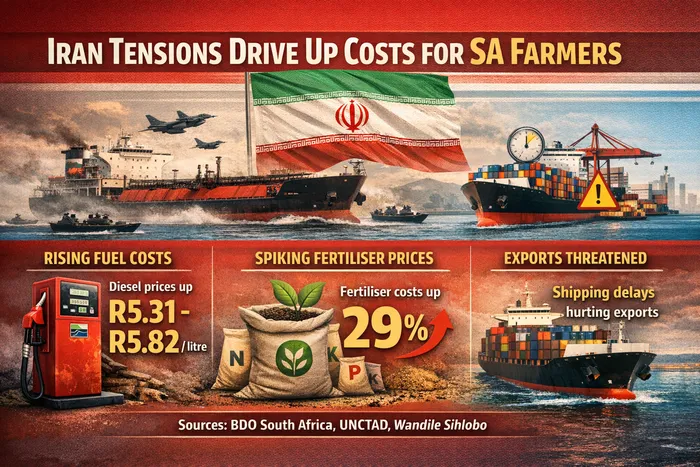
A snapshot of increases that affect food prices.
Image: ChatGPT
Even ahead of the war in the middle of last year, Wandile Sihlobo, chief economist at the Agricultural Business Chamber of South Africa and Presidential Envoy on Agriculture and Land, said fertiliser prices were high.
“The current levels were significantly above pre-pandemic levels, indicating that farmers continued to face elevated input costs even as the prices were far below the elevated levels seen in 2022/23 following the start of Russia’s invasion of Ukraine, continued COVID-19 supply chain issues, and restrictions on Chinese exports,” Sihlobo added.
In February, the World Bank noted that fertiliser prices jumped by 18% in 2025.
Sihlobo also noted that South Africa imports roughly 80% of its annual fertiliser requirements, and therefore, these global fertiliser price dynamics matter significantly.
More recently, Sihlobo said the rise in fertiliser prices is concerning and is placing immense pressure on South African farmers. But the idea that higher fertiliser prices will lead to immediate higher food prices now is misplaced.
“Farmers can’t pass costs directly to consumers. They unfortunately can only manage them by reducing plantings. But this is not the case. The food products we have on shelves and will have for months were planted months ago. We have plenty of supplies in South Africa.”
Export logistics are coming under similar strain. South Africa’s citrus, wine and fresh produce industries depend on reliable shipping, but delays and rising freight costs are increasing the risk of losses, said BDO.
“Fresh produce exports rely on timing and reliability,” Nkosi said. “A delay at port can translate directly into financial loss.”
BDO explained that the disruption is particularly significant given that some of South Africa’s fastest-growing export markets are in the Middle East.
Grain producers are most exposed to rising input costs, while export-oriented horticulture faces logistics risks. Irrigated regions are under pressure from higher energy costs, said BDO.
BDO added that, if disruptions ease within the next few months, costs may stabilise. But prolonged instability could entrench higher input costs, compress margins and force weaker producers out of the market, experts note.
IOL BUSINESS