
Statistics South Africa has changed the way it counts unemployment, which lifts the lid on millions who fall between the cracks of traditional definitions.
Image: File
South Africa’s unemployment rate dipped to 31.9% in the third quarter of 2025. But Statistics South Africa says the story is now bigger than that headline number.
From this quarter, Statistics South Africa has changed the way it measures the world of work – and it says the new approach gives “a more complete picture of people’s connection to the labour market”.
“These updates are based on new recommendations from the International Conference of Labour Statisticians,” said Statistics South Africa.
The biggest shift is that the old category called Not Economically Active is gone. It has been replaced by “Outside of the Labour Force”.
Inside this, Statistics South Africa has created a new group: the “Potential Labour Force”.
These are “people who want to work but are either not actively looking for a job or not currently available to start work as well as the discouraged jobseekers”.
Statistics South Africa said this change matters because it lifts the lid on millions who fall between the cracks of traditional definitions.
At the same time, the new classifications arrive in an economy where informal work plays a far larger role than headline unemployment numbers can capture.
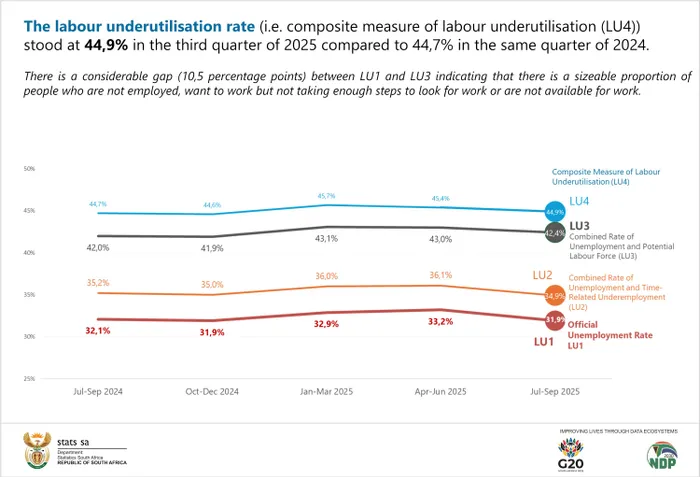
Statistics South Africa's new labour definitions.
Image: Statistics South Africa
South Africa’s township economy is estimated to be worth between R900 billion and R1 trillion a year. Informal retail – especially spaza shops – forms the backbone of this economy and is a major source of income and employment.
The informal economy contributes substantially to the economy. Spaza shops alone account for about 5.2% to growth domestic product and employ around 2.6 million people.
Other growing township sectors include fast food, transport, tourism, housing and digital services.
Against this backdrop, Statistics South Africa has also updated the definitions of the informal sector and informal employment to align with international standards.
The agency cautioned that “figures for these categories in the third quarter of 2025 should not be compared with earlier estimates, since they are now measured differently”.
Statistics South Africa said the changes ensure South Africa’s labour data remains “credible, relevant and internationally comparable”.
To show the new reality, Statistics South Africa now reports four Labour Underutilisation measures: LU1 to LU4.
This then means that the unemployment rates are:
Statistics South Africa said there were “13.3 million underutilised persons” in the third quarter, including “8 million unemployed, 4.5 million in the potential labour force, and 747 000 in time-related underemployment”.
Statistics South Africa said LU3 is “conceptually similar to the expanded unemployment rate but slightly broader”.
The gap between LU1 and LU3 of 10.5 percentage points shows how many South Africans “want to work but are not actively looking for work”.
Women and young people feel the pressure most. Statistics South Africa said the gap for men was 9 percentage points, compared with 11.8 percentage points for women.
Among youth, the situation is stark. Their official unemployment rate was 58.5%, while LU3 climbed to 69.3%.
Statistics South Africa said the new measures “offer a broader and more realistic understanding of South Africa’s labour market”.
The agency added that aligning the figures to international standards keeps the data “a reliable foundation for analysis, planning and informed public debate”.
IOL BUSINESS