
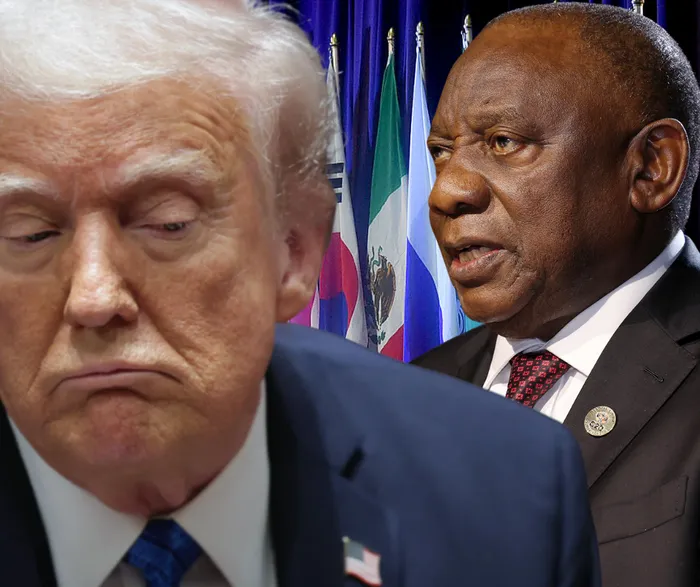
Strained relations between Washington and Pretoria could have significant economic implications.
Image: IOL Graphics
It’s no secret that relations between South Africa and the United States are frosty at present. In fact, that’s putting it mildly.
Following Donald Trump’s snubbing of the 2025 G20 Summit in Johannesburg, the US President has barred South Africa from attending the 2026 G20 in Miami and has also halted all US aid to the country.
Behind this are misinformed accusations of a white genocide and controversial land reform policies, but South Africa’s alignment with US adversaries such as Russia, China and Iran is believed to be another major point of consternation.
According to Freddie Mitchell, chief economist at Aluma Capital, the economic implications of this strained relationship are not yet fully visible and could only emerge within the next 12 to 24 months.
“The current landscape may appear stable, but much like the delayed effects of interest rate changes on economic activity, so too will the ramifications of these political decisions reveal themselves in time,” Mitchell said.
Amid these tensions, South Africa is unlikely to receive any kind of significant reprieve from the infamous 30% “Liberation Day tariffs” that were announced earlier this year.
Although the US administration has announced a temporary reprieve for a handful of SA products, particularly agricultural goods such as oranges and macadamia nuts, the 30% tariffs remain in place for most other exports. Exports of the East London-built Mercedes C-Class, for instance, are said to have dropped by around 70% since the tariffs were imposed.
According to Nedbank, the economic impact will be far more brutal than the loss of duty-free access to the US, through the AGOA policy that has now lapsed.
"These tariffs will force industries to recalculate their export strategies, and many South African industry sectors, notably agriculture and automotive, might find exporting to the US no longer economically viable. This, in turn, would trigger further major job losses," Nedbank said.
Some sources suggest around 30,000 jobs could be at immediate risk as a result of the tariffs.
In response to the abovementioned challenges, South Africa’s government has taken steps to diversify its export avenues by targeting 27 other countries.
“It is evident that while the Johannesburg summit aspired towards a more inclusive global governance (with an emphasis on themes relevant to the Global South), the US’s withdrawal from collaborative discourse indicates an unsettling fracturing within multilateral dynamics,” Mitchell said.
The Johannesburg Declaration, which embodies commitments to global financial reform and sustainability, poses a direct challenge to US hegemony and ideals, he added.
This means South Africa stands at a critical crossroads, where it must decide whether to remain within the G20 framework or carve out new paths in international trade networks.
“The need for diversified partnerships has never been more pronounced, as the country navigates a geopolitical landscape laden with tension and uncertainty,” Mitchell said.
“While the immediate effects of the growing rift may be contained, the spectre of a diminished relationship with the US looms large, demanding that South Africa adapt to both domestic pressures and international perceptions.
“The coming months will reveal the true cost of this diplomatic chill, as South Africa embarks on its “Plan B” in an increasingly complex global arena.”
Political analyst Zakhlele Ndlovu fears that Trump’s latest moves will sabotage South Africa’s economy and said there was a risk of an “investment strike” from US companies.
“South Africa is a lightweight but acts as if it is a heavyweight. As long as the ANC remains in power, there's no chance of reconciliation and resetting of strained relations. The ANC is punching above its weight,” Ndlovu said.
However, Avocate Sipho Mantula, a researcher at the Thabo Mbeki School of Public Affairs, believes the BRICS countries and the Global South need to rise to the occasion, take space in the global arena and re-draw the rules of engagement.
IOL Business