

More than a million children are the victim of violence in schools.
Image: Wesley Fryer | Wikimedia Commons
Millions of South African children experience violence and bullying at school, a problem researchers have linked to poorer academic performance, lower school participation and reduced educational attainment.
The issue is particularly relevant during Youth Month, as educational achievement remains one of the strongest predictors of employment prospects in a country where millions of young people remain unemployed.
Marking Child Protection Week, Statistics South Africa’s latest data shows the extent of violence affecting children in schools. Drawing on information from the General Household Survey, it said that 1.15 million learners aged five years and older experienced some form of violence at school in 2024.
While the proportion of learners experiencing corporal punishment has declined over the past 14 years, violence remains widespread.
Statistics South Africa found that incidents involving teachers were significantly higher than those involving fellow learners, with 156,229 learners reporting physical violence involving teachers compared with 87,059 reporting physical violence involving other learners.
About 14% of learners who experienced violence reported physical violence from teachers, while roughly 8% reported physical violence from fellow learners.
The survey found that younger learners were particularly vulnerable. Children aged between five and eight reported higher levels of violence, with the incidence peaking at 20.6% among seven-year-olds and again at 19.5% among 13-year-olds.
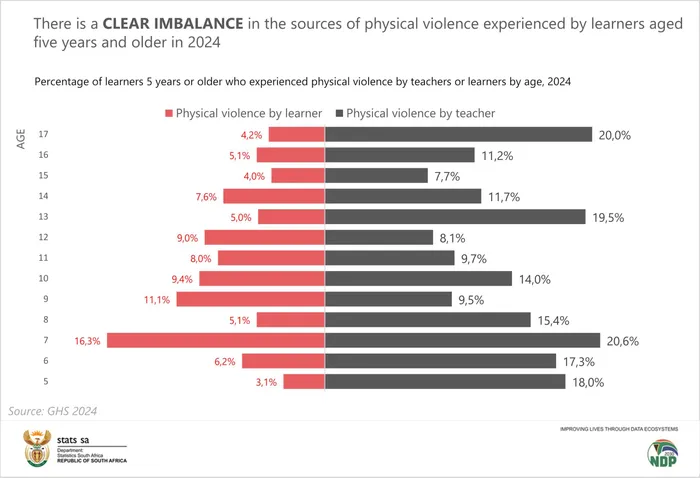
Learners experience violence by teachers, Statistics South Africa research finds.
Image: Statistics South Africa
Peer-perpetrated violence was most common among seven-year-olds, where 16.3% reported experiencing it.
Verbal abuse was more frequently linked to fellow learners than teachers. Twenty-one percent of affected learners identified peers as the source of verbal abuse, compared with 12% who reported similar experiences involving teachers.
Girls were disproportionately affected by several forms of violence. Females accounted for about 63% of reported verbal abuse incidents involving teachers and roughly 58% of physical violence cases involving teachers. In cases of peer-related verbal violence, girls represented 56.2% of affected learners.
The level of bullying in schools had an adverse impact on educational outcomes, according to researchers.
The Institute for Security Studies said around one in 10 high school learners skips school to avoid bullying, while many victims experience depression, anxiety and social withdrawal.
A study published in the South African Journal of Childhood Education found an association between bullying experiences and numeracy achievement, with learners who reported being bullied tending to perform worse in numeracy assessments than their peers.
Researchers noted that learners who experience bullying may avoid school or disengage from classroom activities, both of which can affect academic performance.
International research has reached similar conclusions. The American Psychological Association found that children exposed to chronic bullying recorded lower academic achievement, greater dislike of school and less confidence in their academic abilities.
At the same time, research published through the National Library of Medicine has also linked bullying victimisation to lower academic grades, reduced educational motivation, weaker school participation and difficulties concentrating on schoolwork.
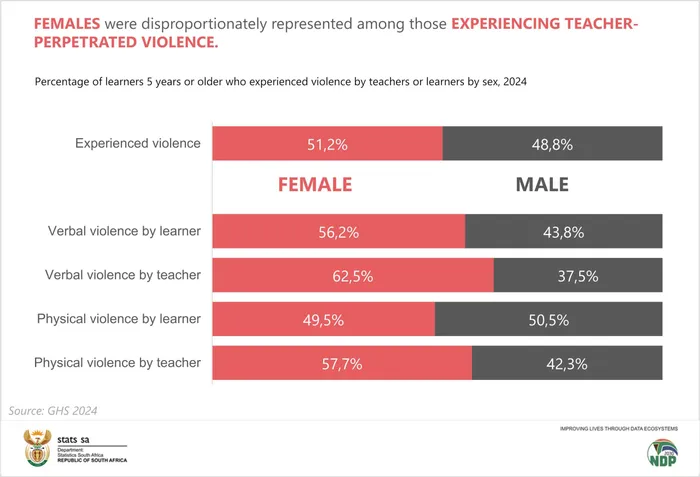
More girl children than males experience violence in schools.
Image: Statistics South Africa
Statistics South Africa's labour market data continues to show stronger employment outcomes among graduates than among people with lower levels of educational attainment.
Those without a matric qualification face the steepest uphill climb, with the highest unemployment rate across all education levels. For those who complete matric, the situation improves marginally, though the unemployment rate remains high.
Youth who obtain vocational or technical training fare somewhat better, with the unemployment rate reduced to around a third, Statistics South Africa’s data shows.
The clearest advantage is seen among university graduates, whose unemployment rate drops significantly to less than a quarter, which Statistics South Africa says illustrates “the protective effect of higher education in a tight labour market”.
Statistics South Africa's latest labour market data shows that 4.7 million people aged between 15 and 34 were unemployed in the first quarter of 2026, while a further 10.6 million were outside the labour force altogether.
Young people aged 15-34 who are employed remain concentrated in service-related industries and low to semi-skilled occupations. These industries include trade, which accounts for nearly one in four jobs, followed by community and social services and finance.
In terms of occupations, elementary occupations accounted for the largest share of youth employment, followed by sales and services occupations and clerks. By contrast, relatively fewer young people were employed in higher-skilled occupations such as managers, professionals and technicians, the agency said.
More than four in ten young people aged 15 to 34 were not in employment, education or training. Among those aged 15 to 24, the unemployment rate was at almost two thirds, while unemployment among those aged 25 to 34 reached more than 40%.
IOL BUSINESS