
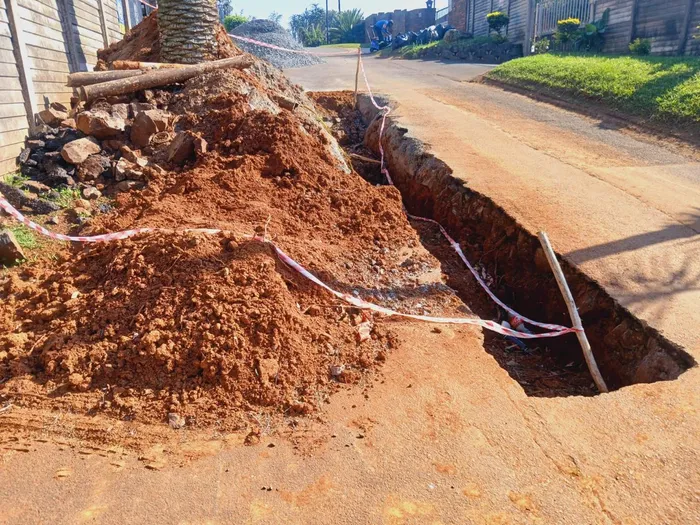
EThekwini Municipality residents recently expressed frustration over the city's incomplete repairs, with dug-up roads left unattended, thereby causing further disruption to daily life.
Image: Supplied
The local elections taking place in 2026 could go a long way towards boosting consumer confidence, particularly in Gauteng, which has seen its housing market come under pressure due to the ongoing failure of service delivery.
Positive macro-economic indicators
This is also true for most of the other housing markets in South Africa outside the Western Cape, says Dr Andrew Golding, chief executive of the Pam Golding Property group.
“2026 looks like it will continue to offer good prospects in the property market, as interest rates continue to decline, SA’s GDP and revenue collections continue to increase, which, all taken together, provide for a stable and encouraging outlook for 2026.”
2026 LGE elections
Last month, the Electoral Commission of South Africa (IEC) said it is all systems go for the Local Government Elections 2026/7.
Last month, deputy chief electoral officer Masego Shiburi said the Commission is encouraged by the number of South Africans who have acted on the call to register and update their details through various convenient platforms ahead of the upcoming local government general elections in 2026/2027.
The government is yet to announce the election date.
The property group says the increasingly positive macro-economic indicators serve to further boost market confidence in general, with spin-offs in turn for favourable sentiment and increased activity in the housing market.
With the recent interest rate reduction-with further cuts anticipated by mid-2026, and supported by a new 3% inflation target indicating greater price stability, increased affordability for home loan seekers and a stronger lending appetite by the banks, together with South Africa’s removal from the FATF Grey List and, notably, S&P’s first credit rating upgrade in 20 years, 2025 draws to a distinctly more buoyant close, says Golding.
“By lowering the inflation target to 3%, the Reserve Bank aims to anchor inflation expectations more firmly, thereby creating scope for further interest rate cuts (possibly 75bps) according to the latest forecasts. This will reduce home loan costs, stimulate demand and enhance banks’ willingness to lend.”
The property group says, for example, in certain suburbs in Johannesburg, they are seeing a shortage of stock which has not been experienced for a long time.
It says Cape Town’s continued outperformance reflects ongoing demand and an intensifying shortage of supply, despite ongoing development.
Demand for residential property in Cape Town is being reinforced by ongoing, albeit slower, semigration and brisk investment demand. According to StatsSA, the Western Cape accounts for 44.3% of building plans passed for 2025 to date, well ahead of Gauteng at 27.6%.
Encouragingly, from an investor and homeowner perspective, the national recovery in house prices is evident across all three major regional housing markets, with the Western Cape, which led the recovery, continuing to register the strongest growth in prices, Golding says.
Coastal vs non-coastal HPI
The growth in coastal house prices appears to have slowed, peaking at +5.7% during the past three months. Meanwhile, non-coastal HPI continues to gather momentum, rising to +3.9% in October this year.
As a result, the coastal price premium narrowed to +1.8% last month. Lightstone defines coastal properties as those located within 500 metres of the coastline.
Notwithstanding that, first-time buyers continue to prefer freehold homes, the percentage of sectional title homes purchased is increasing as a percentage of total sales.
A greater percentage of female first-time buyers opt for a sectional title home, possibly because it is more affordable, requires less maintenance, and is generally more secure. However, when a first-time buyer is purchasing an investment property, a sectional title home is the preferred choice.
Among metro housing markets, Cape Town was the first to recover. While it remains the primary engine of the recovery, Tshwane is also making a solid contribution, and the recovery has now spread to all metro markets.
Year-to-date, Cape Town continues to outperform other major metro housing markets in terms of HPI by a wide margin, while two of Gauteng’s three metro markets – Johannesburg and Ekurhuleni - continue to lag.
Within Gauteng, house price inflation (HPI) in Tshwane continues to outperform relative to the two other metro housing markets. Prices are strengthening in all three coastal metro markets.
While national volumes have not fully recovered to pre-2008 levels, the Western Cape has registered a recovery in sales volumes based on a 2008 benchmark. While most positive changes are from this province, Limpopo has also shown gains.
The graph below highlights the significant outperformance of the Western Cape market in terms of sales volume. While already evident that this region is outperforming in terms of price, it is also clear that the influx of semigrants is indeed significantly impacting activity too.
Female buyers
Over the past decade, women have emerged as dominant players in South Africa’s residential property landscape, accounting for nearly 60% of ownership either independently or jointly.
Notably, female first-time buyers now outnumber males, with 53% purchasing solo in 2025 compared to 46.3% in 2015 (ooba Home Loans). This shift is said to reflect broader socio-economic trends: women’s average gross income has grown by 76.3% over the past 10 years, enabling more independent purchases.
However, female income has remained lower than male income by a fairly consistent margin over the past decade. Many are entering the market younger, prioritising security, affordability, and lifestyle integration - from gated communities and energy-efficient homes to proximity to schools and work.
In regions like KwaZulu-Natal and the Eastern Cape, women lead first-time ownership gains at 57.7% and 56.2% of 2025 mortgage applications, respectively, according to ooba Home Loans.
Buyers are getting older as a result of a deterioration in affordability, as pressure on household finances squeezes the ability to save for a deposit, etc.
The current global environment, which is characterised by unusually elevated levels of uncertainty, which is resulting in a high degree of uncertainty in financial markets in general and interest rates in particular, is also weighing on sentiment.
Investment buyers
According to ooba Home Loans, the demand for investment / buy-to-rent properties ticked higher in October this year, rising to 13.2% of all applications. Investment demand remains elevated in the Western Cape, at 35.8% of applications in Oct’25 and remained steady at 13% in Tshwane.
2026 outlook
Overall, Golding says, while the market is stabilising and showing pockets of vibrancy, a sustained recovery will depend on broader economic improvements, policy certainty and continued financial sector support.