
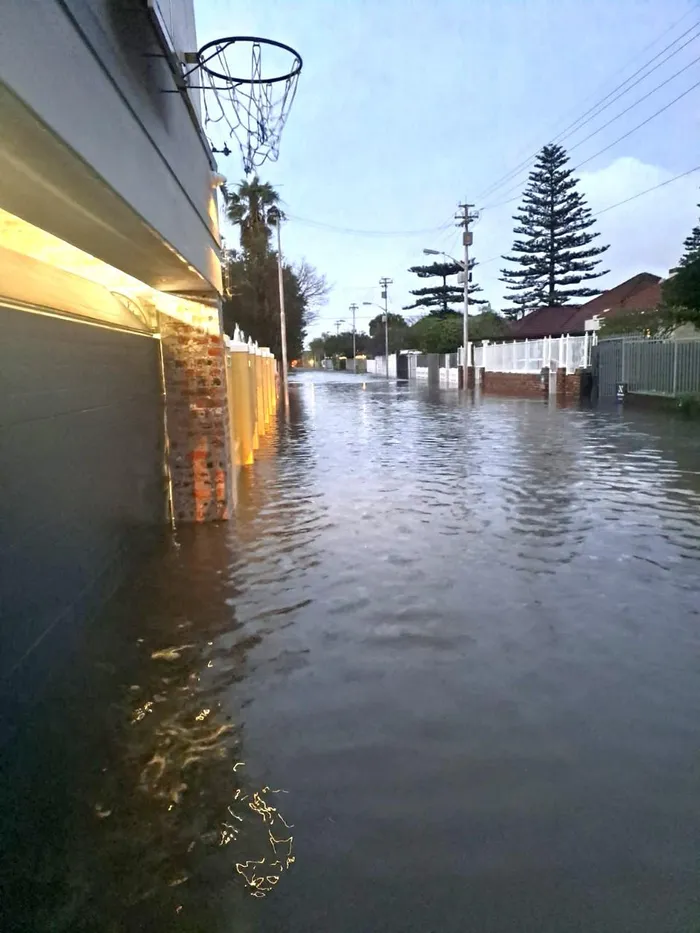
Tynemouth Road in Plumstead completed recently flooded after a big storm in the city.
Image: Supplied
A property's ability to withstand extreme weather is becoming a critical factor in its long-term value and insurability.
This indicates that a profound shift is underway in the high-value real estate market, as savvy developers and discerning buyers increasingly prioritise climate resilience alongside traditional markers of luxury.
“We’re seeing a fundamental change in buyer psychology, especially at the top end of the market,” says Nancy Massing, managing director of Lew Geffen Sotheby’s International Realty in Noordhoek.
"High-net-worth individuals are no longer just asking about the view or the square meterage. They’re asking, ‘Will this home be insurable in 15 years, and how will it perform in a heatwave or a severe storm?’. They are looking for legacy assets, and a vulnerable property doesn’t fit that bill."
On Thursday, December 18, the South African Weather Services (SAWS) predicted that it will be a wet holiday season due to the La Niña effect, which is expected to influence rainfall and temperature patterns across the country.
The global property market is already feeling the financial impact of climate volatility.
According to a 2023 report from "McKinsey & Company", the value of at-risk residential property in coastal cities globally could exceed $1 trillion by 2050.
This is no longer a distant threat, but a present-day reality influencing buying decisions and risk assessments.
This awakening is driven by tangible economic pressures. In coastal areas from Miami to Cape Town, rising sea levels and storm surges have led to skyrocketing insurance premiums.
In wildfire-prone regions like California and the Western Cape, properties without adequate defensible space and fire-resistant materials are facing similar financial headwinds, with some insurers even pulling out of high-risk markets entirely.
Features defining future-proof homes
In response, a new era of climate-resilient design is emerging, moving beyond mere sustainability to focus on survivability and autonomy.
Architects and forward-thinking developers are embedding resilience into the DNA of new luxury builds.
Key features now moving into the mainstream include:
Elevated foundations and flood mitigation: In flood-prone zones, homes are being elevated well above mandatory codes. "In new developments along the Cape Peninsula, we’re seeing elevated foundations become a major selling point, directly addressing concerns about future storm surges and flash floods," notes Massing.
Fire-resistant materials and buffer zones: In response to the growing wildfire risk, properties are incorporating non-combustible cladding and automated exterior sprinkler systems. Landscaping is also being strategically designed to create defensible space.
Passive cooling for a hotter future: As heatwaves become more frequent and intense, passive cooling design is crucial. Features like high thermal mass walls, strategic orientation for cross-ventilation, and deep overhangs are valued for keeping homes comfortable without over-reliance on vulnerable air conditioning systems.
Self-sufficient infrastructure: The most sought-after resilient homes function as self-sufficient ecosystems. “There's a growing demand for full energy independence through solar power and battery storage, coupled with rainwater harvesting and greywater systems. This autonomy ensures continuity and comfort even during load-shedding or municipal water shortages,” says Massing.
Property value evolution
The conversation around property value is evolving. While "green" certifications like energy efficiency remain important, the new language of luxury is centered on "grey" infrastructure-the literal bones of a building and its ability to withstand stress.
“We are starting to see a clear valuation premium for properties that are ‘climate-certified’ or marketed with resilience as a core feature,” explains Massing.
“It’s a compelling competitive advantage. A beautiful home that is also strong, adaptable, and enduring is fundamentally a smarter investment.”
For developers, the message is clear that integrating resilience from the blueprint stage is no longer an optional extra, but a critical component of marketability and long-term asset preservation. For buyers, particularly in the luxury sector, climate-aware choices are transitioning from a smart consideration to an essential criterion for safeguarding a significant financial and legacy investment.
In July this year, PSG Insure said to better understand risk exposure, some insurers have adopted a method called geocoding.
This uses GPS-based data, historic claims information, and predictive modelling to assess how risky a location is for certain losses.
The insurer said geocoding allows insurers to evaluate not just where past claims have occurred, but also where future risks may emerge.
“For example, areas not traditionally prone to flooding may now be flagged as high risk due to shifting rainfall patterns and inadequate drainage. Similarly, properties bordering fire-prone vegetation may carry higher premiums or be excluded altogether from certain types of cover.”
PSG Insure said this means one's quote could be affected by where the property is situated, even if they have never made a claim before. If their area is identified as high risk, insurers may apply additional conditions, increase excesses or, in some cases, decline the request for cover altogether.