

South Africa’s semigration boom is shifting, as homebuyers prioritise reliable infrastructure, service delivery and job opportunities over coastal appeal.
Image: City of Johannesburg
South Africa’s semigration boom is shifting, as homebuyers prioritise reliable infrastructure, service delivery and job opportunities over coastal appeal.
Buyers are being more pragmatic, focusing on long-term sustainability rather than lifestyle, according to Stephan Potgieter, chief executive officer of BetterHome Group Mortgage Origination and BetterBond.
“The initial pandemic-driven ‘lifestyle’ rush to the coast has been replaced by a more strategic, service-driven model,” Potgieter said.
Potgieter added that “buyers are no longer just looking for a view; they are looking for functional infrastructure, efficient service delivery, financial sustainability, educational opportunities and, increasingly, career longevity”.
Separate data from Statistics South Africa shows economic opportunity remains the primary driver of relocation, with 28.1% of internal migrants moving for work. Gauteng continues to attract the largest share of internal migrants, with 4.6 million lifetime migrants drawn to the province.
The Western Cape remains the preferred semigration destination, according to property data from LOOM, but buyers are becoming more selective.
While most seller-buyers in 2025 stayed within their province, those who moved were most likely to choose the Western Cape. Within Cape Town, about 80% of sellers bought again within the metro, while others relocated to towns such as Langebaan, Hermanus and George.
Potgieter said governance and municipal performance are playing a growing role in these decisions, pointing to the West Coast District Municipality being ranked South Africa’s best-run municipality in 2025 by Ratings Afrika.
According to First National Bank’s Property Barometer, homes in the province are selling in an average of 6.2 weeks, compared with around 12 weeks nationally. BetterBond’s February Property Brief shows the Western Cape and Mpumalanga are leading house price inflation, both recording growth of 7%.
Homes in the Western Cape sold for an average of R2.26 million over the 12 months to January 2026, while Pretoria recorded average prices of around R1.73 million, according to BetterBond data.
In contrast, BetterBond data shows declining average house prices in Johannesburg’s north-western suburbs, which Potgieter attributed to recurring water disruptions and service delivery concerns.
“BetterBond’s data shows that the only regional decline in average home price was in Johannesburg’s north western suburbs, highlighting the growing impact of recurring water disruptions and concerns over service delivery,” said Potgieter.
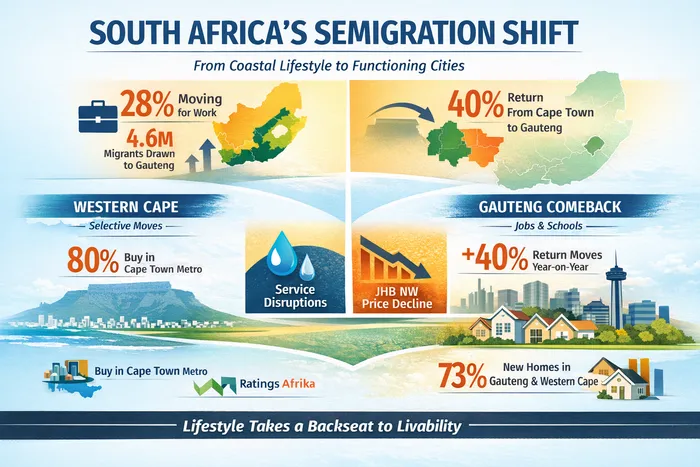
The semigration shift.
Image: ChatGPT
At the same time, semigration is no longer a one-way trend. A growing number of homeowners are moving back to Gauteng, Potgieter said, driven by stronger economic opportunities and career prospects.
“After relocating to coastal areas during the pandemic, professionals are returning to the province because of its stronger economic opportunities and career prospects,” he said.
Wise Move data shows a 40% year-on-year increase in relocations from Cape Town back to Gauteng in 2025.
According to LOOM, Gauteng continues to attract buyers seeking long-term employment opportunities, particularly as fully remote work declines and hybrid models take hold.
Access to education remains a key factor shaping demand, Potgieter said.
“Proximity to good schools and tertiary institutions certainly plays a role in strategic buyer decisions. There are suburbs that consistently show steady house price growth and ongoing demand for rental accommodation because they are feeder zones for sought-after schools,” Potgieter said.
The Western Cape and Gauteng accounted for almost 73% of more than 150,000 new residential properties developed in the R500,000-and-above price segment over the past five years, according to LOOM.
Smaller towns are also gaining ground, with LOOM data showing growth rates outpacing larger metros as buyers look for a balance between lifestyle and reliable infrastructure.
“Semigration is becoming a strategic decision driven by services, infrastructure and economic opportunity,” Potgieter said.
IOL BUSINESS