
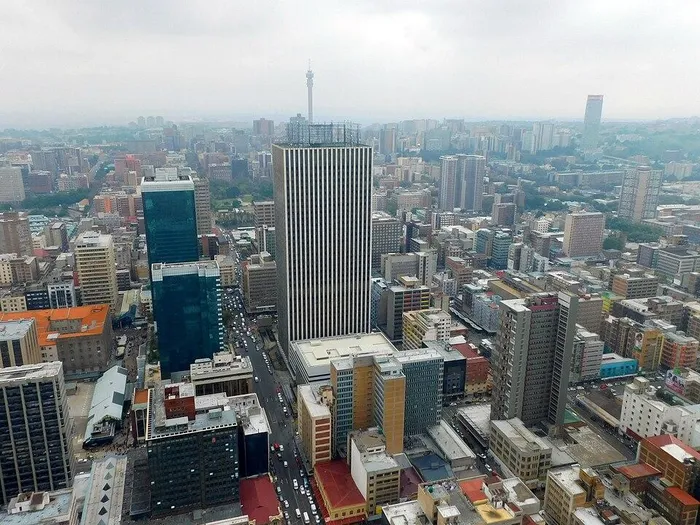
Johannesburg must begin viewing urban redevelopment not merely as property development but as economic reconstruction.
Image: Wikimedia
Johannesburg remains a strategically important economic hub in Africa.
Despite various challenges, Johannesburg remains one of the most strategically important economic hubs in Africa.
Johannesburg is the economic engine of South Africa, says the RB Property Group in its newsletter.
It is the financial capital of the continent, home to Africa’s largest stock exchange, major banks, corporate headquarters, universities, transport networks, and one of the largest concentrations of economic infrastructure in Africa, the property investment company says.
Yet today, the City of Johannesburg finds itself at a critical crossroads, says Rob Buthelezi, chairman at the RB Property Group.
He says that rising municipal debt, infrastructure deterioration, declining revenue collection, service delivery pressures, and growing social frustration are exposing deeper structural challenges within the city’s economy.
“Reports indicating that the City faces creditor obligations estimated at approximately R25 billion are not merely accounting concerns - they are warning signs of broader economic stress within the urban ecosystem.”
But behind the debt crisis lies an even larger issue that continues to affect every municipality, every household, and every sector of the economy, he adds.
Finance Minister Enoch Godongwana warned this week that Johannesburg is in severe financial distress and that the National Treasury could withhold grant funding unless urgent corrective action is taken.
Godongwana also said the city could not afford the wage agreement reached with municipal workers late last year.
According to Berry Everitt, CEO of the Chas Everitt International property group, the current standoff between the Finance Minister and the Johannesburg Mayor Dada Morero over the city’s finances and the controversial municipal wage agreement is stirring up uncertainty among investors, businesses, property owners and residents alike - at a time when the city can least afford a loss of confidence.
“Johannesburg is not just another municipality. It is the economic engine room of South Africa and a major gateway for foreign investment into the country. If confidence in the City collapses, the effects will be felt throughout the national economy.”
According to RB Property Group, Johannesburg already possesses:
It says that the problem is not necessarily the absence of assets.
The problem is that many of these assets are underutilised, fragmented, or disconnected from scalable economic recovery strategies, says Buthelezi.
He says this is why Johannesburg must begin viewing urban redevelopment not merely as property development, but as economic reconstruction.
One of the greatest opportunities available to Johannesburg lies in the repurposing and regeneration of existing urban infrastructure and buildings, RB Property Group says.
It says the Johannesburg CBD contains significant numbers of underutilised and distressed properties located within areas already supported by: roads, transport systems, electricity infrastructure, water infrastructure, fibre networks and established economic activity.
Rather than continuously expanding outward through expensive infrastructure duplication, the city has an opportunity to rebuild inward through adaptive reuse and urban regeneration, Buthelezi says.
Advantages of repurposing existing buildings: lower development costs, faster implementation timelines, reduced environmental impact, activation of dormant assets, improved urban safety and increased economic density within existing infrastructure networks.
Most importantly, the property investor says repurposing existing buildings is one of the greenest forms of development possible because it avoids the heavy carbon costs associated with demolition and ground-up construction.
It says urban regeneration, therefore, becomes both an economic and environmental solution simultaneously.
One of the biggest policy shifts South Africa must consider is reclassifying housing and urban regeneration as strategic social and economic infrastructure, Buthelezi says.
He says housing is often viewed purely as a social expenditure. “But in reality, housing stimulates multiple sectors simultaneously: construction, engineering, manufacturing, retail, telecommunications, transport, maintenance and financial services.
“Well-located housing also improves labour mobility, reduces transport costs, stimulates local businesses, and strengthens municipal revenue collection over time.”
Every large-scale housing and redevelopment project creates direct and indirect employment opportunities throughout the value chain, the chairman says.
If approached strategically, Johannesburg’s redevelopment pipeline could become one of the largest employment generators in the country, he adds.
South Africa cannot discuss municipal collapse, crime, infrastructure deterioration, or social instability without confronting unemployment honestly, RB Property Group says.
It says unemployment is not simply a labour-market issue anymore. It says it is now: an economic issue, a municipal issue. sustainability issue, a social issue, a developmental issue, and increasingly, a national stability issue.
The country’s youth unemployment levels are particularly alarming, Buthelezi says.
“Every year, thousands of graduates, skilled young professionals, and entrepreneurs enter an economy unable to absorb them at scale. This creates growing frustration, economic exclusion, and social instability.”
RB Property Group says it believes the youth are not the problem, but they are one of the greatest untapped solutions available to South Africa.
Independent Media Property