
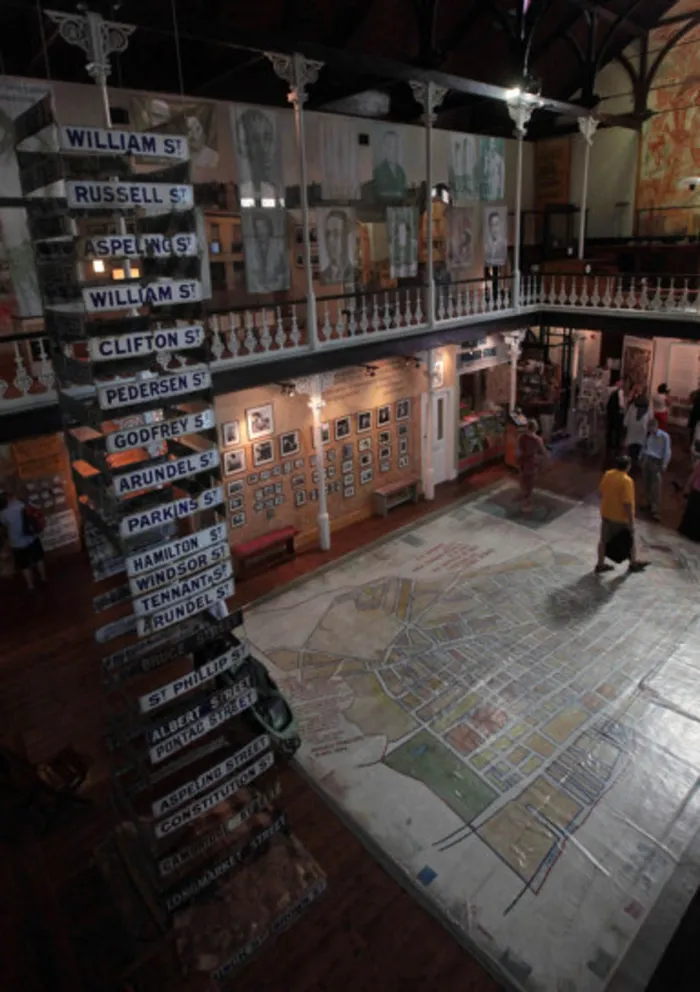
The layout of the old District Six and several of the original road signs, safe in the District Six Museum in Caledon Street. It is estimated that in three years, 5 000 families, 3 000 of them land claimants, will be living in the area. The layout of the old District Six and several of the original road signs, safe in the District Six Museum in Caledon Street. It is estimated that in three years, 5 000 families, 3 000 of them land claimants, will be living in the area.
The cause of one of the biggest delays in Cape Town’s long land restitution process is that the city charges the regional Land Claims Commission market-related prices for plots in prime locations.
This has been revealed by Western Cape Land Claims commissioner Beverley Jansen, who says that more than 13 years after the deadline for claims, 1 000 remain unresolved in the province.
In the financial year ending on March 31, the commission had spent R176 million paying claimants or buying land, she said. But financial constraints and legal processes in releasing land remained the commission’s “biggest stumbling blocks”.
The City of Cape Town has countered that while it understands the commission’s dilemma, it cannot give away for free land that was bought with ratepayers’ money.
Where claimants returned to land from which they had been removed, the land was given back at no cost.
Complications arose when claimants wanted to move to other land that the city had allocated for development.
Last week, 44 families moved into their new homes in District Six. This was part of the second phase of the development, in which 114 families in all are to return. In the first phase, 24 families moved back.
Jansen said the rest of the families would receive their homes in the next few months.
It was estimated that, in three years, 5 000 families would be living in District Six, she said. Of these, 3 000 would be land claimants and the rest people on housing waiting lists. Janesen could not explain how this would be achieved.
District Six, from which thousands of people were forcibly removed under the Group Areas Act from the 1950s, has been one of the city’s most publicised restitution cases.
By the end of 1998, more than 17 000 claims had been lodged in the province. Many were individual and others community claims, with up to 4 000 people registered in a single claim. Jansen said around 16 000 claims had been settled.
In Bowwood Road, Claremont, 66 families were to receive land, Jansen said.
But the process had been delayed because the city initially wanted R45m for the land, close to Cavendish Square. The commission did not have the means to pay this amount. The city said it lowered the price to R27m.
In Simon’s Town, Goodwood, Milnerton and Constantia, claimants would have to wait until the national and provincial Departments of Public Works released land.
“Our biggest stumbling blocks are waiting for state departments to release land and some municipalities wanting to charge market value,” Jansen said.
Pogiso Molapo, the city’s land restitution manager, said that in cases like District Six, claimants simply returned to the areas from which they were removed. But in other instances, claiants earmarked land other than where they had lived.
“There are cases where people are choosing the best pieces of land and some of this land belongs to the city. We have bought this land with ratepayers’ money and cannot give it away. All we then ask for is that they pay us what we paid for it. These are not direct claims – in those cases we forgo the land.”
Molapo said it was not viable for the city to give away land. “That will be wasted money and we are guarding against that,” he said.