
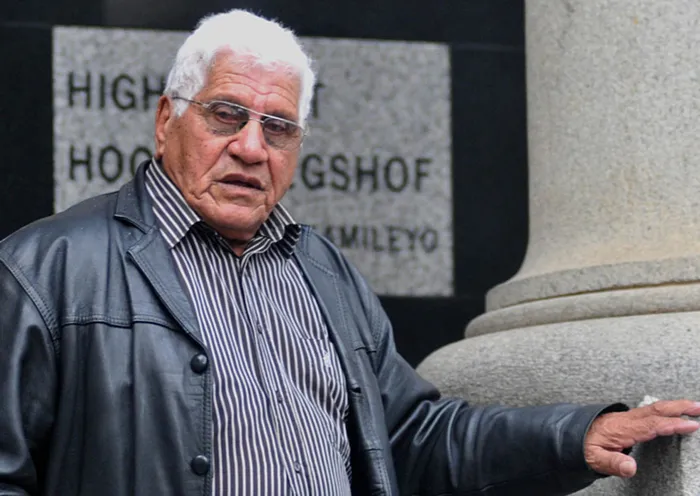
Sedick Sadien leaves the Land Claims Court, sitting at the Western Cape High Court, where he testified about how he and his family were dispossessed of their farm in Constantia in 1962. Sedick Sadien leaves the Land Claims Court, sitting at the Western Cape High Court, where he testified about how he and his family were dispossessed of their farm in Constantia in 1962.
FATIMA SCHROEDER
High Court Writer
SADNESS and a hint of anger showed on the face of Sedick Sadien as he recalled the day in 1962 that apartheid laws forced him and his family to give up their Constantia farm and home.
From his pocket in the Land Claims Court yesterday, he produced lovingly preserved black-and-white pictures of the farm, showing his uncle, who has since died, standing near the horse stables and pear trees.
Sadien, 76, was testifying in the Western Cape High Court, where the Land Claims Court is sitting. His family are claiming restitution, saying they were dispossessed under the Group Areas Act.
They farmed a range of fruit and vegetables, which they sold at the market in Cape Town. They also produced seeds which they sold to Starke Ayres nursery.
According to Sadien, the man who took over the land was Jacob Badenhorst, a manager at Groot Constantia, which at the time was a government-owned enterprise.
They had been accustomed to doing business transactions with Badenhorst. But they were not accustomed to his demeanour on the day he demanded they move out.
Sadien recalled that Badenhorst threatened to shoot them and dug trenches on the farm so that they could not drive along the roadways.
“It was so heartsore. He spoke so ugly to us, we could have cried,” he said.
By then, most of the coloured people living around them had left and their homes and business properties had been demolished.
With nowhere to go, Sadien, his wife, children and father, left with what they could carry.
Most of their possessions were left behind because they had nowhere to put them.
Sadien said his father went to live with his sister, while he and his family ended up living with his in-laws in Wynberg.
With only farming as their background, he and his family had to work as labourers in the building industry. Sadien eventually became a plasterer, earning a modest income – but a mere fraction of what he was accustomed to as a farmer.
Meanwhile, they returned to Constantia occasionally to go to the mosque there, and could see what Badenhorst had done to the property.
Sadien’s uncle was the imam of the mosque in Constantia, which is still there.
Sadien told the court Badenhorst had built pig pens and was farming the land. His wife was selling fruit and vegetables from a stall on the farm.
Sadien is not one of the claimants in the case, which was lodged in 1999 by
his nephew’s children, Rashaad and Magmoed Sadien.
According to court papers, Sadien’s grandfather, Dout Sadien, acquired the land in 1902. It is near the historic Groot Constantia farm.
Dout Sadien died in 1921, his wife 35 years later. Their five sons bought the land from Sadien’s estate.
However, under the Group Areas Act, Constantia was declared a whites-only area in 1961, and the brothers had to sell the land to Badenhorst for about half the amount they had paid for it five years earlier.
In 1981 Badenhorst sold the farm to Yamiv (Pty) Ltd, of which his son Frederick was a director.
Yamiv, although notified of the land claim in 1999, sold the property in 2003 to Jazz Spirit 12 (Pty) Ltd.
Badenhorst’s son Hein is a director of Jazz Spirit 12.
According to papers, and contrary to the restitution act, it failed to notify the commission of any intent to sell, develop, subdivide or rezone the property.
The case continues.
fatima.schroeder@inl.co.za