
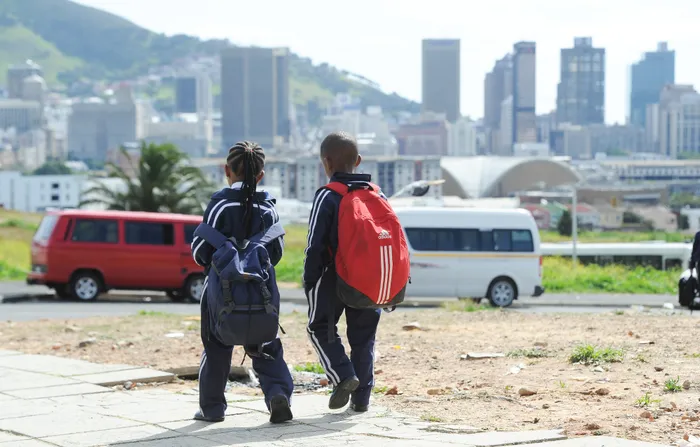
Placement remains ongoing for 7 540 learners in the Western Cape as schools prepare to open on Wednesday.
Image: Henk Kruger/Independent Newspapers
Education watchdogs have criticised the provincial and national government for their placement strategy, citing that they must take responsibility for racial profiling in schools and that the system is flawed. This while political parties said it noted that 23,000 children nationally have yet to be placed for the 2026 school year, as 7,540 are being processed provincially.
Bronagh Hammond, Director of Communication – Western Cape Education Department confirmed that as of January 7, the WCED has successfully placed 180,960 (96%) learners for whom applications were received for Grade R, 1, and 8 for the 2026 school year. Placement is still in progress for 7,540 learners in these grades.
Hammond said the WCED built 175 new classrooms through the building of schools and the expansion of existing schools, which will contribute towards the placement of learners.
Last year, the department confirmed that nine schools were set to be completed with 265 classrooms. These included Blueberry High, Leiden Junior High, Kilimanjaro High, Ashton Vocational Academy, Masifunde Primary, Happy Valley No. 2, Blue Downs High, Vuyiseka High, and Darling High.
Education MEC David Maynier visited one of the new schools, Brantwood High in Kuils River last week in preparation for the opening of schools on Wednesday.
A year ago, the WCED grappled with over 9,000 late applications and, by February last year, managed to resolve it. By November 2025, over 10,000 late applications were received, and by January, 758 new extremely late applications arrived.
Hammond said they were prepared for the school year and urged parents to start the year on the right note, ensuring that stationery and uniforms were sorted to allow their children to have the strongest foundation in becoming independent and thriving adults.
“Preparing for the school year requires extensive planning and coordination. The WCED has procured and delivered essential items well in advance to ensure teaching and learning can begin immediately. For example, schools were able to order top-up textbooks between 12–23 May 2025, with full delivery completed by October 2025, amounting to R58.7 million,” she added.
“Stationery for non-section 21 schools valued at R25.3 million was delivered by November, and an additional R31.6 million worth of goods were delivered by December last year.
“We are also ready to respond to new requirements that may arise due to late applications or unexpected demand.”
She added that late applications continue to affect placement progress and that since November 1, the WCED has received 10,666 late applications: November 2025: 5,873 new late applications, December : 4,035 new late applications, January 2026 (up to 7 January): 758 new extremely late applications.
Hammond said late applications create considerable challenges for the WCED as they disrupt planning for learner placement, resource allocation, and staffing, and place additional strain on the department to place learners immediately during a period when schools are closed for the holidays.
The department said in addition, the WCED will conduct its 10-day snap survey once schools have been open for ten days, which will provide accurate data on learner numbers.
Roger Solomons, Build One South Africa (BOSA) spokesperson called on the Department of Basic Education Minister Siviwe Gwarube to convene a special meeting for a proactive plan for each province, temporary classrooms, and accountability, to tackle the issue of placements.
“Reports that nearly 23,000 learners remain without school placements just days before the start of the academic year point to a serious failure of coordination, planning, and accountability within South Africa’s basic education system, " Solomons said.
Vanessa le Roux of Parents for Equal Education echoed the same sentiments, stating that an integrated plan was needed: “They must take responsibility for the racial profiling in admissions, where thousands of children of colour don't have a school yet, and if you are a child of colour, they place you anywhere they feel fit, even in schools parents didn't apply for or have the means to get their children there daily.
“They must take responsibility for overcrowded classrooms, while former model C schools, that are also defined as public schools, are sitting with a maximum of 25 learners per class.”
Joscelyn Beukes, Founding Chairperson of Empowerment Network Solutions, an NPO added that a new coordinated system for placement was needed.
“We have a flawed, broken system that demands a united government response. No single department can fix the education placement crisis we are facing. We need a multi-departmental partnership involving WCED, DSD, Home Affairs, SASSA, SAPS, Law Enforcement, the Department of Infrastructure, the City of Cape Town, and every municipality, " she said.
Cape Argus