
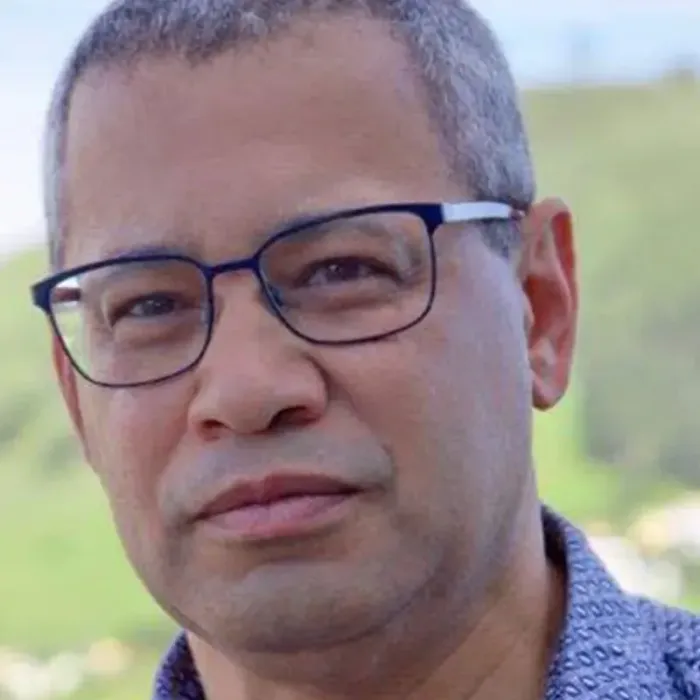
Lorenzo Davids is the Executive Director of Urban Issues Consulting.
Image: Supplied
South Africa is drowning in a self-induced political complexity that it never anticipated. Political complexity is not new. However, current political challenges are exhausting its usage.
The parallel Madlanga Commission and the Parliamentary Ad-Hoc Committee Inquiry into Allegations made by Lieutenant General Nhlanhla Mkhwanazi have heard allegations of corruption, compromised and incompetent police personnel, abuse of procurement systems, bribery to secure certain outcomes, and a criminal justice system that serves whoever will pay enough money.
Like under Apartheid, South Africa’s criminal justice system is where all dark, ugly heart of power goes to hide. It's where power bows to money and where people and the constitution have no influence. It's where the Political Killings Task Team were sent to die.
Like Vlakplaas and Eugene De Kock, every corrupt government that senses its end is near sets up murderous death squads to eliminate enemy voices and to delay its inevitable demise. We are seeing the Apartheid security cluster playbook in full use under the ANC.
Listening to the people being questioned at both committees, one is filled with a sinking feeling that we have become what we had hoped we’d never be: a replica of the Apartheid State’s political killing machine.
This is Lang Hendrik van den Bergh and the Bureau for State Security all over. But this is at a much more complex level. This is about money, power, political affiliations, political factions, political interference, control over procurement systems, aggressive wealth accumulation, and tribal alliances, all intertwined into this toxic complexity.
This kind of inquiry topples presidencies, as it did John Vorster's government in 1978 due to the Info Scandal. Also known as Muldergate, it forced Vorster to resign as Prime Minister on 20 September 1978 and, nine months later, as State President on 4 June 1979. It involved the illegal use of multimillion-dollars worth of state funding to buy newspapers and journalists to sell a sanitised Apartheid South Africa overseas.
South Africans cannot be blamed for having lost all confidence in the President, the police and the entire criminal justice system. Last week, we heard Witness C tell the Madlanga Commission of a R1.2 billion SAPS health services contract in which senior police officials were allegedly receiving kickbacks. We are all well beyond resignations and new governance safeguards. We are in the “we need an entirely new government” zone. The ANC government has failed the test of institutional integrity. We have replaced the rule of law with the law of looting.
The ANC is at its most vulnerable it’s ever been. It faces the reality of being booted out of power in 2029 and its senior leaders being prosecuted. The stain they have brought onto freedom and democracy will remain forever. They also face tensions within their alliance with Cosatu and the SCAP. Last week, the ANC and Cosatu met to begin to prepare their economic recovery message for the upcoming 2026 local government elections.
Over the years, these discussions have diminished to the level where it's no longer about policy or plans, but about power and positions. If the current alliance fractures, the country will face a labour-versus-business election in 2029, further complicating the policy environment.
Add to this interesting complexity the Democratic Alliance’s new 'Economic Inclusion for All' Bill brings to the policy table. It states that it offers South Africans a better future than all Black Economic Empowerment (BEE) policies have done to date.
If the DA can show that their bill will outperform BBBEE over a shorter period in job creation, poverty elimination, and better living standards for all, especially for the bottom 50%, they will capture significant votes. It's then a certainty that the ANC will lose in 2029. No one, other than the ANC, believes that BBBEE has adequately benefited the bottom 50% of the population. With BEE having been the cornerstone of the ANC transformation agenda, the DA will cause a significant political realignment if it can show a better form of economic empowerment.
And to remind South Africa why the Political Killings Task Team is so important, underway in Gqeberha right now, the 1985 murder of the Cradock Four inquest continues. These hearings remind us why the current Madlanga Commission is so important.
Our generation must not leave behind a legacy of unquestioned state violence or state failures. Let’s face our political complexities. While we have commissions about the political killings of 1985, our children must not in future ask: “but why did you do nothing about the political killings of 2025?”