
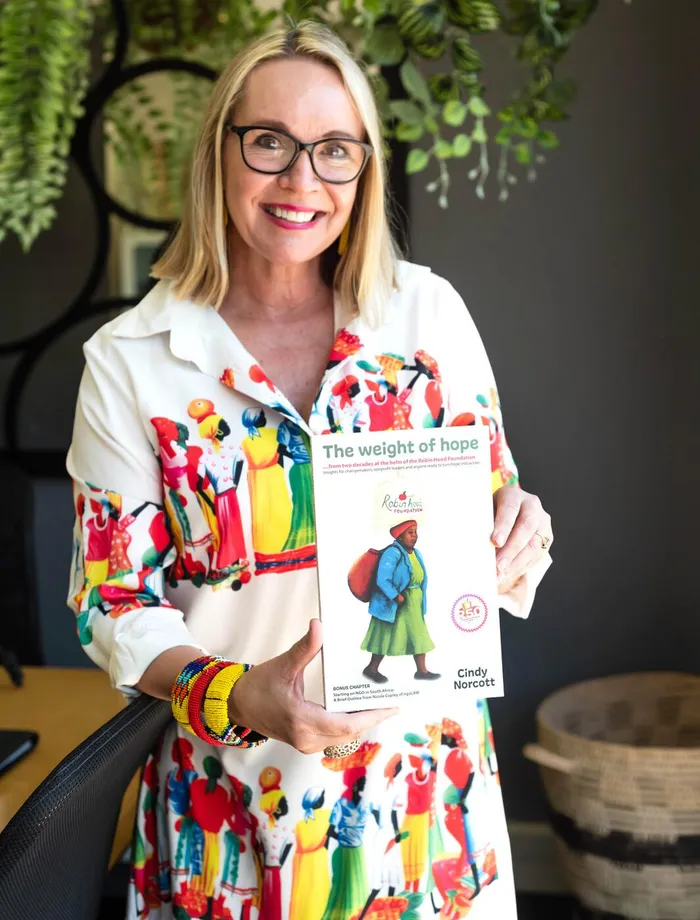
Cindy Norcott is a South African entrepreneur and philanthropist best known for founding the Robin Hood Foundation more than 20 years ago.
Image: Supplied
Cindy Norcott, one of South Africa's most respected entrepreneurs and philanthropists, has released her third book, “The Weight of Hope”.
It is her first book, focusing on the story and work of the Robin Hood Foundation, which she founded over 20 years ago.
Reflecting on this moment, she said, “This book marks a turning point, a moment to pause, look back and pass on what I have learned.”
The release comes as she prepares to hand over leadership of the foundation after serving for two decades.
Norcott mentioned that the book was influenced by her decision at the start of the year to step back from daily leadership.
“I decided to hand over the leadership of the foundation to one of our committee members, Tilanie Grote. I have had a year to do the handover,” she explained.
During this period, she found herself reflecting on the questions that she had received from non-profit founders and volunteers over the years.
“I love writing, and it struck me that so many non-profit founders have asked me to coach or mentor them. When I started my non-profit, I never had a guidebook or a mentor,” she said.
This realisation became the motivation for the book. She wanted to gather the lessons that she had learned and the mistakes that she had made into a resource that new founders could learn from.
“I decided that I would write a little road map and openly share what I have learned. As I pass the baton to Tilanie, it is a gift I want to pass on to people who want to make a difference or improve the non-profit they are already in,” she said.
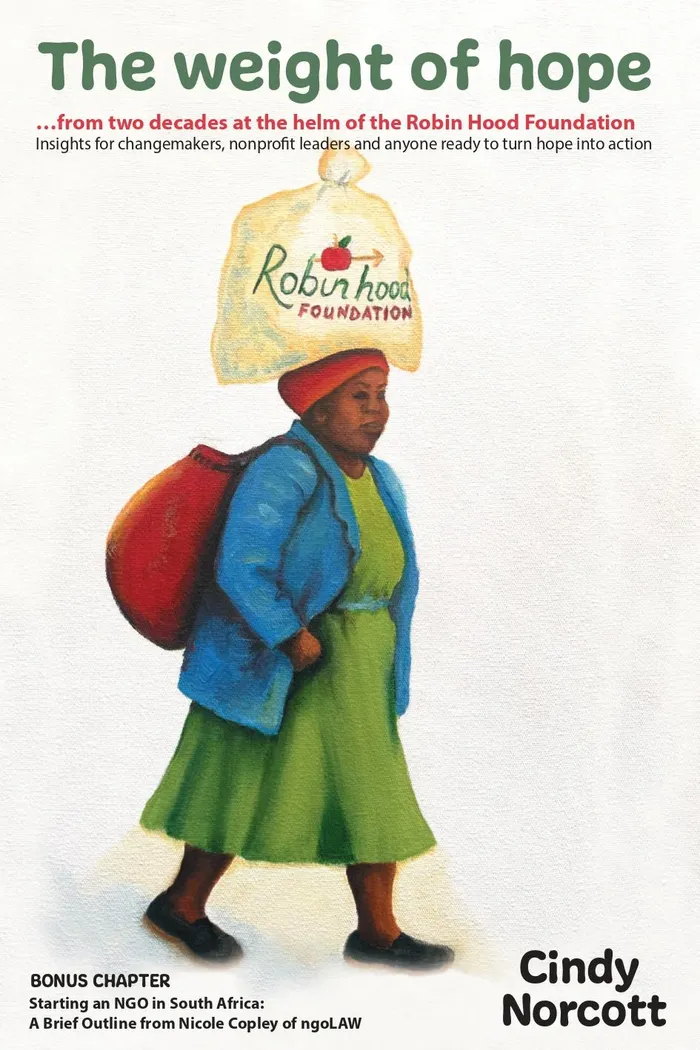
"The Weight of Hope" is Cindy Norcott’s new book capturing the lessons, challenges and experiences she has gathered over more than 20 years of leading the Robin Hood Foundation.
Image: Supplied
One of the themes she explores is the risk of entering communities with assumptions about what is needed.
Norcott said that many people who start non-profits are driven by passion, but they sometimes impose ideas that are not shaped by the community itself.
“These ideas always come from a good place, a true desire to help, but often they are not an actual solution for what the community needs,” she said.
She believes that listening is the most important starting point.
“Meet with the community leaders or sit with the leader of the organisation you want to help and ask questions. Ask them what their current challenges are. Not everyone sees their situation as a problem that needs to be fixed,” she said.
She added that people in communities “know best what they need”, so any effort to help must be grounded in humility. “Put your ego aside and go into community service with a learning and service mindset.”
Two decades of leading the foundation have shown her that relationships are at the centre of non-profit work. She said that ideas alone cannot sustain an organisation without trust and support.
“I have met many grassroots founders with amazing ideas, but no support because nobody knows them. When I started the foundation, I had already been running my own business for years and had a network and a positive brand. That helped us open doors,” she said.
Fundraising remains one of the hardest parts of running a non-profit. She noted that donors are cautious and often guarded due to the lack of regulation in the sector.
“There are scoundrels amongst us,” she said.
Building trust over many years has helped the foundation survive when others have closed within a short period.
“Many non-profits do not last two years because they run out of money. Having deep and long-standing relationships over these twenty years has allowed us to keep going.”
Cindy Norcott is a South African entrepreneur and philanthropist best known for founding the Robin Hood Foundation more than 20 years ago.
Image: Supplied
Norcott believes that the foundation's modest structure has also reassured donors.
“We have only had one full-time paid employee, and the rest of the team are volunteers. People want to support a non-profit that is a good custodian of resources,” she said.
As she hands over leadership, there are values that she hopes will remain part of the organisation. She calls them abundance, joy and dignity.
“When we host a project, we fill the bags to the brim. Every project is multi-layered, and there is always plenty for the recipients,” she said.
She added that joy is central to their work. “We love what we do. We bring compassion, connection, conversation and laughter. There is a difference in the room before and after a project.”
Dignity, she said, is central.
“We treat people as VIPs, we do not make them wait, and we show them respect. We make sure that donations are always of high quality. Just because someone is in need does not mean they should receive something broken or in poor condition,” she said.
Every project, she believes, should give people hope.
Norcott sees “The Weight of Hope" as more than a memoir. It is a practical guide for anyone who wants to start, run or grow a non-profit. It offers lessons on managing volunteers, fundraising, maintaining relationships and sustaining a sense of purpose.
It also speaks to the emotional effort the work requires.
“People think charity work is simple, but it asks a lot of you. I have learned that you cannot pour from an empty cup, and I hope readers understand that too,” she said.
The launch of the book captures a legacy built through thousands of interactions across communities in KwaZulu-Natal. It also marks the beginning of a new chapter for both Norcott and the foundation.
As a final gesture of support, R50 from each book sale will go back to the Robin Hood Foundation. “This thing is bigger than us,” she said.
“I want the work to continue with care, and I want the people we serve to feel hope when they meet us.”