
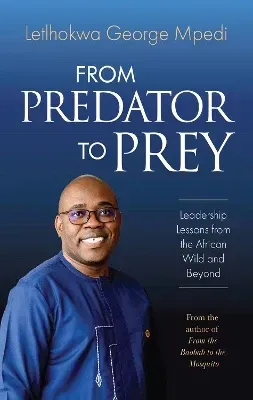
Through the lens of animals like the leopard, honey badger and wolf, valuable lessons about resilience, collaboration, and self-empowerment are uncovered.
Image: Supplied.
Leadership has always arrived for me in symbols before it shows up in strategy.
A crow feather on the pavement. A wolf in meditation. A dream that shakes me awake at 3 a.m. Recently it arrived as a leopard, cut in half and carried on a palanquin, paraded like a warning. I woke with the taste of judgment in my mouth and the quiet knowing: I had been brought down to size again.
When I opened From Predator to Prey, I found a vivid, spiritually resonant approach to leadership that fits beautifully with totems, personal symbolism, and the journey from self-doubt to self-authority. It reads less like a corporate manual and more like a field guide to leading with instinct, humility, and courage in a world where anyone can become prey if they forget their power.
Letlhokwa George Mpedi uses stories and behaviours from the African wild to illuminate choices such as collaboration, loyalty, discipline, curiosity, and knowing when to fight or retreat. The African lens centres community, interdependence, and shared survival, which makes the lessons feel earthy, spiritual, and practical rather than abstract theory.
The night after the leopard dream, a seal appeared, swimming south towards Table Mountain, easy and joyful, as if the ocean were a playground and not a battlefield. That little seal did more for my nervous system than any leadership keynote I’ve ever heard. It reminded me that leadership is also allowed to feel like water, like play, like being safe in my own skin.
Somewhere between the leopard and the seal, I realised something I now say out loud: I never want to feel like prey or bait again.
What does it mean to lead when the world keeps casting you as the hunted one? How do you move from scanning for danger to scanning for possibility?
What I found in these pages was a series of concise lessons that feel less like theory and more like conversations with the wild.
Each animal carries a different lesson: collaboration, symbiosis, solitude, resilience, curiosity, play, gratitude and diverse styles of leadership.
The leopard spoke to me first. Its speed and focus reminded me of moments in my own life when decisive action was essential, when hesitation would have cost me opportunities. It showed me that leadership is not about constant motion but about knowing when to move with precision and when to wait.
Practice noticing when urgency is real and when it is imagined. Train yourself to act quickly when the moment demands it, but also to conserve energy when patience will serve you better.
The honey badger carries fearlessness and tenacity. Reading that chapter made me think of times I have had to stand firm against pressure to shrink or conform. The honey badger’s refusal to be intimidated became a mirror for my own insistence on holding ground when my values were tested.
Identify one area of your life where you’ve been backing down too easily. Commit to holding your ground there, even if it feels uncomfortable.
The bee hums with collaboration and community. It reminded me that loyalty is not about obedience to one leader but about mutual care. I thought about the teams and partnerships I have nurtured, and how true collaboration strengthens everyone involved rather than silencing individual voices.
Look at your current collaborations. Ask yourself: are they nourishing you as much as you are nourishing them? If not, adjust where you invest your energy.
The elephant brought empathy and memory. Its presence reminded me that leadership is about carrying lessons forward, remembering both the paths that worked and the ones that hurt. For me, this meant recognising how past experiences shape the way I protect and guide others now.
Reflect on one past experience that still shapes how you lead. Write down what it taught you, and how you can use that lesson to guide others today.
The lion represents strength and presence. It made me reflect on how leadership is not about proving authority but about holding space with steadiness. I saw in myself the moments when I have led not by force but by clarity and calm.
Practice showing up with calm authority. In your next meeting or conversation, focus less on proving yourself and more on creating steadiness for others.
The wolf balances loyalty with strategy. It reminded me of my own instinct to know when to act collectively and when to retreat into solitude. For me, this was a lesson in discerning where my loyalty belongs and ensuring it serves growth rather than diminishment.
Review where your loyalty lies. Ask: does this bond or commitment help me grow, or does it hold me back? Adjust accordingly.
So here is what this reading has given me.
Permission to hold both the leopard and the seal in my story, the hurt and the healing, the public shrinking and the private expansion.
Language for patterns I’ve felt in my bones: that collaboration without boundaries becomes sacrifice, that power without play becomes control, that resilience without rest becomes self-harm.
A renewed commitment to lead from possibility, not fear. To move from what if they hunt me to what if I have been the one holding the leash all along.
Simon Sinek says leadership is not about being in charge; it is about taking care of those in your charge. I would add: it is also about taking care of the parts of yourself that have been hunted, silenced, or paraded half-alive. Those parts deserve your loyalty first.
This is my last leadership reflection for the year, and it feels fitting that it doesn’t end with a neat five-step model but with a question for you and for me.
If you stopped seeing yourself as prey, what kind of leader would you dare to become?
Because once you reclaim your wild, the old narrative doesn’t stand a chance.
* From Predator to Prey is published by Tracy McDonald Publishers.