

Stationery lists have many parents stressed out, as they rush to get everything in order before the 2026 school year begins.
Image: Volodymyr Hryshchenko/Unsplash
It’s back-to-school and parents are scrambling to get those last-minute stationery items to complete the list.
For many people, the yearly stationery lists come with a financial burden. With many households relying on social grants or living from one salary to another, making ends meet is already tough.
Each stationery list differs from school to school, with common items such as rulers, pencils, pens, and books being common among schools. However, over the years, many parents have expressed that the lists are becoming a little hard to manage.
A grandmother from Chatsworth, KwaZulu-Natal, posted on Facebook a picture of stationery and shared how she is a caregiver for her two grandchildren, and the parents are not around.
“I’m currently renting, and whatever child support goes towards food rent is seen to by my elder son. If anyone has any spare stationery to share for my two grandkids, 2 different grades with the same stationery.”
The Chatsworth grandmother is not the only caregiver or parent who has expressed concern with the school stationery supplies list, with many expressing that it is financially too much.
From school uniform, shoes, supplies, and stationery, going back-to-school comes with a huge financial responsibility for parents, no matter what school they go to.
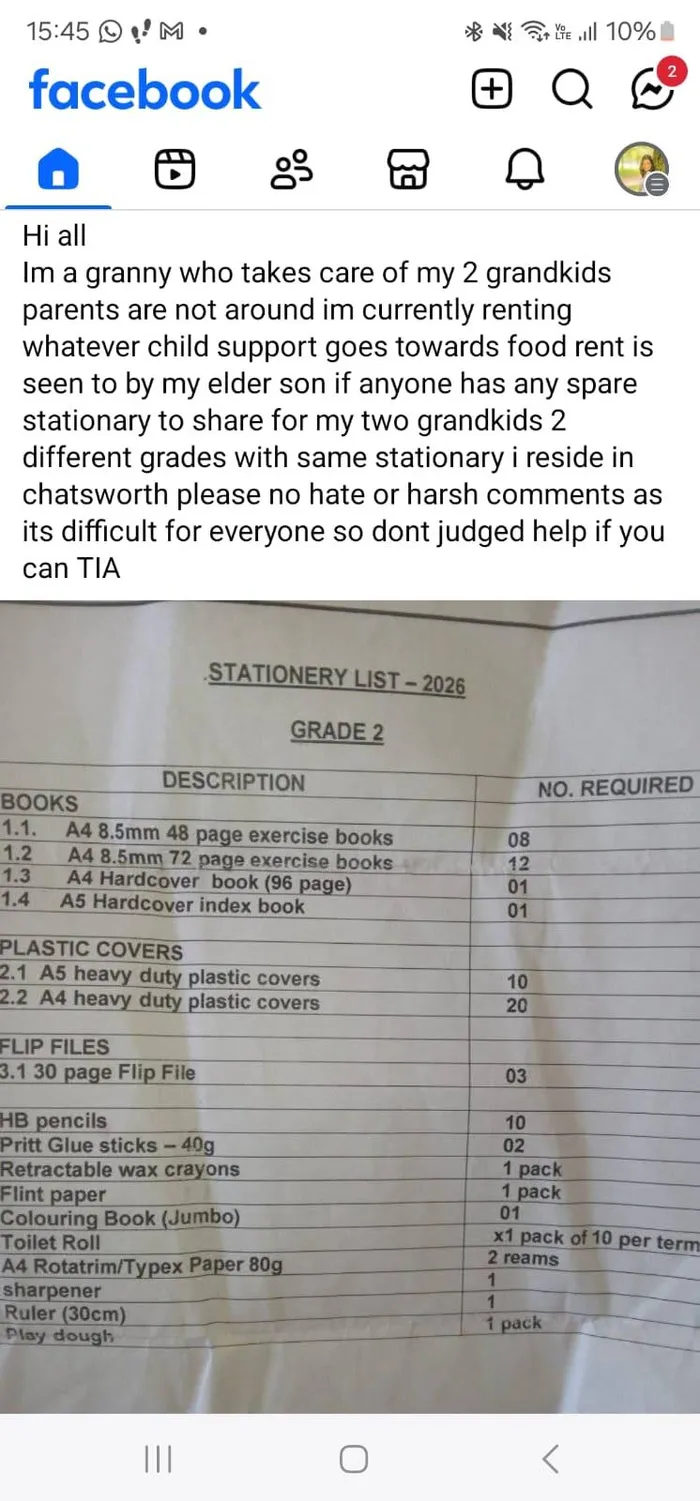
A grandmother from Chatsworth, KwaZulu-Natal Natal posted on Facebook, how she is a caregiver for her two grandchildren and the parents are not around.
Image: Facebook/Screenshot
The South African Schools Act of 1996 outlines the expected provisions for public schools in the country, according to Matakanye Matakanya, the General Secretary of the National Association of School Governing Bodies, who spoke on Cape Talk.
In discussing public schools, it is necessary to differentiate between those that charge fees and those that do not.
"The no-fee schools, meaning nobody pays school fees, so everything is done by the government. So there's no way you can just rock out and say bring stationery, bring this and that, those things are to be done by the Department of Education."
Fee-paying schools are split into Quintile four and Quintile five schools and cater to the least poor 40% of learners.
Makatanya explains that these schools receive less state funding than no-fee schools but are allowed to charge fees for better resources.
"Government subsidises them, because there are some parents who are unable to pay school fees. That money will be paid by the government."
IOL