
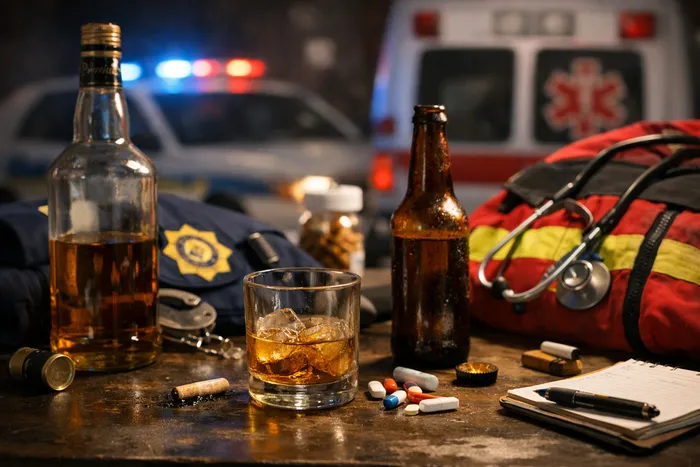
New research from the University of the Western Cape suggests that the higher the levels of stress and psychological distress among these frontline workers, the more likely they are to turn to harmful drinking as a way of coping.
Image: Sora
A recent study examining the relationship between alcohol consumption and mental health among first responders in South Africa has raised critical concerns.
Titled “Alcohol Use in First Responders in South Africa: Psychological Distress Factors Related to Harmful Drinking and Alcohol Dependence,” the research from the University of the Western Cape (UWC) suggests that the higher the levels of stress and psychological distress among these frontline workers, the more likely they are to turn to harmful drinking as a way of coping.
Published in the Turkish Journal on Addictions, involved a comprehensive survey of over 400 first responders, including 309 police officers and 120 paramedics from the Western Cape.
Harmful drinking, defined as a pattern of consumption that results in physical or mental harm, often manifests as binge drinking, characterised by consuming four or more drinks for women and five or more for men in a single occasion.
The study reveals that anxiety, depersonalisation, chronic fatigue, and insomnia are significant indicators of harmful alcohol use.
Notably, one surprising finding was the absence of post-traumatic stress disorder (PTSD) as a predictor of alcohol abuse, despite previous research suggesting a strong correlation. PTSD, a debilitating condition triggered by traumatic events, typically manifests through intrusive thoughts, nightmares, and severe anxiety.
Prof Anita Padmanabhanunni, a psychologist and Dean of the Faculty of Community and Health Sciences, along with Prof Tyrone Pretorius, former Rector and Vice-Chancellor of the University of the Western Cape, underscored the importance of this study as the first of its kind to specifically explore the nexus between alcohol dependency and psychological distress in South African first responders.
Participants identified as at risk consistently reported elevated levels of psychological distress across multiple metrics.
This connection reinforces the notion that individuals may increasingly turn to alcohol as a coping mechanism for emotional turmoil, such as anxiety and trauma. While this may provide temporary relief, it often leads to a damaging cycle of dependence and further emotional distress.
The researchers advocate for timely interventions targeting mental wellness, including critical incident debriefing sessions and mindfulness-based support programmes.
Prof Padmanabhanunni stressed that safeguarding the mental well-being of first responders is vital for maintaining effective emergency services and ensuring high-quality community care.
Despite the existence of support services in certain South African contexts, access remains hampered by distrust, stigma, and logistical barriers, resulting in many first responders refraining from seeking necessary help.
"In South Africa, concerns about confidentiality and fear of judgement can deter individuals from reaching out for mental health support, which may exacerbate their distress and perpetuate reliance on harmful coping strategies like alcohol use," Prof Padmanabhanunni noted.
The entrenched culture of toughness within emergency services propagates the idea that emotional restraint equates to competence, thereby discouraging help-seeking behaviour.
"When emotional distress is equated with ‘weakness,’ many first responders feel obliged to endure their struggles in silence instead of seeking help. This dynamic is often influenced by societal constructions of masculinity," Prof Padmanabhanunni added.
IOL