
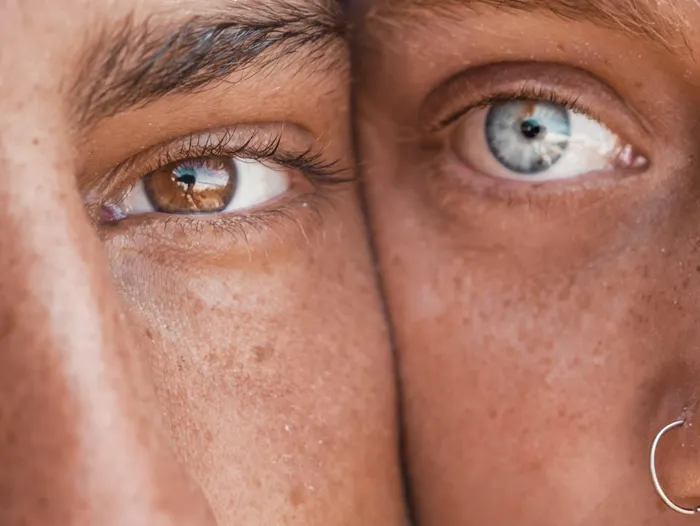
Changing you natural eye colour permanently is now a possibility.
Image: Max Ravier / Pexels
You can now permanently change your eye colour, and in South Africa, a first-of-its-kind procedure is giving both medical insight and a deeply personal look at what that transformation really means.
This isn’t just another cosmetic trend. It marks the arrival of South Africa’s first permanent eye-colour change procedure, performed by the only surgeon in the country formally trained and qualified in the technique, Dr Rob Daniel.
While similar procedures have sparked controversy globally, this approach is notably different. Daniel trained in France and works within a framework rooted in refractive surgery, with strict patient selection and clinical governance at its core.
For decades, changing your eye colour meant relying on contact lenses. Temporary, often uncomfortable, and not without risk. This new procedure offers something far more lasting.
“It’s the first time we can safely and permanently alter eye colour without entering the eye itself,” Dr Daniel explains. “That’s what makes it such a significant step forward.”

It’s the first time eye colour can safely and permanently be altered.
Image: Mark Arron Smith / Pexels
The technique, known as keratopigmentation, avoids the risks associated with earlier methods like iris implants or laser depigmentation.
Instead, a femtosecond laser is used to create a precise micro-tunnel within the cornea, the clear front layer of the eye.
Medical-grade pigment is then carefully placed into this space, forming a new colour layer that sits in front of the natural iris.
The colour is visible immediately, though it takes a few months to fully settle.
Most patients experience mild discomfort for a day or two and return to normal activities within a few days.
Because the procedure does not enter the internal structures of the eye, many of the more serious risks linked to intraocular surgery are avoided.
Still, Dr Daniel emphasises that careful screening is essential.
“We assess both the physical health of the eye and the patient’s expectations. This is permanent, so psychological readiness is just as important as medical suitability.”
While the idea of changing eye colour may sound purely aesthetic, the reasons behind it are often more complex.
“There’s definitely a visual transformation, but for many patients it’s also about identity and confidence,” says Dr Daniel. “In some cases, it can even help with light sensitivity or iris defects.”
Most people choose shades that look natural, such as green or light blue, often guided by digital simulations during the consultation process.
For 33-year-old Jay du Preez, the decision to change his eye colour was shaped by far more than appearance.
“I had always wanted blue eyes,” he says. “But after Bell’s Palsy, my self-confidence took a major knock. I became very aware of my face in a way I never had before.”
What followed was a deeply considered process. He spent months researching, asking questions, and trying to understand whether he could trust something so permanent.
“I wasn’t just asking if it would look good. I needed to feel safe, physically and mentally.”
Part of that journey included speaking to his parents, something he says carried unexpected emotional weight.
“They gave me my natural eye colour. Changing that felt significant. When they supported me, it lifted a weight I didn’t even realise I was carrying.”

Jay du Preez's decision to change his eye colour was shaped by far more than appearance.
Image: Supplied
Despite the seriousness of the decision, du Preez describes the procedure itself as calm and controlled.
“Dr Rob has a very soothing presence. I expected nerves, but I didn’t feel any. I was more curious than anything.”
Seeing the result for the first time was a moment he won’t forget.
“Pure amazement and joy. It felt surreal.”
But the real impact, he says, came afterwards in quieter, more personal moments.
“It’s catching my reflection and feeling… aligned. After everything I went through, it feels like something has settled back into place.”
Not everyone immediately notices the change, something he sees as a positive.
“People will say there’s something different about you, but they can’t always place it. I actually love that. It means it looks natural.”
For him, that subtlety was important. The goal wasn’t to look like someone else, but to feel more like himself.
“It’s not about becoming someone new. It’s about seeing on the outside what I’ve always felt inside.”
As with any medical procedure, there are risks, though these are largely limited to the cornea and managed through strict sterile protocols and aftercare.
Over time, pigment may fade slightly, with touch-ups possible.
Daniel stresses that the procedure should only be performed by a highly trained ophthalmic surgeon using certified pigments designed specifically for the eye.
For those considering it, du Preez’s advice is simple.
“Take your time. Make sure it’s truly for you. When you’re certain, it can be incredibly rewarding.”
The ability to permanently change eye colour once felt out of reach.
Now, with the procedure available locally for the first time, it opens up a new conversation around identity, confidence and choice.
For du Preez, the outcome is difficult to sum up in dramatic terms.
“It’s not excitement or shock,” he says. “It’s a quiet feeling that this is right.”