

The surgery may take a few hours, but the recovery unfolds over weeks, and the final result emerges slowly over months.
Image: Freepik
Most people considering a facelift spend months researching surgeons and studying before-and-after photos, but very few give the same attention to what comes next.
Recovery from a traditional full facelift is not a minor detail. It is a process that demands time, patience, and a clear understanding of what lies ahead.
This is not the polished version, but what recovery actually looks and feels like.
A traditional full facelift, or rhytidectomy, targets the lower two-thirds of the face and neck, lifting sagging skin, tightening underlying tissue, softening jowls, and restoring a more defined, youthful contour.
Most modern procedures use the SMAS technique, which works beneath the skin rather than simply pulling it tight.
This approach avoids the overly stretched look associated with older methods and delivers results that are both more natural and longer lasting, often holding for seven to ten years.
Incisions are typically placed along the hairline, around the ears, and into the lower scalp. Through these, the surgeon lifts the skin, repositions deeper structures, removes excess tissue, and carefully closes the area.
The surgery may take several hours under general anaesthesia or deep sedation, but once it ends, recovery begins.
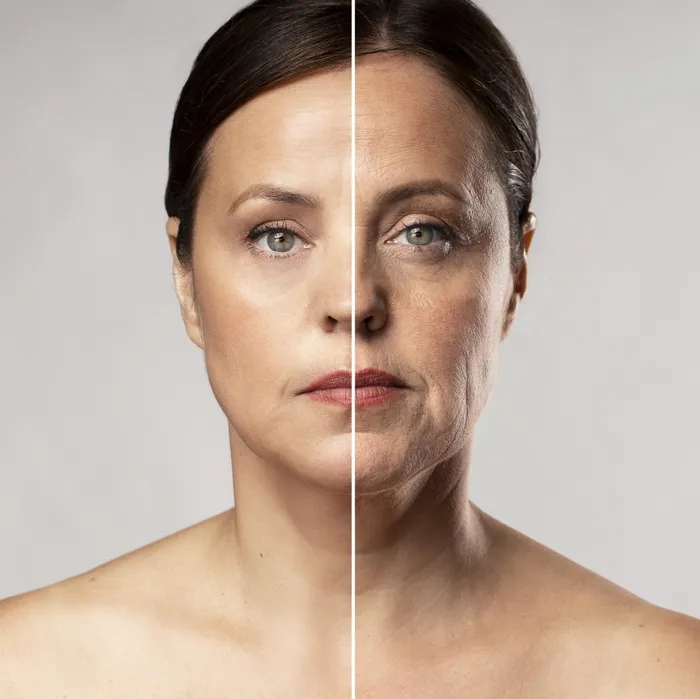
A traditional full facelift, or rhytidectomy, targets the lower two-thirds of the face and neck, lifting sagging skin, tightening underlying tissue, softening jowls, and restoring a more defined, youthful contour.
Image: Freepik
Waking up after surgery can feel disorienting. Your head will be wrapped in bandages, and small drainage tubes may be in place to prevent fluid buildup.
The dominant sensation is not sharp pain but pressure and tightness, as if the face has been firmly secured in place.
Board-certified plastic surgeon Dr Pradeep K. Sinha puts it plainly: “Following facelift surgery, expect to wake up with a large wrapping around your head to minimise swelling and bruising, and small drains may be present for a brief period of time to draw off any fluid.”
You will be groggy, unsteady, and unable to manage on your own. Having someone with you for at least the first night is essential, not optional.
This is where reality sets in.
Swelling and bruising peak during this window, not immediately after surgery, which means you may look significantly worse before things begin to improve.
The face can become heavily swollen, bruising deepens in colour, and the contours created during surgery may be completely hidden beneath inflammation.
Tightness, particularly in the neck, is one of the most common early complaints, along with soreness around the ears.
Bruising may also begin to travel downward into the neck and chest, which can look alarming but is entirely normal.
Keeping your head elevated at all times is critical. Any strain, bending, or spike in blood pressure increases the risk of complications like a hematoma, which requires urgent medical attention.
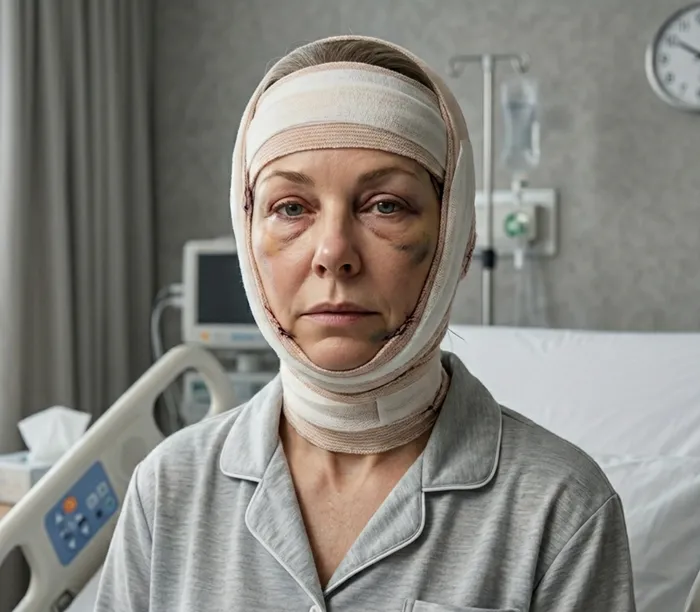
The face can become heavily swollen.
Image: AI / Gemini
By around day five, swelling begins to stabilise and gradually subside. Bruising starts to fade, and most patients no longer need strong pain medication within the first week.
Sutures are typically removed between days seven and ten, often marking a psychological turning point.
By the end of the second week, many people feel more like themselves again, and going out in public becomes manageable.
Facial plastic surgeon Dominic Bray is direct with patients about expectations: “I tell my patients to give me two weeks of their time until they are comfortable to be visible socially or professionally.”
It is a simple guideline, but an important one. While some recover faster, planning for two full weeks reduces unnecessary stress.
Physically, facelift recovery is a strange and often unfamiliar experience.
The face feels tight, stiff, and slightly foreign. Movements like turning the head or opening the mouth can feel restricted.
Numbness around the ears and incision sites is extremely common and may last for weeks.
As sensation begins to return, tingling or pins-and-needles sensations often follow, a sign that nerves are healing.
Small lumps beneath the skin can also develop as deeper tissues settle and remodel.
These are temporary and typically resolve without intervention.
The emotional side of recovery is rarely discussed, but it is one of the most important parts to understand.
In the first week, many patients experience a dip in mood as swelling peaks and the mirror reflects something unfamiliar.
The excitement that led up to surgery is replaced by doubt, discomfort, and, at times, regret.
Facial plastic surgeon Raghu Athré describes it candidly: “For many people, the hardest part of the first week of facelift recovery isn’t physical, it’s emotional.”
That feeling is more common than most people expect, and it is temporary. As swelling improves, confidence usually returns with it.
By weeks three and four, most patients are back to their normal routines, and the results of the surgery begin to show more clearly.
Light exercise can usually resume, with more intense activity following in the weeks after.
Healing, however, continues well beyond what is visible.
Residual swelling can take months to fully resolve, scars continue to fade, and sensation gradually returns.
Final results often take up to a year to settle completely.
Sun protection becomes critical during this phase, as healing skin is highly sensitive to pigmentation changes.
While generally safe, a facelift is still a surgical procedure with real risks.
A hematoma is the most common complication and requires prompt treatment.
Temporary numbness is expected, while permanent nerve damage is rare.
Other risks, including infection, visible scarring, and asymmetry, are significantly reduced when patients follow recovery instructions carefully.
Smoking remains one of the biggest risk factors for poor healing, as it restricts blood flow and can compromise the skin.
A full facelift is not just a procedure; it is a process. The surgery may take a few hours, but the recovery unfolds over weeks, and the final result emerges slowly over months.
Swelling, bruising, tightness, numbness, and emotional ups and downs are all part of the journey. Understanding this upfront makes the experience far more manageable.
IOL Lifestyle