
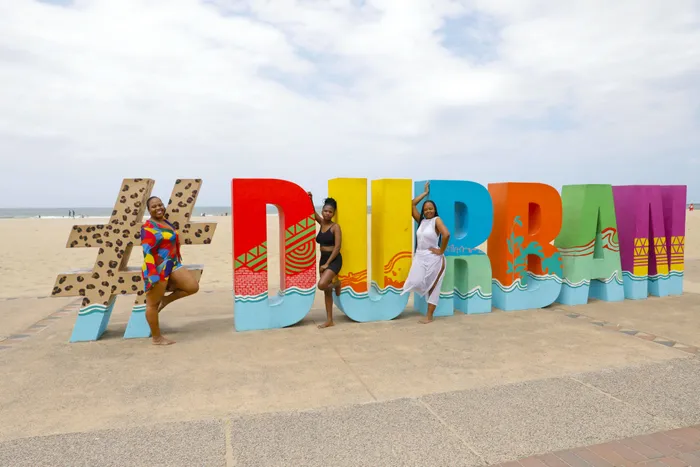
Over 1 million visitors are expected to visit KwaZulu-Natal this December, bringing an anticipated R13 billion tourism injection into our provincial economy.
Image: Doctor Ngcobo / Independent Newspapers
KwaZulu-Natal has launched its 2025 summer tourism campaign with provincial officials projecting continued growth in domestic and international travel.
Speaking at La Clef Boutique Hotel in the Midlands on Tuesday, KZN MEC for Economic Development, Tourism and Environmental Affairs Rev. Musa Zondi said the province was fully prepared for the upcoming holiday rush.
“As the province of KwaZulu-Natal, we are expecting holidaymakers from all corners of the country and neighbouring countries to head to our shores to enjoy their much-deserved break this summer season.”
Tourism performance figures presented at the launch show a continued recovery in visitor numbers.
According to the province’s latest tourism outlook, “international arrivals into KZN have steadily increased since Covid-19 but has not yet reached 2019 levels.”
The report shows that international arrivals for the first three months of 2025 increased to 194,140, compared to 181,785 in the same period of 2024.
Domestic travel has surpassed pre-pandemic levels, with the document noting that “domestic trips in and around KZN have increased compared to previous years.”
KZN recorded 1.9 million domestic trips in the first quarter of 2025, up from 1.18 million in 2024.
The same report forecasts that December is expected to generate “between 1 million and 1.1 million domestic trips and 34 000 international visitors,” with projected tourist spend estimated at “around R13 billion.”
Zondi linked these trends to a wider national recovery. “Between January and May this year, Durban alone recorded over 2.8 million domestic trips and 186,000 international visitors, injecting more than R5 billion into the local economy,” he said.
He emphasised that improved security planning remained a central feature of the 2025 holiday programme. “We do not simply talk about it, we invest in it, we train for it, and we make it visible across all corners of our province,” he said.
He highlighted the establishment of what he described as “South Africa’s first dedicated Coastal and Tourism Policing Unit”, active along more than 100 kilometres of shoreline, supported by cooperation between SAPS, Metro Police, private security and community policing structures.
Beachfront lighting and 484 CCTV cameras are operational in high-demand tourism zones, supported by joint operations from law enforcement and municipal entities. “We really want every visitor to feel welcome and safe,” he said.
Water quality and municipal readiness have also been strengthened. “As of today, only one beach is closed for bathing, and this is a significant improvement from previous seasons,” Zondi said.
Zondi said the province was also entering a strong expansion phase supported by hotel, tourism and infrastructure upgrades. He confirmed that “Southern Sun is investing over R1 billion into the Elangeni and Maharani Hotel precinct,” describing it as part of a wider beachfront regeneration effort.
The December tourism forecast shows that cruise travel will be an important contributor this summer. “According to the cruise ship schedule it is expected that there will be 66 ships docking in Durban between November 2025 and June 2026,” with an estimated 110,994 passengers arriving over this period.
Dr Sibusiso Ndebele, chairperson of the KZN Tourism and Film Authority, said that the summer campaign reflected a broader push to ensure tourism development occurred across all parts of the province.
“The summer season is not just a coastal affair. People come to KwaZulu-Natal to hike the Drakensberg, to unwind in the Midlands, and to explore the Big Five in our inland reserves.”
Ndebele said new governance systems were being implemented to deepen oversight and direct delivery at local level. He explained that the board had assigned members to lead strategic stakeholder engagement in each district to ensure that tourism growth “becomes service.”