
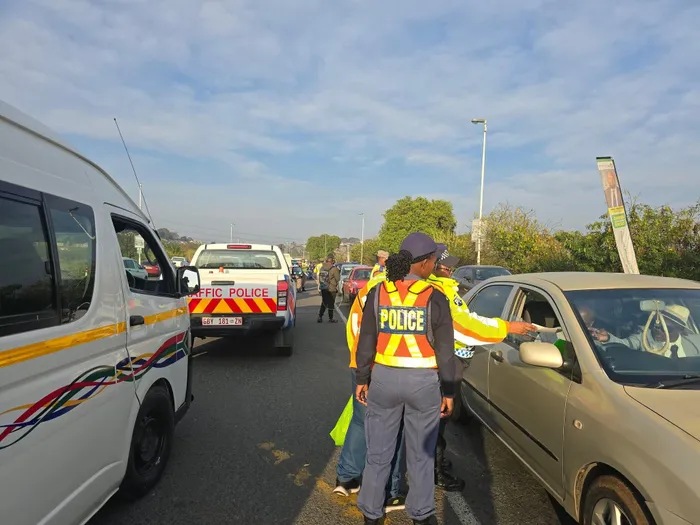
With the festive season in full swing, KwaZulu-Natal's road safety crackdown has resulted in a surge of drunk-driving arrests.
Image: KZN Department of Transport / Facebook
KwaZulu-Natal’s intensified festive-season road safety crackdown has led to a wave of drunk-driving arrests, while the National Financial Ombud Scheme (NFO) warns that driving under the influence could cost motorists far more than just a night in jail.
Since Friday night, 66 motorists were arrested across the province, with Newcastle once again recording the highest number of offenders.
According to the KZN Department of Transport a university lecturer and a bodyguard employed by a businessman were among those arrested. The list also included two educators, a nurse, a police officer, and a taxi driver.
Arrests were recorded as follows:
• Newcastle – 32
• Durban – 23
• Ulundi – 11
MEC for Transport and Human Settlements, Siboniso Duma, stated that thousands of motorists have been caught since August.
“Since August 15, we have arrested 1540 motorists. Those who were arrested this weekend will appear in court tomorrow (Monday),” he said.
Duma criticised the continued recklessness on the roads. “They think the Road Traffic Inspectorate (RTI) team is playing games. Despite arresting 32 motorists in Newcastle yesterday, they are still reckless. A total of 53 motorists have been arrested. RTI and SAPS will arrest even more again,” he said.
Meanwhile, as the festive season is upon us, the Non-life Insurance Division of the National Financial Ombud Scheme has reported a surge in complaints involving rejected motor vehicle accident claims where drivers were found to be under the influence of alcohol or other intoxicating substances.
According to Lead Ombud Edite Teixeira-Mckinon, many drivers mistakenly believe insurers may only reject claims based on breathalyser or blood test results.
She explained that insurers carry a lighter burden of proof in civil matters. They only need to show, on a balance of probabilities, that the driver was under the influence. This can be supported by evidence such as witnesses at the scene, the driver’s whereabouts before the crash, tracking data, bank records showing alcohol purchases, video footage, medical reports, and even the time and circumstances of the accident.
In one recent case, an insurer rejected a claim after the driver’s medical records indicated he was under the influence, despite his denial. The doctor who treated him noted he was under “EtOH (ethanol) influence” and “reeked of alcohol” evidence the Ombud found compelling when upholding the insurer’s decision.
Another matter showed the opposite outcome. A claim initially rejected on the basis of police officers describing a driver as “tipsy” was later overturned after the Ombud found that the insurer’s assessor had asked leading questions and had not considered the driver’s head injuries at the scene.
After reviewing the full evidence, the Ombud issued a provisional ruling for the insurer to settle the claim.
Teixeira-Mckinon noted that even when alcohol consumption cannot be proven, insurers may still rely on other exclusions, such as the insured leaving the accident scene unlawfully or providing incomplete information about their movements prior to the crash. Tracking data or cellphone records showing visits to drinking establishments often play a decisive role.
“The financial implications of a rejected accident claim extend beyond the insured's own vehicle damage to include damage caused to a third party,” she warned. Consumers, she added, should “think before you drink, before you drive.”