
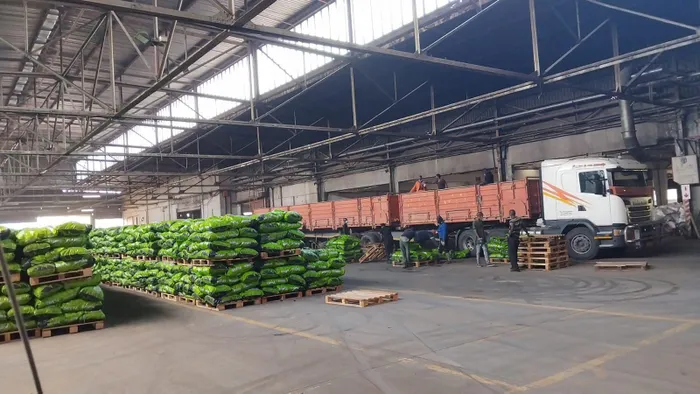
EIT Group's expansion of South Africa's first intermodal freight village in Estcourt aims to revolutionise logistic and cut transport costs by 50%.
Image: Supplied
South Africa’s first fully operational intermodal freight village in Estcourt, KwaZulu-Natal, is set to expand into a multi-billion-rand operation aimed at reducing logistics costs and boosting the competitiveness of local manufacturers.
This is according to EIT Group CEO Wessel Jacobs. The facility, modelled on similar operations in Eastern Europe, combines road, rail, and value-added logistics services.
It currently handles containerised cargo, with plans to include bulk commodities in the future. Jacobs states that the expansion “will set an important precedent for reducing logistics costs and enhancing the competitiveness of local manufacturers.”
EIT Group CFO Manka Sebastian says the expansion is expected to create jobs in Estcourt, supporting the government’s economic recovery plan while cutting transport costs to the Durban port by as much as 50%.
“When you look at Europe, transport costs make up 10% of imports and 8% of exports. In Asia, logistics accounts for 19% of imports and 16% of exports. In Africa, 45% of our import costs come from transport and 35% of our export costs do too. If we now play our part and make logistics between 30 and 50% more cost efficient, we could nullify the punitive tariffs imposed by the Trump administration,” she says.
The freight village is located on the former Masonite board manufacturing site along the N3 and a rail corridor junction, 567 km from the Transnet City Deep container terminal and Sentrarand yards in Gauteng, and 176 km from Durban’s Container Terminal and Bayhead main rail terminal.
Jacobs says the location is critical to linking road and rail, two of South Africa’s largest logistics challenges, with road transport accounting for more than 85% of freight movement and rail less than 14%.
By transferring cargo from trucks to rail at Estcourt, the facility avoids a section of the route characterised by steep inclines, high fuel costs, accidents, and congestion, which Jacobs states “ultimately accounts for 50% of the costs” and is a “game changer” for freight efficiency.
He also notes that warehousing and infrastructure in Estcourt are available at a fraction of the cost compared to major cities.
The first phase of the development was completed and fully operational in March 2024. Jacobs says this phase was “the proof-of-concept phase” and that EIT is now enlarging terminal one, which is 60,000 sq/m, and planning a second terminal on a 500-hectare site to separate clean cargo from minerals and other bulk goods.
The first test train ran in November 2023, and EIT now operates three weekly train slots to Durban, with plans to increase to three trains daily.
Sebastian says strong collaboration with both the public and private sectors ensures smooth operations, with security on call for any safety concerns and ongoing work with Transnet Freight Rail addressing operational challenges.
“To date, we are yet to miss a single vessel at the port,” Jacobs concludes.