
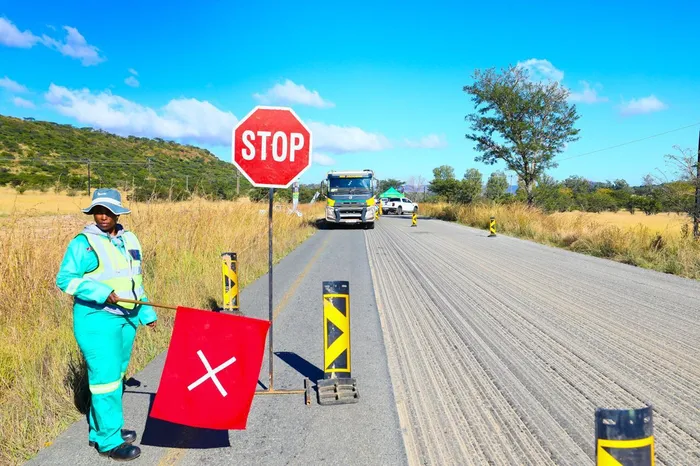
Concern has been raised about the poor state of some roads in the KZN Midlands and surrounding areas.
Image: File
Municipalities and the freight sector have warned that many KwaZulu-Natal roads are in poor condition, warning that further delays in maintenance could have a devastating impact on the economy, tourism, and public safety.
The warning comes after the KZN Department of Transport cautioned that budget cuts and unfunded mandates are draining the department's budget, forcing it to “rob Peter to pay Paul.”
Three municipalities have spoken about the state of road infrastructure in their areas, with two indicating concern over the poor state of provincial roads. However, they also acknowledged that the Department of Transport is working hard to improve and maintain road networks in their regions. The department has warned of a nearly R17 billion backlog in road infrastructure.
This financial year, the department had to re-prioritise its budget, with millions being diverted to the scholar transport function. Recently, it acknowledged that it had to shift more than R100 million from its own budget, meant for other services, including road projects, to cover scholar transport. It stated that this could require it to halt building or maintaining roads.
MEC for Transport Siboniso Duma told the Finance Portfolio Committee recently that they are having to take money away from these projects to pay for scholar transport.
The department received about R343 million for scholar transport, but this budget was exhausted by August. Since then, it has been taking money from other areas to fund scholar transport.
Thami Mkhulisa, Director for Community Services and spokesperson for the Impendle Local Municipality, said that one of the busiest routes in the Midlands, known as the R617, is a death trap.
“This is a busy road that gets very crowded in the festive season, as it connects Pietermaritzburg to Underberg and Eastern Lesotho. People driving to the Sani Pass tend to use that road, and it gets very busy as we head into the festive season.”
“But we have seen that the Department of Transport is hiring a company to do some of the repair work there. If the department is unable to maintain this road, the consequences could be catastrophic.”
Another provincial road that is presenting challenges is the P130, which connects Impendle to Howick. The road is also problematic and has had fatalities involving children heading to school recently. “It is also a road that is very busy as there are tourist attractions between the two municipalities, so when there is rain, the road becomes dangerous,” Mkhulisa said. “The fact is that all these roads are vital to our survival,” he added.
Msunduzi Mayor, Mzimkhulu Thebolla, said the Department of Transport is working on several road projects but was quick to add that “we still have many gravel roads that need to be paved.”
Among the major routes in the Midlands is the busy road between Vulindlela and Edendale, which is used by thousands of people as it connects the Pietermaritzburg areas of Vulindlela and Edendale. A section of the road is breaking up. The road was recently fixed in another section after developing a major sinkhole and had to be closed for about a year.
The uMngeni Local Municipality complained recently that many provincial roads were in poor condition, which is damaging to their tourism economy.
Member of the Transport Portfolio Committee Riona Gokool said the provincial roads are in a crisis.
“The province currently claims to manage approximately 34 400 km of provincial roads, of which only approximately 8 700 km are paved, and the rest (approximately 25 700 km) are unpaved — meaning a very large rural network remains gravel or dirt.
Many provincial roads remain in a state of crisis — with potholes, eroded gravel roads, washed-out surfaces, unsafe bridges, and rural communities cut off after bad weather or floods. Some contracted works remain unfinished or abandoned,” she said.
She said that this is hammering the economy on several fronts. “Poor provincial roads slow down the transport of goods — especially agricultural produce from rural areas to markets, or raw materials from farms and mines to factories or ports. This increases delivery times and costs, reducing competitiveness. Rural businesses may struggle to get goods in or out.
“Investors look not just at big highways (like the N3 or N2) but at the ‘last-mile connectivity’ — roads connecting industrial parks, farms, ports, and small towns. If those roads are collapsing, KZN becomes a less attractive destination for new investment,” she said.
The All African Truck Drivers Forum and Allied South Africa, Gugu Sokhela, said the provincial roads are in poor condition and dangerous.
“Many of these roads have potholes, which is dangerous, and it affects our ability to deliver goods. For instance, in areas where we should be travelling at 80 km/h to reach our destinations, we are travelling at 40 km/h. That is not the worst part; the most dangerous aspect is that some drivers are not familiar with the road conditions. They hit a pothole, lose control of the vehicle, and lose their lives.”