

President Cyril Ramaphosa has the sole authority to accept or reject the credentials of the US ambassador.
Image: GCIS
South Africa is within its rights to reject the newly appointed US ambassador based on his previous utterances and personal behaviour.
This is according to international relations experts who said the rules governing such processes allow a receiving country to reject an ambassador based on the ambassador's personal conduct, not on the position of their government.
Leo Brent Bozell III was on Friday sworn in as the ambassador-designate to South Africa and is expected to take up the post next month.
Currently, South Africa has no ambassador to the US after the country expelled Ibrahim Rasool for comments deemed defamatory to US President Donald Trump. Washington has also refused to accept special envoy Mcebisi Jonas.
These incidents have led to questions about whether South Africa should accept the new ambassador, especially as recent letters circulating on social media show that he had opposed the US engaging with ANC leadership as it sought to dismantle the apartheid system. Only President Cyril Ramaphosa has the authority to accept or reject the credentials of an ambassador.
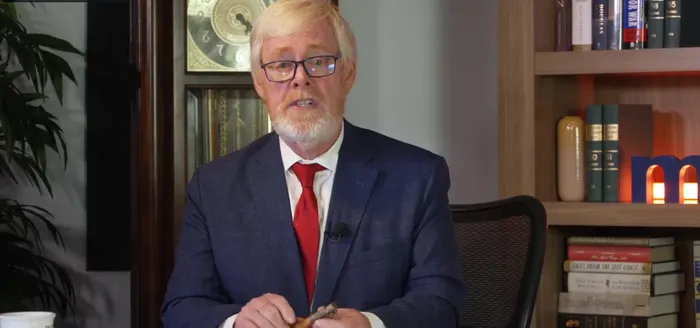
Comments made by US Ambassador-designate Brent Bozell III during apartheid have been raised as a concern.
Image: Screenshot
A letter written in 1987 that bears Bozell’s name has surfaced online, in which he is said to express opposition to a meeting between the ANC, led by Oliver Tambo, and US officials.
The letter, under the headline “National Conservative Political Action,” stated that, “the NCPAC is proud to be a member of the coalition against ANC terrorism. We agree that the impending meeting between Secretary of State Shultz and ANC President Tambo represents an unsatisfactory trend in US policy towards South Africa.”
International relations experts have commented on the situation.
Former ambassador Dr Kingsley Makhubela said in an interview yesterday that there are certain requirements in terms of the Vienna Convention.
“South Africa can accept or decline to provide an agrément for the ambassador designate. I just want to clarify one issue that sometimes confuses people: to decline (the deployment) must be based on his personal behaviour, not articulating his government position. This means that what the new US ambassador said in the Senate about South Africa cannot be the basis for declining him,” he said.
“However, South Africa can decline it based on his previous behaviour; those are the bases,” said the former ambassador. He added that Bozell will need to understand the South African political space. "If he does not do that, he is likely to become irrelevant and engage only with people who agree with him, while those who do not may decide to ostracise him."
Dr Nolubabalo Magam, senior lecturer at the Political Sciences department at UNISA, said it might serve South Africa well to accept the ambassador.
“The fact that the current administration in the White House favours people with such profiles could augur well for South Africa, mainly to disprove the false claims of white genocide in SA. The current American policy hasn't followed the traditional system of diplomacy that the world is used to. They are saying this is who we are appointing, and you must accept it, or we will find alternative ways to disrupt your country.
“So, SA will not sever ties with America by rejecting the ambassador’s credentials. This is America simply forcing its views and stance on SA. There is also the fact that if SA rejects the ambassador's credentials, Trump will definitely try to reassert the might of the US on SA,” said Magam.
Wits University’s international relations expert, Professor John Stremlau, said the US does not have a good track record when it comes to supporting the fight against Apartheid, pointing out that the Minister of International Relations, Ronald Lamola, recently reminded US Secretary of State Marco Rubio that America did not remove Nelson Mandela from the terrorists' list until 2008.
“But I still feel that South Africa and the USA should find ways to work together for common purposes of multilateralism,” he said.
Ryan Smith, DA spokesperson on International Relations and Cooperation, said:
“The ambassador designate still needs to present his credentials to the president for approval. If the president deems his appointment to be unfit, he and he alone has the prerogative to reject the proposal. That is the process, and no one else but the president can make that decision. It’s not up to the opposition to decide.”