
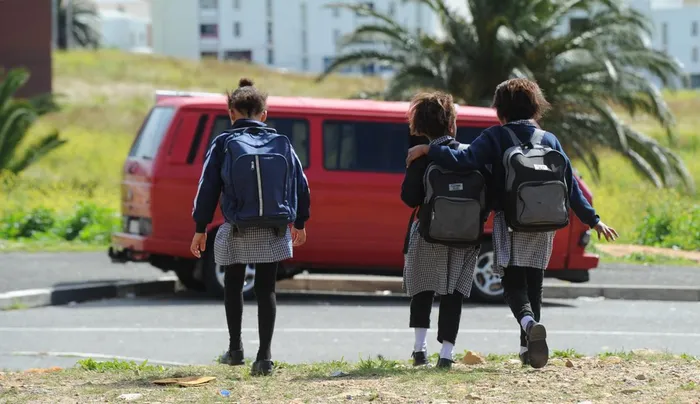
Parliament's Portfolio Committee on Basic Education is sounding the alarm over unlawful practices at no-fee schools, where report cards are withheld to pressure parents into fundraising.
Image: Henk Kruger / Independent Newspapers
Concerns have been raised over reports that some schools and School Governing Bodies (SGBs) are withholding learners’ academic report cards in an effort to pressure parents into participating in fundraising activities, prompting intervention by Parliament’s Portfolio Committee on Basic Education.
Chairperson of the committee, Joy Maimela, said the committee has received complaints and has also noted social media posts indicating that some parents at no-fee schools are being required to purchase stationery if they want their children to receive their report cards. Pupils cannot enroll for the next grade without their report cards.
She emphasised that such practices are unlawful and undermine the constitutional right of learners to basic education.
“A learner’s academic progress and access to report cards can and must never be used as leverage to compel parents to contribute financially or participate in fundraising activities,” the Chairperson said.
Maimela stressed that government already makes provision for learner-teacher support material (LTSM), including stationery, at no-fee-paying schools. “SGBs or school managements can therefore not implement new measures that are in conflict with legislation, regulations and policies,” she said.
The chairperson reiterated that participation in school fundraising initiatives is voluntary and must not result in any form of punishment or discrimination against learners. “Penalising learners for the socio-economic circumstances of their parents is unjust, unethical, and contrary to the aim and principles of equity and inclusivity that underpin South Africa’s education system,” she said.
She further warned that parents who have enrolled their children in no-fee schools should not be pressured, directly or indirectly, to incur costs that the law explicitly seeks to prevent. “Such actions defeat the very purpose of the no-fee school policy,” Maimela said.
The committee has called on provincial education departments to urgently intervene where these practices are reported and to ensure that school management teams and SGBs are fully aware of their legal obligations. It will continue to exercise oversight to ensure compliance with the South African Schools Act, the Basic Education Laws Amendment Act, and relevant departmental policies.
Parents and guardians who experience these challenges are encouraged to report them to their provincial education departments and to escalate matters where necessary. The committee said it remains committed to protecting the rights and dignity of learners and ensuring that access to education is not compromised by unlawful or exclusionary practices.
In addition, the committee has expressed serious concern over reports of the non-delivery of learner-teacher support material to some no-fee-paying schools in KwaZulu-Natal at the start of the academic year.
“The failure to deliver textbooks and stationery timeously undermines teaching and learning and disadvantages learners, particularly those in under-resourced and no-fee schools,” Ms Maimela said. She noted that in other provinces learners have already collected their LTSM or will do so at the start of the school year so that teaching and learning can commence on the first day.
“Learners cannot be expected to perform or keep up with the curriculum when essential learning materials are not available,” she said.
The committee is particularly concerned that some schools are being forced to improvise or place pressure on parents to provide learning materials, despite clear policy provisions that assign this responsibility to the state. Maimela called on the KwaZulu-Natal Department of Education to urgently account for the delays, provide clear timelines for delivery, and implement corrective measures to prevent further disruptions.